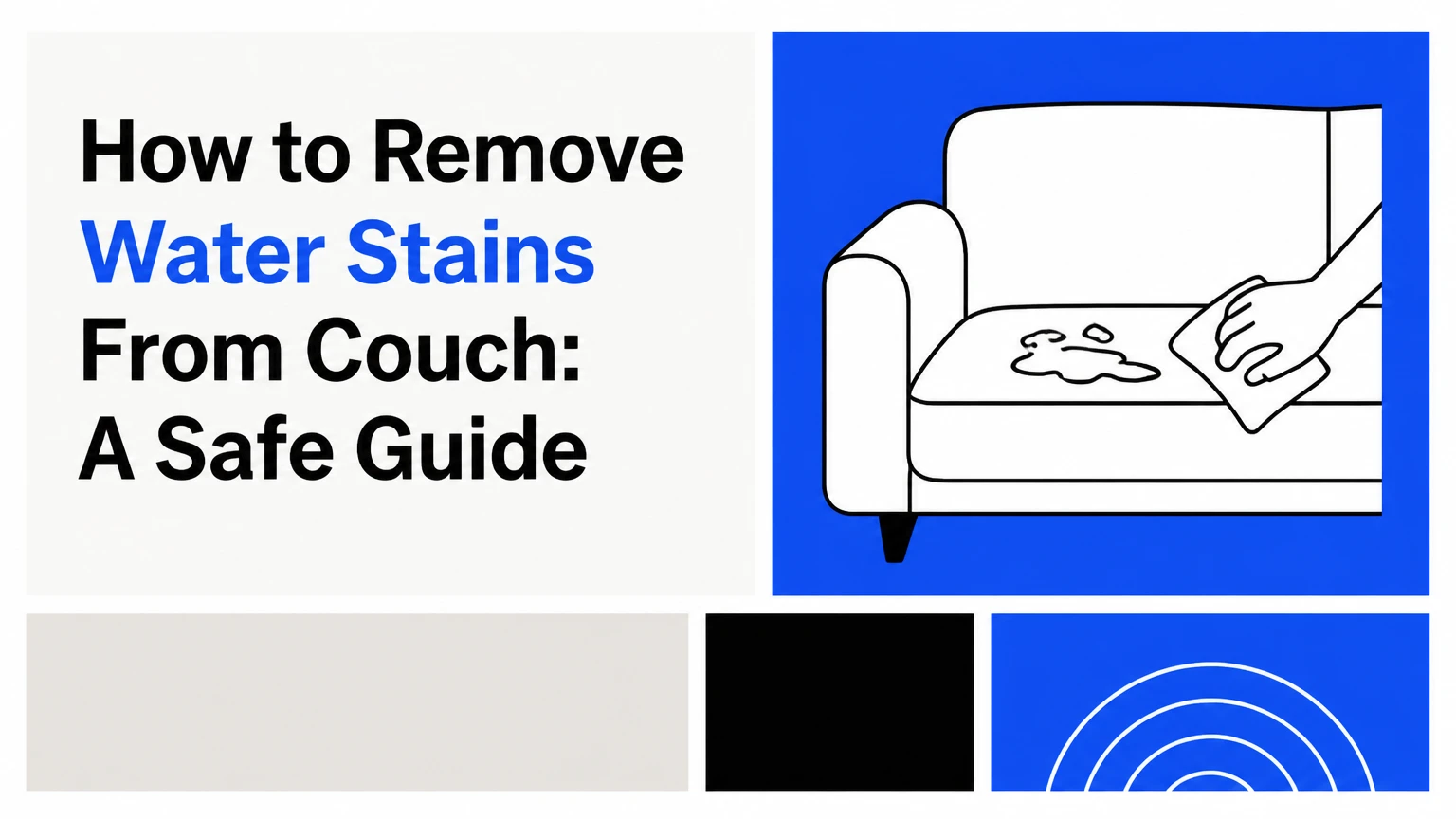
To remove water stains from a couch, first identify the upholstery cleaning code, then use a compatible low-moisture cleaner, blot rather than scrub, and dry the fabric quickly with moving air. W-code fabric usually tolerates a diluted water-based solution, while S, X, velvet, wool, and silk often require solvent or professional cleaning.
Key facts at a glance
A water ring usually contains concentrated minerals, soil, detergent residue, or migrated dye left at the drying edge.
The couch care code determines whether water, solvent, both, or neither is safe.
Distilled water reduces new mineral deposits, but it cannot make an incompatible fabric water-safe.
Over-wetting can move dirt from the cushion core back to the surface and prolong drying.
Cool airflow is safer than heat for drying upholstery and reducing visible tide lines.
A typical DIY spot treatment costs $2-$15 and takes 15-30 minutes of active work.
Why Does Water Leave a Ring on a Couch?
A water ring forms when moisture dissolves or moves material inside upholstery and deposits that material at the boundary of the wet area. The residue may include calcium or magnesium minerals, household dust, old spills, detergent, natural-fiber discoloration, or dye released from the fabric.
Water itself is therefore only part of the problem. A clean spill on a clean synthetic fabric may dry invisibly, while the same amount of water on a soiled cotton cushion can create a dark circular edge.
What kind of stain is it?
Use the stain’s appearance to guide diagnosis, not to override the cleaning code.
| Appearance | Likely material at the ring | Main risk during cleaning | First response |
|---|---|---|---|
| Pale gray or dark circular edge | Displaced dust and body soil | Ring becomes wider | Vacuum, then clean the whole cushion face evenly |
| White, chalky outline | Hard-water minerals | New mineral deposit | Use distilled water on W or S/W fabric |
| Yellow or tan halo | Natural-fiber browning or old residue | Permanent color shift | Stop repeated wetting and seek professional advice |
| Shiny or flattened patch | Altered nap from rubbing | Texture damage | Let dry, then brush only if the fabric permits |
| Sticky or stiff perimeter | Soap or fabric-protectant residue | Soil reattaches quickly | Use minimal compatible cleaner and extract residue |
A circular outline that appeared after a spill may also contain the original liquid. Milk, juice, pet urine, and cleaning products can leave a residue that resembles a water stain. If the mark smells sour, feels tacky, or changes color when damp, treat the underlying spill rather than assuming mineral residue.
Which Couch Cleaning Code Should You Follow?
The upholstery cleaning code is the deciding safety specification. Find the care label beneath removable cushions, along the platform, or under the couch frame, and follow the furniture manufacturer’s instructions if they conflict with general fabric advice.
| Code | Permitted cleaning method | Water-stain approach | DIY risk level |
|---|---|---|---|
| W | Water-based upholstery products | Controlled distilled-water treatment | Moderate |
| S | Water-free solvent products | Upholstery solvent or isopropyl alcohol when manufacturer-approved | Moderate to high |
| S/W | Water-based or solvent products | Choose the method that matches the fiber and stain | Moderate |
| X | Vacuuming or brushing only | Do not apply liquid at home | High |
| Missing | Unknown | Pause and contact manufacturer or cleaner | High |
The letters are not a fabric composition label. A polyester couch can carry W, S, S/W, or X depending on its backing, dye, finish, and construction.
What if the care tag is missing?
Do not infer safety from color, price, or the word “microfiber.” Check the couch model online, contact the manufacturer with the product number, or test a hidden seam with the intended product. A hidden test can reveal dye bleeding, but it cannot prove that liquid will not shrink backing, damage foam, or leave a permanent ring.
For an unmarked antique, silk-covered sofa, loose-weave linen, mohair, rayon, or heavily textured velvet, professional assessment is the safer choice. The cost of a consultation is usually lower than replacing a cushion cover or repairing a distorted finish.
Before You Start: Materials, Time, and Safety
Prepare the materials before wetting the couch because uninterrupted cleaning and drying reduce the chance of a second ring. For one cushion, use 2-4 white microfiber cloths, an upholstery vacuum attachment, distilled water, a measuring spoon, a spray bottle, and a fan.
| Requirement | Typical specification | Why it matters |
|---|---|---|
| Distilled water | 250-500 milliliters | Limits calcium and magnesium residue |
| White microfiber cloths | 4 cloths, 30 x 30 centimeters | Prevents colored dye transfer |
| Spray bottle | 250-500 milliliters | Produces a controlled mist |
| Drying airflow | Box fan, 20-30 centimeters away | Speeds evaporation without heat |
| Active work | 15-30 minutes | Covers vacuuming, testing, and blotting |
| Total drying | 2-8 hours | Depends on humidity, foam, and moisture volume |
Wear gloves when using upholstery solvent or alcohol. Keep isopropyl alcohol away from flames, pilot lights, cigarettes, heat guns, and hot hairdryers, and ventilate the room before spraying.
Remove cushions when possible. Clean the entire visible face of one cushion rather than treating only a perfect circle, because partial wetting creates another boundary as the area dries.
How to Remove Water Stains From a W-Code Couch
W-code upholstery can receive a controlled water-based treatment, but successful removal depends on even moisture distribution and rapid drying. Use a dilute cleaner, apply the smallest amount that can lift the residue, and avoid saturating the cushion or its foam.
Step 1: Vacuum the entire cushion
Vacuum the cushion face, seams, piping, and crevices with an upholstery attachment. Use slow passes in two directions, because loose soil can turn into gray slurry when water reaches it.
Success checkpoint: The cloth remains mostly clean when you lightly wipe an inconspicuous dry area.
Common mistake: Spraying first and vacuuming later, which drives loose grit deeper into the weave.
Step 2: Make and test a mild solution
For a W-code synthetic or cotton-blend cushion, mix 500 milliliters of distilled water with 15 milliliters of a pH-neutral upholstery detergent. If no upholstery detergent is available, use no more than 1/4 teaspoon of clear, mild dishwashing liquid.
White vinegar is sometimes useful for mineral residue, but a 1:1 vinegar-and-water mixture is unnecessarily acidic for many dyed fabrics and finishes. If the manufacturer permits vinegar and the mark is clearly mineral-based, use 1 tablespoon of white vinegar in 500 milliliters of distilled water, then test it first.
Spray the mixture onto a hidden seam or underside. Wait 10 minutes, blot with a white cloth, and inspect the cloth and fabric after drying.
Success checkpoint: No color appears on the cloth, and the test area shows no halo, stiffness, or texture change.
Common mistake: Treating “natural” as synonymous with safe. Acidity can affect dyes, finishes, and natural fibers.
Step 3: Rehydrate the complete affected area
Mist the ring lightly from its outer edge toward the center, then extend the mist across the full cushion panel. The goal is even dampness, not a visibly soaked cushion.
For a small ring, begin with approximately 10-20 milliliters of solution. Add more only if the cloth lifts residue but the ring remains visible. Do not pour cleaner onto the upholstery.
Success checkpoint: The fabric is uniformly damp across the panel, with no liquid pooling at seams.
Common mistake: Wetting only the dark outline, which creates a new drying boundary outside the old one.
Step 4: Blot from the edge inward
Fold a white microfiber cloth into quarters and press vertically over the damp area. Rotate to a dry section after each few presses, replacing the cloth when it becomes visibly soiled.
Do not scrub in circles. Scrubbing can disturb microfiber nap, abrade delicate yarns, and force dissolved residue sideways through the weave.
Success checkpoint: The cloth picks up soil or mineral residue, while the ring loses contrast as the fabric becomes evenly damp.
Common mistake: Rubbing harder when the stain does not disappear immediately. Many rings remain visible until the fabric dries evenly.
Step 5: Remove residue and feather the boundary
If the product instructions require rinsing, mist a small amount of distilled water and blot again. A soap film can attract soil and create a second dark outline.
Feather the treatment beyond the original ring by several centimeters, or clean the full cushion face when the color and fabric allow it. Keep the outer edge thin and irregular rather than creating a sharply defined wet perimeter.
Success checkpoint: No foamy or sticky residue remains, and the cushion has no isolated wet circle.
Common mistake: Adding baking soda or more detergent before removing the first product. Mixed residues are harder to extract.
Step 6: Dry the upholstery with cool airflow
Stand the cushion on its edge if the construction permits, leaving space around both sides. Aim a fan across the fabric, not directly into one small spot, and keep airflow running until the surface and seams feel dry.
A cool hairdryer can help with a small edge, but hold it at least 20 centimeters away and keep it moving. Never use an iron, heat gun, radiator, or hot hairdryer.
Success checkpoint: The fabric feels dry at the seams and the ring does not darken again after 30 minutes.
Common mistake: Returning the cushion before the foam has released moisture, which can cause odor and a reappearing stain.
How Should You Clean S-Code Upholstery and Microfiber?
S-code upholstery should be cleaned with a manufacturer-approved solvent, not a water-based vinegar solution. Synthetic microfiber often responds well to a light application of 91% or 99% isopropyl alcohol, but the alcohol must pass a hidden dye and finish test before use.
Step 1: Confirm solvent compatibility
Read the furniture label and the solvent label. Test 1 teaspoon of alcohol or upholstery solvent on a concealed seam, then blot with white cloth and allow it to dry for 15 minutes.
Reject the product if the test transfers dye, leaves a shiny patch, softens adhesive, removes a protective finish, or changes the nap.
Step 2: Ventilate and mist sparingly
Open windows, keep children and pets away, and remove ignition sources. Add the solvent to a clean spray bottle, then mist the ring from approximately 20-30 centimeters away.
For one cushion, begin with 15-30 milliliters. The fabric should become lightly damp, never wet through.
Step 3: Lift residue without grinding it in
Use a clean white sponge or microfiber cloth to work from the outer edge toward the center with short, gentle strokes. On microfiber, a soft brush can loosen dried soil, but aggressive circular scrubbing can leave a permanent directional patch.
Replace the cloth as soon as it shows discoloration. Dirty cloths redeposit the material that caused the ring.
Step 4: Restore the microfiber nap
Allow the surface to dry completely, usually within 20-60 minutes under ventilation. Brush the dry microfiber in one direction with a clean, soft nylon brush or upholstery brush.
Alcohol may leave a temporary stiff feel because it changes how loose fibers lie. Brushing cannot repair heat damage, dye loss, or a crushed pile.
| Solvent approach | Typical amount per cushion | Surface drying time | Main limitation |
|---|---|---|---|
| 91% isopropyl alcohol | 15-30 milliliters | 20-60 minutes | Flammable fumes |
| 99% isopropyl alcohol | 15-25 milliliters | 15-45 minutes | Can strip some finishes |
| Manufacturer upholstery solvent | Label-directed dose | 30-90 minutes | Product-specific testing |
| Professional solvent cleaning | Cleaner-determined | 4-12 hours | Higher cost |
Alcohol is not suitable for every microfiber couch, despite common online advice. Some microfiber covers contain coatings, blended fibers, or backing adhesives that react poorly to solvent.
What Should You Do With S/W and X-Code Upholstery?
S/W upholstery permits either water or solvent cleaning, so choose the method that passes testing and matches the fiber. X-code upholstery should receive vacuuming or brushing only at home; a professional cleaner must determine whether the manufacturer allows a specialized process.
| Couch situation | Safe first action | Avoid | Escalation point |
|---|---|---|---|
| S/W polyester ring | Test distilled-water cleaner first | Saturating the foam | Ring remains after one controlled attempt |
| X-code sofa | Vacuum and brush dry residue | Water, vinegar, alcohol, steam | Professional upholstery inspection |
| Removable W-code cover | Check zipper label and wash instructions | Assuming machine washing is safe | Shrinkage or dye bleed risk |
| Velvet cushion | Vacuum with low suction and test label-approved method | Rubbing, steam, hot air | Any nap or color change |
| Wool or silk upholstery | Blot fresh liquid and isolate cushion | Vinegar, alcohol, soaking | Professional cleaner |
Removable covers require separate care. A cover labeled machine washable may still shrink if washed in hot water or dried at high heat, while a zippered cover labeled “dry clean only” should not be soaked on the assumption that it can be reinstalled later.
Should You Use Vinegar, Baking Soda, Steam, or an Extractor?
A low-moisture, code-compatible treatment is the best first option for a small surface ring. Extraction is better for deep contamination on water-safe fabric, while baking soda mainly addresses odor and loose surface moisture, not a mineral ring.
| Method | Compatible codes | Typical cost | Drying time | Best use |
|---|---|---|---|---|
| Diluted upholstery detergent | W, S/W | $5-$15 | 2-6 hours | Small surface ring |
| Diluted white vinegar | W, selected S/W | $1-$4 | 2-6 hours | Tested mineral residue |
| Isopropyl alcohol | S, selected microfiber | $3-$8 | 20-60 minutes | Solvent-safe synthetic fabric |
| Baking soda powder | Label-dependent | $2-$5 | 30-90 minutes before vacuuming | Odor absorption |
| Portable extractor | W, S/W | $30-$180 | 4-8 hours | Deep or repeated soil |
| Professional cleaning | Manufacturer-approved | $80-$200 | 6-12 hours | Delicate or high-risk upholstery |
Baking soda paste is a poor general solution for water rings. The powder can lodge in deep pile, leave alkaline residue, and create a pale patch that resembles the original mark.
Steam can soften and redistribute residue, but steam is still moisture. It does not bypass a W, S, S/W, or X code, and high heat can flatten velvet, loosen adhesives, or set dye. Use an extractor only with the recommended upholstery formula and enough suction to remove the applied liquid.
How Much Do the Methods Cost and How Long Do They Take?
Typical DIY treatment costs $2-$15, with 15-30 minutes of active work and 2-8 hours of drying. Professional upholstery cleaning commonly costs $80-$200 per couch, while portable extractor rental commonly costs $30-$40 per day.
| Option | Supply or service cost | Active time | Total drying or service time |
|---|---|---|---|
| Distilled water and mild detergent | $2-$10 | 15-25 minutes | 2-6 hours |
| Isopropyl alcohol treatment | $3-$8 | 10-20 minutes | 20-60 minutes |
| Upholstery spray cleaner | $7-$15 | 10-20 minutes | 1-4 hours |
| Extractor rental | $30-$40 per day | 20-40 minutes | 4-8 hours |
| Portable extractor purchase | $100-$180 | 20-40 minutes | 4-8 hours |
| Professional upholstery cleaning | $80-$200 per couch | 1-2 hours | 6-12 hours |
These are typical consumer ranges, not fixed prices. Regional labor rates, couch size, access, fabric testing, stain depth, and the number of cushions can change the final quote.
Common Mistakes and How to Fix Them
Why did the water stain get bigger?
A ring usually gets bigger because the cleaner spread moisture beyond the original edge or because dissolved soil moved outward during drying. Re-treating the entire cushion face lightly with a compatible product can remove the visible boundary, but repeated spot spraying makes the problem worse.
Blot excess moisture, stop adding product, and use a fan across the whole panel. If the fabric remains damp after eight hours, separate the cushion from the couch and increase ventilation.
What if the ring turned brown or yellow?
Brown or yellow discoloration can indicate cellulosic browning in cotton, linen, rayon, or other plant-based fibers. Prolonged moisture can also bring old soil, foam contaminants, or a previous spill back to the surface.
Do not immediately apply a stronger vinegar mixture. A more acidic solution may damage dye or weaken fibers without correcting the cause. Dry the cushion, photograph the discoloration, and obtain a professional assessment if the color remains.
What if the fabric feels stiff?
Stiffness usually comes from dried detergent, solvent residue, compressed nap, or incomplete drying. On tested microfiber, brush the fully dry surface gently with a clean soft brush; on velvet, follow the manufacturer’s nap direction and avoid force.
If stiffness is widespread, the cushion may need controlled rinsing and extraction rather than another spot treatment. Do not add fabric softener, which can leave an oily film and alter flame-retardant or stain-resistant finishes.
What if the stain returns after drying?
A reappearing stain often means the original liquid reached the foam or batting and migrated back during evaporation. A surface wipe cannot remove contamination that remains below the cover.
Remove the cushion cover only if its care label permits it. Otherwise, professional extraction may be necessary, especially when odor, yellowing, or a damp interior accompanies the returning mark.
What if the dye bleeds?
Stop immediately when a white cloth picks up couch color. Continued blotting can enlarge the loss and leave a lighter patch.
Allow the area to dry without heat and contact the manufacturer or an upholstery specialist. Dye bleeding is a material failure, not a problem that more detergent can solve.
How Should You Treat an Old, Fresh, or Hard-Water Ring?
Fresh spills respond best to immediate blotting, while old rings need residue removal and even-panel cleaning. Hard-water marks require compatible cleaning plus mineral control, but distilled water alone will not dissolve every old contaminant.
| Situation | First 5-minute response | Recommended next step | Expected difficulty |
|---|---|---|---|
| Fresh plain-water spill | Press with dry white towels | Dry with fan before an edge forms | Low |
| Fresh beverage spill | Blot without spreading | Use code-approved upholstery cleaner | Moderate |
| One-day water ring | Vacuum and hidden-test solution | Treat full cushion panel lightly | Moderate |
| Old dark ring | Remove surface soil first | Use extractor or professional cleaning | Moderate to high |
| Hard-water outline | Use distilled water in treatment | Test mild acid only on W fabric | Moderate |
| Reappearing ring | Stop repeated spot cleaning | Inspect foam and seek extraction | High |
Fresh liquid should be absorbed rather than rubbed. Place several dry towels over the area and press with the flat palm for 10-20 seconds, repeating with dry sections until transfer decreases.
Old rings may have multiple causes. If the mark remains after one properly tested treatment and complete drying, assume embedded soil, dye migration, fiber browning, or foam contamination rather than simply “more water needed.”
How Can You Prevent Another Water Ring?
Prevent future rings by cleaning spills immediately, using distilled water for W-code spot treatments, and drying the full affected panel evenly. A fabric protector can reduce absorption, but it cannot make S or X upholstery water-safe.
Keep a labeled spray bottle, white cloths, and the care-code information near the couch. Blot fresh spills within five minutes when possible, remove removable cushions from the frame, and use airflow before moisture reaches the foam.
Avoid placing wet clothing, damp towels, uncovered drinks, or plant pots directly on upholstery. Condensation from glasses can create the same mineral boundary as a larger spill.
A professional upholstery cleaner can apply or renew a protector when the fabric manufacturer permits it. Ask whether the product is compatible with the existing finish, because some solvents and detergents can strip protection and change the fabric’s hand.
When Should You Hire a Professional?
Hire a professional when the label shows X, the fabric is silk, wool, velvet, rayon, mohair, or antique textile, or the stain returns after one controlled cleaning. Professional service is also appropriate when the cushion is deeply wet, smells musty, shows widespread yellowing, or has visible dye transfer.
A qualified cleaner should inspect the fiber, backing, dye stability, construction, and cushion fill before applying a product. Ask for the intended method, estimated drying time, insurance coverage, and whether the cleaner will test for colorfastness.
DIY cleaning is not a good choice for valuable furniture with irreplaceable fabric. A low-cost household mixture can create a repair bill exceeding the $80-$200 typical professional cleaning range.
FAQ
Can I remove a water stain with plain tap water?
Plain tap water can enlarge a ring because dissolved calcium, magnesium, iron, and other minerals may remain after evaporation. Use distilled water for W or S/W upholstery, but confirm that the cleaning code permits water before applying any liquid.
Can hydrogen peroxide remove a couch water ring?
Hydrogen peroxide is not a standard treatment for a plain water ring and may lighten dyed upholstery. It can also react differently with cotton, polyester, wool, and fabric finishes, so do not use it unless the manufacturer or a qualified cleaner specifies the product and concentration.
Can I wash a couch cushion in a washing machine?
Only wash a cushion cover when its sewn-in label specifically permits machine washing. The cover may shrink, bleed, distort, or fail to fit again, and the foam insert usually should not enter a household washer unless the manufacturer provides explicit instructions.
How do I remove a water ring from a leather couch?
Leather upholstery needs a leather-specific cleaner and conditioner, not vinegar, dish soap, or rubbing alcohol. Blot the liquid, let the surface dry naturally, and follow the leather manufacturer’s care instructions because water marks can involve finish damage rather than fabric residue.
Will a water ring disappear on its own?
A very small ring on colorfast synthetic upholstery may become less visible as residual moisture equalizes, but a mineral or soil boundary usually remains after complete drying. If the mark persists for 24 hours, use the tested code-compatible method once rather than repeatedly wetting the same spot.
The Bottom Line
The safest way to remove water stains from a couch is to match the treatment to the upholstery code, test a hidden area, apply minimal compatible cleaner, blot with white cloths, and dry with cool moving air. Use distilled water only on water-safe fabric, use solvent cautiously on approved S-code upholstery, and stop before delicate or X-code furniture suffers permanent damage.