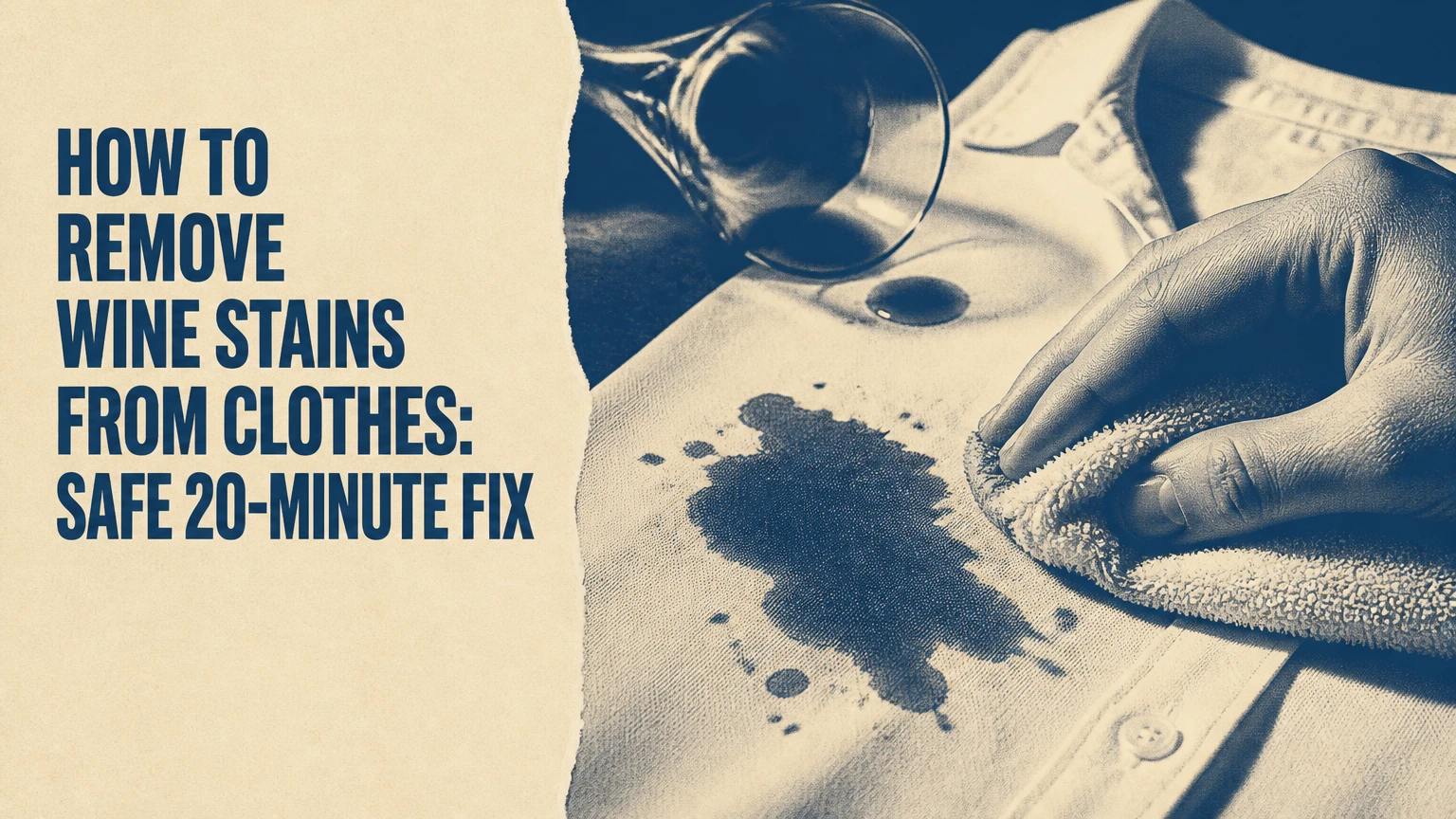
To remove wine stains from clothes, blot the spill, rinse the fabric from the reverse side with cold water, apply liquid laundry detergent, and wash according to the care label. Fresh red wine usually responds within 10-20 minutes; dried stains need repeated treatment, while silk, wool, rayon, and dry-clean-only garments need professional care.
Key Facts
- Cold water and prompt blotting reduce the amount of wine left inside clothing fibers.
- Club soda can help flush a fresh stain, but it is not chemically superior to plain cold water.
- Salt and baking soda absorb surface liquid; neither reliably removes a dried wine stain.
- Hydrogen peroxide can fade colored garments, so test a hidden seam before using it.
- Heat from an iron, radiator, tumble dryer, or hot wash can make residual pigment harder to remove.
- A care label overrides a general home remedy, especially for silk, wool, acetate, rayon, and dry-clean-only clothing.
How to Remove Wine Stains From Clothes Immediately
Fresh wine stains are easiest to remove when treated before the liquid dries. Use a clean white absorbent cloth, cold water, and liquid laundry detergent, then inspect the garment before any heat touches it. The essential sequence is blotting, reverse-side rinsing, detergent treatment, washing, and air-drying.
Step 1: Blot the wine spill
Place a folded white towel behind the stained area and press the front with another clean white cloth. Work from the outside edge toward the center, replacing the cloth when it becomes wet or colored.
Do not scrub. Rubbing spreads the stain laterally and can force pigment into yarn spaces, particularly in loosely woven linen, cotton jersey, and rayon. Paper towels work in an emergency, but white cotton cloth is less likely to leave pulp or colored fibers.
You will know this step worked when: the cloth picks up less liquid after two or three presses and the wet patch stops expanding.
Common mistake: pressing with a colored napkin. Dye transfer can create a second stain.
Step 2: Rinse from the reverse side
Hold the stained section under cool running water, with the reverse side facing the stream, for 30-60 seconds. Reverse-side rinsing pushes dissolved wine back out through the front instead of driving it farther into the garment.
For a garment that cannot be held under a tap, place it stain-side down on a white towel and pour 120-240 milliliters of cold water through the back. Do not use boiling water or a hot wash at this stage.
You will know this step worked when: the red or purple color becomes visibly lighter and transfers to the towel beneath the garment.
Common mistake: pouring water directly onto the visible front and stopping after a few seconds. A short rinse may dilute the perimeter while leaving concentrated wine below it.
Step 3: Apply liquid laundry detergent
Spread 1 teaspoon of heavy-duty liquid laundry detergent over a stain approximately 5 centimeters wide. For a larger mark, use about 1 teaspoon per additional 5 centimeters, without saturating the entire garment.
Gently work the detergent into the fabric with clean fingertips. Leave it for 5-10 minutes, then rinse with cool water. Liquid detergent contains surfactants that loosen oily and particulate material and help suspend pigment for rinsing.
You will know this step worked when: the treated area feels slippery and the color lightens after rinsing.
Common mistake: using a large amount of detergent. Excess product can leave a halo or require several rinses.
Step 4: Wash and inspect before drying
Wash the garment at the coolest temperature permitted by its care label, commonly 20-30°C for colored clothing and 30-40°C for sturdy cottons. Use the normal detergent dose for the load, not a concentrated dose poured directly onto the garment.
Inspect the stain in bright, indirect light while the garment is still damp. Repeat treatment if any pink, red, brown, or purple shadow remains. Air-dry only after the mark has disappeared.
You will know this step worked when: the fabric has its original color and no darker outline appears as it dries.
Common mistake: putting the garment straight into a tumble dryer. Dryer heat can make a remaining stain substantially harder to treat.
Why Do Wine Stains Remain in Fabric?
Wine stains remain because colored compounds dissolve into the spill and become trapped between or within textile fibers. Red wine contains anthocyanins, the pigments responsible for much of its color, along with tannins, acids, alcohol, sugars, and other compounds that can leave residue after evaporation.
Cotton, linen, and rayon absorb water readily, so wine can travel along their capillaries before drying. Polyester absorbs less liquid but can retain color at the fiber surface, where a suitable surfactant may remove it efficiently. Silk and wool require greater caution because their protein fibers can be damaged by alkaline products, oxidizers, agitation, and prolonged soaking.
Three cleaning mechanisms matter:
- Absorption: blotting removes liquid before it migrates.
- Surfactant action: detergent surrounds loosened soil and helps water carry it away.
- Oxidation: oxygen-based products can alter colored molecules, but they may also alter garment dyes.
A wine mark is not primarily a protein stain. Enzyme cleaners designed for blood, milk, or egg therefore have no special advantage simply because the product label says “enzyme.” A general color-safe oxygen product or a laundry pre-treater is usually more relevant.
Which Wine Stain Treatment Should You Choose?
The best treatment depends on whether the stain is fresh or dried, whether the garment is white or dyed, and whether the fabric is washable. Liquid detergent is the safest first choice for most washable garments; hydrogen peroxide and oxygen bleach are escalation options, not automatic upgrades.
| Treatment | Typical amount | Contact time | Main risk | Best use |
|---|---|---|---|---|
| Cold water | 120-240 ml | 30-60 sec | Limited effect on dried marks | Fresh washable clothing |
| Liquid laundry detergent | 1 tsp per 5 cm mark | 5-10 min | Residue if overdosed | Cotton, linen, polyester |
| Club soda | 120-240 ml | 30-60 sec | No proven advantage over water | Restaurant emergency |
| 3% hydrogen peroxide | 1 tsp test amount | 5-10 min | Color fading | White or colorfast sturdy fabric |
| Oxygen bleach solution | Label dose, often 15-30 ml/L | 1-6 hr | Dye change or fiber damage | White cotton and linen |
| Diluted white vinegar | 1 tbsp per 250 ml water | 5 min | Odor, possible dye effects | Residue or odor after rinsing |
Is club soda better than cold water?
Club soda is a convenient flushing liquid, but plain cold water is usually equally suitable for a fresh wine spill. Carbonation does not reliably dissolve red-wine pigment, and club soda can contain mineral salts that leave a ring if the fabric is not rinsed afterward.
Use 120-240 milliliters from the reverse side, blot, and follow with detergent when you return home. Do not pour an entire bottle onto a small spot. The extra liquid can enlarge the wet boundary and make a ring more likely.
Does salt or baking soda remove wine stains?
Salt and baking soda can absorb some surface moisture from a fresh spill, but they do not replace rinsing and detergent. Sprinkle a thin layer only after blotting, leave it for 5-15 minutes, brush or shake it off, and rinse the garment before washing.
Salt is not a reliable treatment for a dried wine stain because the pigment has already remained in the fiber after the liquid evaporates. Baking soda can also be mildly alkaline, which may shift some red-wine color toward purple or blue on certain fabrics and dyes.
Can hydrogen peroxide remove red wine?
A 3% hydrogen peroxide solution can lighten red-wine pigment on white, colorfast cotton or linen, but it can also bleach garment dye and weaken some fibers with repeated exposure. Test 1 teaspoon on an inside seam for 5 minutes, rinse, and check after drying before treating the visible stain.
If the test passes, place a white towel beneath the mark and apply enough peroxide to dampen the area, usually 1-2 teaspoons for a 5-centimeter spot. Leave it for 5-10 minutes, rinse thoroughly, apply detergent, and wash. Never mix hydrogen peroxide with chlorine bleach, ammonia, vinegar, or other cleaners.
Hydrogen peroxide is a poor choice for silk, wool, leather, acetate, dark navy, saturated red, and garments with unstable dyes. Its oxidizing action does not distinguish between wine pigment and the color the manufacturer added.
What Is the Safest Method for Each Fabric?
Fabric type determines whether a home treatment is appropriate. Washable cotton, linen, and polyester generally tolerate cold rinsing and detergent, while silk, wool, rayon, acetate, and dry-clean-only garments have narrower safety margins.
| Fabric or garment | First treatment | Water limit | Soaking limit | Escalation rule |
|---|---|---|---|---|
| Cotton | Reverse rinse plus detergent | 30-40°C wash | 30-60 min | Oxygen bleach if colorfast |
| Linen | Blot, rinse, detergent | 30-40°C wash | 30-60 min | Oxygen bleach on white linen |
| Polyester | Blot, detergent, cool wash | 20-40°C wash | 15-30 min | Color-safe pre-treater |
| Rayon or viscose | Blot only, label-based cleaning | Usually cold | Avoid prolonged soaking | Professional cleaner if marked |
| Silk | Blot, protect from friction | Cold water only if washable | No home soak | Professional cleaner |
| Wool | Blot, cold water if washable | Cold, wool cycle | 5-10 min maximum | Wool specialist |
| Acetate | Blot without solvents | Care-label temperature | No soaking | Professional cleaner |
White cotton and linen
White cotton and linen offer the widest home-treatment options. Start with cold water and liquid detergent; if a shadow remains, use a color-safe oxygen bleach according to the product label, typically in a solution measured per liter of water.
Do not assume every white garment is chlorine-bleach safe. Elastane, printed graphics, optical brighteners, trims, and finishes can react differently from the main fabric. Read the care label and test an inconspicuous area.
Colored cotton and synthetic clothing
Colored cotton, polyester, and nylon should receive detergent first. For persistent marks, use a commercial color-safe oxygen pre-treater and follow the label’s maximum contact time, often 5-15 minutes.
A garment that passes a hidden-seam test can still develop a pale patch if peroxide remains concentrated at the center. Rinse the treated area completely before machine washing, and avoid applying oxidizer to embroidery, screen printing, leather patches, or contrast stitching.
Silk, wool, rayon, and dry-clean-only garments
Silk, wool, rayon, and dry-clean-only garments should not receive peroxide, baking soda paste, lemon juice, vigorous rubbing, or an overnight soak. Blot with a white cloth, keep the area as small as possible, and take the garment to a cleaner promptly.
Tell the cleaner whether the spill was red wine, white wine, sweet wine, or fortified wine, and identify every product already used. A home remedy can alter the dye, create a water ring, or interfere with the solvent treatment.
How Do You Remove a Dried Wine Stain?
A dried wine stain usually needs repeated detergent or oxygen-based treatment rather than one aggressive application. First remove any crusted residue, wet the mark with cool water, apply detergent for 10 minutes, rinse, and repeat before considering a color-safe oxygen product.
- Brush off dry residue with a soft toothbrush.
- Place a white towel behind the garment.
- Wet the mark with cool water for 1-2 minutes.
- Apply 1 teaspoon of liquid detergent to each 5-centimeter area.
- Wait 10 minutes, then rinse from the reverse side.
- Wash at the care-label temperature.
- Air-dry and inspect.
- If a shadow remains, test and use oxygen bleach according to its label.
For white cotton, a typical oxygen-bleach soak lasts 1-6 hours. Do not exceed the label’s concentration or time, and do not use the soak on wool, silk, leather, or garments marked “do not bleach.”
A dried stain may require two or three cycles. Escalating concentration too quickly raises the chance of fiber damage without guaranteeing a faster result.
What Should You Avoid When Removing Wine?
Avoid heat, aggressive friction, undiluted acids, and untested oxidizers. These actions can set residual pigment, spread the stain, damage fibers, or change the garment’s original dye before a proper wash removes the wine.
Common mistakes and corrections
| Mistake | What happens | Recovery action | Prevention |
|---|---|---|---|
| Hot water on a fresh stain | Pigment can bind more firmly or spread | Cool-rinse immediately | Use cold or cool water first |
| Rubbing the center | Stain spreads and fibers become fuzzy | Blot perimeter, then rinse reverse side | Press with white cloth |
| Salt left overnight | Powder dries into residue without removing pigment | Brush off, rinse, detergent-wash | Use salt for 5-15 minutes only |
| Peroxide on dark dye | Color fades at the treated spot | Rinse immediately, stop oxidation | Hidden-seam test |
| Dryer before inspection | Heat can set the remaining shadow | Re-treat before further heat | Air-dry every first attempt |
| Lemon juice on colored fabric | Acid and sunlight can cause uneven fading | Rinse thoroughly and air-dry indoors | Use detergent first |
The recommendation to flush wine with boiling water is especially risky. Hot water may be suitable for some washable fabrics after the stain has been removed, but it is not the default first response to a colored beverage spill.
Vinegar is also frequently overstated. Diluted white vinegar may help with odor or alkaline detergent residue, but vinegar does not reliably “neutralize” anthocyanin pigment or replace detergent. Never mix vinegar with hydrogen peroxide in the same container.
How Do You Handle White Wine, Rosé, and Sweet Wine?
White wine usually leaves a faint yellow, sugar, or acid residue rather than a strong red pigment, but white wine should still be rinsed and washed promptly. Rosé follows the red-wine protocol, while sparkling wine needs extra blotting because carbonation can spread liquid over a wider area.
| Wine type | Main residue | First response | Extra concern |
|---|---|---|---|
| Red wine | Anthocyanin pigment and tannin | Reverse cold rinse, detergent | Visible red or purple shadow |
| Rosé | Lower pigment concentration | Blot, cold rinse, detergent | Pale pink ring |
| White wine | Sugar, acid, flavor compounds | Cold rinse, detergent | Yellow or sticky residue |
| Sparkling wine | Wine plus dissolved carbon dioxide | Blot wide area, rinse | Rapid lateral spreading |
| Sweet dessert wine | Sugar and concentrated color | Rinse generously, detergent | Sticky residue after drying |
| Port or fortified wine | Dense pigment and sugar | Blot, reverse rinse, detergent | More persistent dried mark |
Do not use red-wine advice as a reason to pour white wine over a red stain. The extra liquid increases spreading, and any temporary color change is not reliable cleaning.
What If the Stain Turns Purple or Leaves a Ring?
A purple or blue wine mark usually indicates a change in pH or interaction with a fabric dye, while a ring usually indicates uneven wetting or residue. Rinse the garment thoroughly with cool water, stop adding products, and reassess the care label before trying another treatment.
Baking soda, alkaline detergents, some soaps, and certain textile dyes can shift anthocyanin color. A small amount of diluted white vinegar, 1 tablespoon in 250 milliliters of water, may help remove alkaline residue after a complete rinse, but it is not a universal color corrector.
For a ring:
- Re-wet the entire washable panel around the mark with cool water.
- Apply a small amount of liquid detergent to the original area.
- Rinse from the reverse side until no slipperiness remains.
- Wash the garment according to its label.
- Air-dry flat or on a hanger, depending on the fabric.
Do not chase a purple mark with repeated acid and alkaline applications. Alternating products can damage dyes and fibers, and the original wine may already be gone.
What Is the Restaurant or Travel Method?
At a restaurant, blot the spill with a white napkin, place another napkin behind the fabric, and use a small amount of cold water if available. The goal is to remove liquid without creating a large wet circle before the garment can receive detergent.
Ask for a clean white cloth rather than a dyed paper napkin. Club soda is acceptable when it is available, but use approximately 30-60 milliliters at a time and blot between applications. Avoid lemon juice, salt rubbed into the fabric, and hand sanitizer, since each can create dye or finish problems.
When you get home, rinse from the reverse side and apply liquid laundry detergent. A travel stain pen can be useful, but check whether it contains bleach, solvents, or optical brighteners before using it on dark or delicate clothing.
How Much Time and Money Does Removal Take?
A fresh washable wine stain typically takes 10-20 minutes of active treatment and costs less than 1 unit of local currency when household detergent is already available. A dried stain commonly takes 30 minutes of active work plus a 1-6 hour oxygen-bleach soak, while professional cleaning commonly costs approximately $8-$30 for a shirt or dress, depending on region and garment construction.
| Situation | Active time | Waiting time | Typical household cost | Likely next step |
|---|---|---|---|---|
| Fresh cotton spill | 5-10 min | 5-10 min | $0.10-$0.75 | Wash and air-dry |
| Fresh colored polyester | 5-15 min | 5-15 min | $0.10-$1.50 | Color-safe pre-treater |
| Dried white cotton | 15-30 min | 1-6 hr | $0.50-$3 | Oxygen bleach soak |
| Dried dark garment | 15-30 min | 10-20 min | $0.50-$5 | Repeat detergent treatment |
| Silk or wool | 5 min | None at home | $8-$30 cleaning | Professional cleaner |
| Dry-clean-only suit | 5 min | None at home | $15-$50 typical | Professional cleaner |
Costs are typical retail ranges in the United States, not fixed prices. Local detergent, oxygen bleach, garment size, and cleaner pricing can change the total substantially.
When Should You Use a Professional Cleaner?
Use a professional cleaner when the care label says dry clean only, when the garment is silk, wool, rayon, acetate, leather, or heavily structured, or when a home treatment has already caused a ring or color change. Prompt professional attention is safer than repeated household chemistry.
Bring the garment as soon as practical and point out the complete stained area, including any faint edge. State which products touched it, because peroxide, vinegar, detergent, and oxygen bleach can affect the cleaner’s process.
Professional cleaning is not guaranteed to restore every garment. Heat-set pigment, unstable dye, aged silk, and a stain that has been exposed to multiple chemicals may leave a permanent shadow.
FAQ
Can I remove a wine stain without washing the whole garment?
Yes, you can spot-treat a small washable area, but rinse away detergent completely and check for a water ring. For rayon, silk, wool, tailored garments, or fabrics with a visible finish, local wetting may create a more obvious mark than the original spill. Professional cleaning is safer when the care label restricts washing.
Does red wine come out of jeans?
Red wine usually comes out of colorfast cotton denim when treated promptly with cold water and liquid laundry detergent. Turn the jeans inside out, rinse the stain from the reverse side, and wash in cool water. Test peroxide carefully because denim dye can fade even when the fabric itself is sturdy.
Can I use dish soap instead of laundry detergent?
A small amount of clear, dye-free dish soap can loosen a fresh wine stain, but laundry detergent is preferable for machine washing because it is formulated for textile soils and rinses predictably in a washer. Use about 1 teaspoon, rinse thoroughly, and never combine dish soap with bleach or peroxide.
Will hairspray remove a wine stain?
Hairspray is an unreliable wine-stain treatment because modern formulas vary and may contain resins, fragrance, alcohol, or oils that leave a second residue. Cold water followed by liquid laundry detergent is safer and more controllable. Do not apply hairspray to silk, wool, leather, or dry-clean-only clothing.
Can a wine stain be permanent?
Yes. A wine stain can become permanent after prolonged drying, tumble-dryer heat, ironing, dye transfer, fiber damage, or repeated chemical treatments. Even when pigment is removed, a ring or lightened patch may remain because the garment’s finish or dye has changed.
Should I use chlorine bleach on red wine?
Use chlorine bleach only when the care label explicitly permits it and the garment is an appropriate white, bleach-safe textile. Oxygen bleach is generally the safer first escalation for white cotton and linen. Chlorine bleach can yellow fibers, weaken elastane, damage prints, and create uneven results on blended clothing.
The Bottom Line
How to remove wine stains from clothes is a sequence, not a single miracle product: blot immediately, rinse with cool water from the reverse side, apply a measured amount of liquid laundry detergent, wash at the care-label temperature, and air-dry for inspection. Use peroxide or oxygen bleach only after colorfastness testing, and send silk, wool, rayon, acetate, and dry-clean-only garments to a professional.