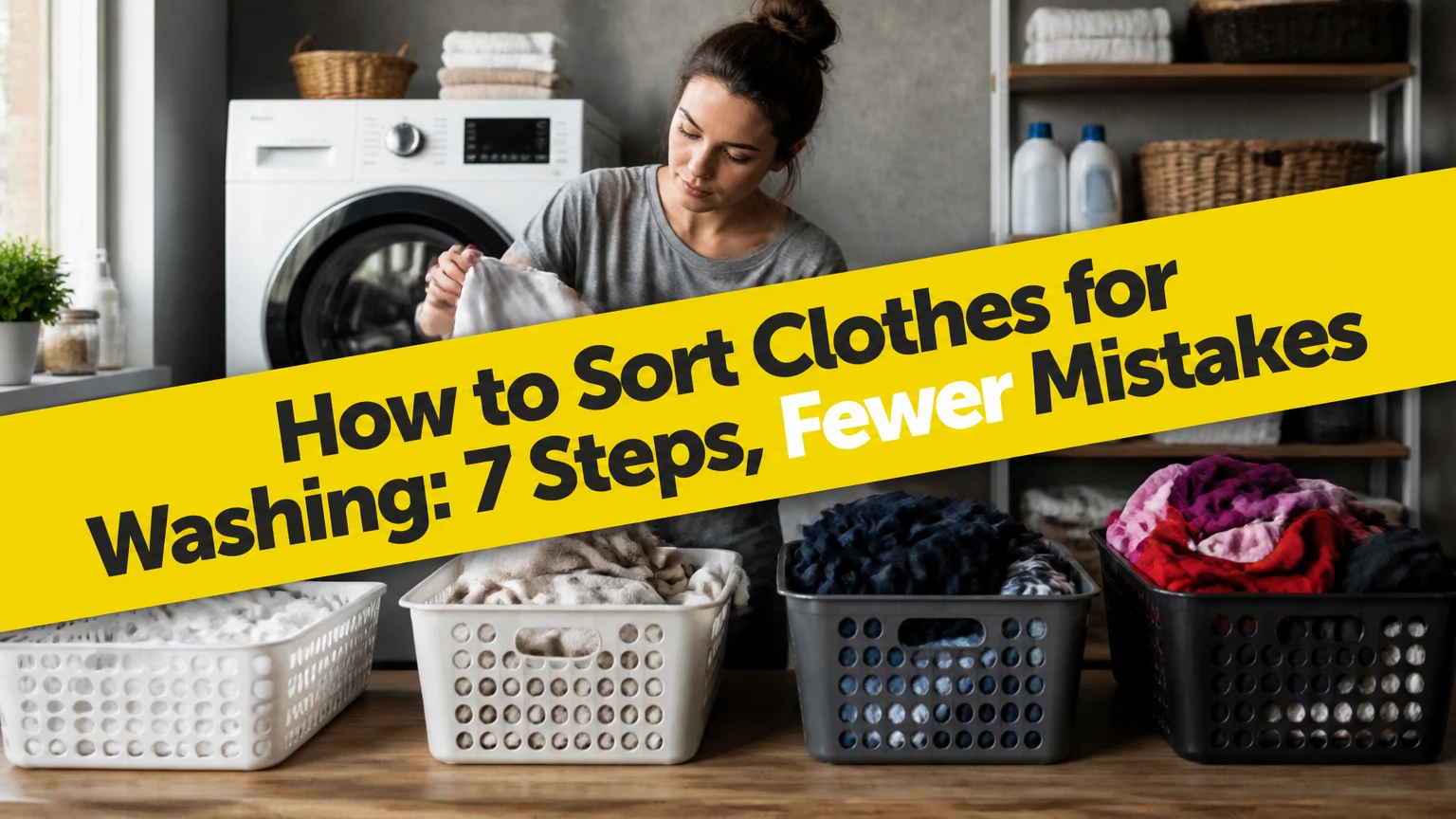
To sort clothes for washing, first remove items that require dry cleaning or hand washing, then separate garments by color, fabric weight, soil level, and lint behavior. Prepare each load by emptying pockets and securing fasteners, choose a care-label-safe temperature and cycle, and leave enough drum space for effective movement and rinsing.
Key Facts
- Color sorting reduces dye transfer, but fabric weight and care labels still determine whether garments belong together.
- Towels, fleece, and chenille shed lint, so they should stay away from dark cotton and corduroy.
- Cold water is usually safest for darks and unstable dyes, but temperature must follow the garment label and soil-removal needs.
- Delicate loads need a gentle cycle, mesh bags where appropriate, and roughly one-third of the drum filled.
- A practical household system uses three piles: whites, colors, and darks, with delicates and heavily soiled items removed separately.
- Never dry a load with transferred dye or an untreated stain, because heat can make the damage harder to reverse.
What Does Sorting Clothes Actually Separate?
Sorting clothes separates garments that need different washing conditions. Color stability controls dye transfer, fabric weight controls friction and crushing, soil level controls redeposition, and lint behavior controls fiber shedding between items.
Color alone is therefore an incomplete sorting system. A white silk blouse and a white canvas jacket share a color category but need very different cycles. Likewise, a black microfiber shirt and black denim can tolerate similar color protection while differing sharply in abrasion, lint, and drying requirements.
Laundry sorting also protects the washer load. Heavy, tightly woven items absorb more water and create greater mechanical force during agitation. Lightweight lace, hosiery, rayon, and silk can snag or stretch when they repeatedly rub against those items.
The care label has priority when rules conflict. The Federal Trade Commission requires covered textile products to provide regular-care information, so the label is the garment-specific source for temperature, cycle, drying, and bleaching limits. A “dry clean only” label overrides a convenient color grouping.
Which sorting factors matter most?
Use this priority order when a load is too small for perfect separation:
- Remove dry-clean-only, hand-wash-only, and visibly damaged garments.
- Separate delicates from heavy or rough fabrics.
- Separate unstable or new dark and bright dyes.
- Isolate heavily soiled, greasy, or muddy items.
- Separate lint givers from lint receivers.
- Match temperature and cycle requirements.
This order prevents the most expensive mistakes first. A slightly mixed shade is usually less harmful than washing wool on a hot cotton cycle or placing a silk item under heavy denim.
Before You Start: Time, Tools, and Limits
A standard basket usually takes 3-5 minutes to sort and about 2 minutes to prepare. The basic process requires a clean floor or sorting surface, a laundry basket or divided hamper, detergent, stain-treatment supplies, and one or more mesh bags for small or fragile items.
| Requirement | Typical specification | Why it matters |
|---|---|---|
| Active sorting time | 3-5 minutes per basket | Separates the main risk groups |
| Preparation time | 2 minutes per load | Prevents snags, pocket damage, and missed objects |
| Basic hamper | $5-$15 | Works for sorting immediately before washing |
| Three-compartment hamper | $25-$50 | Separates whites, colors, and darks at disposal |
| Mesh laundry bags | $5-$10 per multipack | Reduces tangling and abrasion for selected delicates |
| Color-catcher sheets | $4-$8 per pack | Adds dye-absorption protection, but does not replace sorting |
Do not use a hamper as long-term storage for wet towels, sweaty sportswear, or damp swimsuits. Hang those items until they are dry, because trapped moisture can produce mildew odor before wash day.
What should you remove before sorting?
Remove dry-clean-only garments, leather, suede, heavily embellished items, shoes, and anything with a care label that requires a separate process. Check pockets for tissues, pens, coins, cosmetics, batteries, and paper receipts.
Separate garments with loose seams, exposed underwire, sharp hardware, or peeling prints. Those items may need repair, a mesh bag, inside-out washing, or a dedicated gentle load rather than ordinary sorting.
How to Sort Clothes for Washing in 7 Steps
The seven-step process takes about 5-10 active minutes for a normal basket and works with front-load, top-load, and high-efficiency machines. The factor that most determines success is matching the most vulnerable garment in a load to the gentlest compatible setting.
Step 1: Read Every Care Label
Read the care label before placing a garment in a color pile. Separate “dry clean only,” “hand wash,” “do not wash,” and temperature-restricted items before you sort washable clothes by color.
Look for water-temperature symbols, cycle instructions, bleaching limits, tumble-dry restrictions, and line-dry requirements. Wool, cashmere, silk, rayon, lace, lingerie, hosiery, swimsuits, and structured garments deserve special attention because heat and agitation can change their shape.
A label showing a washtub with a hand means hand washing or a machine’s dedicated hand-wash cycle may be appropriate, depending on the full instruction. A crossed-out washtub means do not machine wash.
You will know it worked when: every garment in the planned load has a compatible wash and dry instruction.
Common mistake: treating “cold wash” as permission to use a normal high-agitation cycle.
Step 2: Empty Pockets and Secure Fasteners
Empty every pocket, close zippers, fasten hooks and Velcro, and button shirts loosely before washing. Turn graphic T-shirts, dark jeans, and printed garments inside out to reduce surface abrasion and fading.
Do not button every shirt tightly. Tight buttoning can stress buttonholes; closing the front loosely keeps the shirt from wrapping around other items while reducing strain. Tie drawstrings, remove detachable belts, and place bras, hosiery, and small items in mesh bags.
Inspect for tissues or paper. A single tissue can distribute white fibers across a dark load, while a pen can stain an entire basket.
You will know it worked when: no pocket contains an object and no sharp fastener can freely scrape another garment.
Common mistake: leaving metal zippers open, allowing their teeth to catch or abrade fabric.
Step 3: Create Color Piles
Create separate piles for whites, lights, darks, and bright or high-risk colors. Wash a new red, orange, deep blue, black, or neon garment separately or with similar shades for its first few washes.
| Color group | Typical examples | Usual temperature | Main risk |
|---|---|---|---|
| Whites | White socks, cotton underwear, towels, sheets | 30-60°C | Grayness, dye transfer |
| Lights | Cream, beige, pale pink, light gray, lavender | 20-40°C | Dulling or accidental staining |
| Darks | Black, navy, dark gray, brown, forest green | 20-30°C | Fading and lint visibility |
| Brights | Red, orange, hot pink, royal blue, neon green | 20-30°C | Loose dye transfer |
| New high-risk colors | Unwashed denim, scarlet cotton, saturated purple | 20-30°C | First-wash bleeding |
The temperature column is a planning range, not a replacement for the label. A white towel labeled 60°C may tolerate a hotter cycle, while a white blouse labeled 30°C should not be added to that load merely because both items are white.
Colorfastness testing helps with uncertain garments. Dampen an inside seam, press it with a white cloth, and check for transferred color. A visible mark means wash the item separately or with matching darks.
You will know it worked when: no garment can release an obvious contrasting dye onto the rest of the pile.
Common mistake: assuming a garment is colorfast because it has already been washed once.
Step 4: Separate Fabric Weight, Texture, and Lint
Separate heavy or rough items from delicate and lightweight garments. Keep towels, robes, fleece blankets, and chenille together when possible because they shed lint and require stronger rinsing than silk, lace, rayon, or hosiery.
| Fabric category | Examples | Compatible partners | Keep separate from |
|---|---|---|---|
| Heavy and rough | Denim, canvas, workwear, jackets | Heavy cotton, sturdy towels | Silk, lace, hosiery |
| Medium everyday | T-shirts, cotton shirts, sheets | Similar cotton and polyester items | Wool, fragile embellishment |
| Stretch and performance | Leggings, swimwear, microfiber sportswear | Similar synthetic activewear | Cotton towels and lint givers |
| Delicate | Silk, wool, cashmere, lace, lingerie | Similar gentle-care pieces | Denim, canvas, rough zippers |
| Lint givers | Bath towels, fleece, robes, chenille | Other washable lint givers | Black cotton, corduroy, microfiber |
| Lint receivers | Dark cotton, corduroy, brushed synthetics | Low-lint garments | Towels and fleece |
Workout clothing often belongs with synthetic activewear rather than ordinary cotton. Polyester and nylon can retain body oils and odor, while cotton towels can shed fibers into their textured surfaces.
Do not over-separate every fabric by fiber name. The useful distinction is the required care level, surface texture, weight, and lint behavior. Similar-care cotton T-shirts and cotton-polyester shirts can often share a load.
You will know it worked when: the load contains garments with similar resistance to agitation, lint exposure, and water extraction.
Common mistake: washing towels with black T-shirts because both tolerate warm water.
Step 5: Isolate Heavy Soil and Treat Stains
Pull out muddy, greasy, oily, or heavily sweat-soaked items before combining ordinary clothes. Shake off dried mud outdoors, scrape solid residue away, and pretreat grease, food, blood, or grass stains according to the product and fabric label.
A practical target is to pretreat stains as soon as possible, preferably within 30 minutes for fresh spills. The exact window varies by stain chemistry, but delay increases the chance that pigment and oil will bind to fibers.
Do not wash a greasy work uniform with lightly worn pajamas. Soil can redeposit on cleaner garments, and a normal detergent dose may not remove heavy oil from a full mixed load. Heavily stained items may need a separate pre-soak or a second wash.
Blood and protein stains generally need cold water first. Hot water can set some protein-based stains, while heat can also make an unknown stain harder to identify and remove.
You will know it worked when: loose soil is removed, stains are treated, and no heavily contaminated item is sharing a light-soil load.
Common mistake: putting a stain-treated garment straight into the dryer before checking the mark.
Step 6: Choose Temperature, Cycle, and Detergent
Choose the lowest temperature and gentlest cycle that satisfy the care label and cleaning requirement. Cold water, approximately 20-30°C, suits many darks, brights, lightly soiled garments, and shrink-sensitive fabrics; warm water around 40°C suits many everyday cotton loads; hot water around 60°C is reserved for label-compatible whites, towels, bedding, and selected hygiene-focused loads.
Temperature alone does not sanitize every load. Detergent chemistry, cycle duration, soil level, fabric tolerance, and machine performance also affect results. The American Cleaning Institute advises following both the clothing-care label and the detergent instructions rather than assuming hotter water always cleans better.
| Load type | Temperature range | Cycle choice | Detergent approach |
|---|---|---|---|
| Dark everyday clothing | 20-30°C | Normal, moderate spin | Standard dose for soil and water hardness |
| Bright new colors | 20-30°C | Normal, low-to-moderate spin | Color-safe detergent |
| White cotton clothing | 30-40°C | Cotton or normal | Standard detergent; oxygen bleach only if label permits |
| Towels and bedding | 40-60°C | Cotton or heavy-duty | Full detergent dose; avoid overloading |
| Wool and cashmere | 20-30°C | Wool or hand-wash | Wool detergent; no routine chlorine bleach |
| Silk and lace | 20-30°C | Delicate, low spin | Delicate detergent; use a mesh bag when suitable |
| Sportswear | 20-40°C | Synthetics or sports cycle | Low-residue detergent; skip routine fabric softener |
Hard water can reduce detergent performance because calcium and magnesium interfere with surfactants. If clothes feel stiff or look dull despite correct sorting, use the detergent quantity recommended for hard water, clean the machine, and avoid adding excess product that can leave residue.
You will know it worked when: the selected cycle is safe for the most delicate item and strong enough for the dirtiest item.
Common mistake: choosing 60°C for a mixed load containing elastane, wool, rayon, or untested dark dyes.
Step 7: Load the Drum Without Packing It Tight
Load the washer loosely and leave room for garments to move through water. A practical guide is about three-quarters full for sturdy heavy fabrics and about one-third full for delicate items, although the machine manual takes precedence.
Use the palm or fist test: a hand should fit between the top of the load and the drum in a top-loader, while a front-loader should allow clothing to tumble freely rather than forming a compressed plug. Heavy items should be distributed around the drum instead of placed as one dense bundle.
A packed drum causes poor rinsing, detergent residue, uneven cleaning, and excessive wrinkling. An extremely small load can also unbalance during extraction, especially when one wet towel or pair of jeans absorbs much more water than its neighbors.
You will know it worked when: the drum can rotate the load freely and water can reach every garment.
Common mistake: filling the washer to the door seal because dry clothes appear to fit.
Which Laundry-Sorting System Fits Your Household?
A three-pile system is the best practical default for most households: whites, lights or colors, and darks, with delicates, high-soil items, and lint-heavy pieces removed as exceptions. A five-pile system improves protection when the household has enough laundry to fill separate loads.
| Sorting strategy | Typical piles | Active setup time | Best use case |
|---|---|---|---|
| Two-pile | Lights and darks | 2-4 minutes | Small wardrobes with few delicates |
| Three-pile | Whites, colors, darks | 3-5 minutes | Most apartments and families |
| Five-pile | Whites, lights, darks, brights, delicates | 5-8 minutes | Large wardrobes and frequent laundry |
| Fabric-first | Heavy, everyday, synthetics, delicates | 4-7 minutes | Sportswear, workwear, mixed colors |
| Mixed cold load | Similar care items with color catcher | 1-3 minutes | Occasional emergency loads |
A mixed load is a fallback, not a universal method. Cold water and a color-catcher sheet reduce risk, but they cannot prevent every dye transfer, eliminate lint, or make incompatible cycles safe.
The most efficient system is the smallest system that isolates genuine risks. A single adult with mostly dark cotton and synthetic clothing may need only darks, lights, towels, and delicates. A family with school uniforms, towels, sportswear, and infant clothing benefits from separate soil and lint handling.
What should a busy family do?
Use a three- or four-compartment hamper and teach household members to place clothes into the correct section immediately. Wash full loads within one category, then remove delicates, heavily stained items, towels, and high-risk new colors before starting the machine.
What works in a small apartment?
Use two main bins, darks and lights, then keep one small mesh bag or open container for delicates. Sort fabric risk at wash time, use cold water for low-soil loads, and avoid waiting several weeks for a tiny white load to accumulate.
How should premium clothing be handled?
Follow a stricter system for silk, wool, cashmere, expensive denim, structured garments, and printed clothing. Use inside-out washing, low spin, mesh bags where the label permits, and air drying for items that could lose shape or surface finish.
Common Mistakes and How to Fix Them
A red sock turned white clothes pink
Do not tumble-dry the load. Rewash the affected garments immediately with a dye remover or oxygen-based bleach that the care label permits, using the hottest safe temperature; chlorine bleach can weaken fibers or damage color.
Dark clothes are covered in white lint
Remove loose lint with a roller or fabric brush, then wash dark garments separately from towels and fleece. A dryer sheet or microfiber cloth may collect some surface lint, but cleaning the washer filter and changing the load combination addresses the underlying cause.
Delicates stretched or tore
Stop using a normal or heavy cycle for the damaged category. Place suitable pieces in mesh bags, select a delicate or hand-wash program, reduce spin, and air-dry flat when the label requires it.
Clothes still smell after washing
Rewash synthetic sportswear separately with the correct detergent dose and avoid fabric softener, which can coat performance fibers. Dry garments promptly after the cycle and clean the washer gasket, dispenser, and detergent drawer if odor persists.
White clothes became gray
Check for dye transfer, detergent residue, overloaded drums, and washing-machine buildup. Wash whites separately, use a label-safe oxygen bleach when appropriate, and avoid mixing white loads with dark printed cotton even when the print appears stable.
Damp laundry developed a mildew odor
Do not leave wet towels or sweaty clothes compressed in a hamper. Dry them before storage, then wash promptly; if odor remains, run a compatible warm cycle and clean the machine before treating the clothing as a sorting problem.
How Much Time and Money Does Sorting Take?
A basic sorting routine costs nothing beyond existing baskets and usually adds 5-10 minutes per laundry day. A divided hamper typically costs $25-$50, mesh bags cost $5-$10 per pack, and color-catcher sheets cost approximately $4-$8 per package.
| Household situation | Recommended setup | Typical active time | Typical recurring cost |
|---|---|---|---|
| One person, low laundry volume | Two bins plus one mesh bag | 2-5 minutes | $0-$10 |
| Couple or small apartment | Three-pile hamper | 3-6 minutes | $25-$50 initial |
| Family with towels and sportswear | Four-compartment hamper | 5-8 minutes | $35-$70 initial |
| Delicate or premium wardrobe | Five piles plus mesh bags | 5-10 minutes | $40-$80 initial |
| Emergency mixed load | One basket plus color catcher | 1-3 minutes | $0.10-$0.50 per sheet, typical |
Sorting does not always reduce the number of loads. Its value comes from preventing rewash cycles, dye-removal treatments, premature fabric replacement, and damage caused by incompatible agitation or temperature.
What Changes for Front-Loaders and High-Efficiency Washers?
Front-loaders and high-efficiency machines still require color, fabric, soil, and lint sorting. Their lower water volume makes correct detergent dosing and load size more important because excess detergent and compressed loads can leave residue.
Front-loaders generally tumble clothing, while top-loaders may use an agitator or impeller. Rough heavy items can create more abrasion in an agitator machine, so delicate garments deserve greater separation when that machine type is used.
Follow the machine manual for load capacity, detergent type, and cycle selection. High-efficiency detergent is designed for lower-water systems; ordinary detergent can create excess suds, extend rinsing, and reduce cleaning performance.
The Bottom Line
The safest answer to “how to sort clothes for washing” is to separate laundry in this order: care label, fabric risk, color stability, soil level, lint behavior, then temperature and cycle. Use three main piles for ordinary household laundry, remove delicates and heavily soiled items as exceptions, and never dry a load until stains and dye transfer are gone.
Sorting does not require a five-compartment hamper. It requires recognizing which garment in the load is most vulnerable and choosing conditions that protect it while still cleaning the dirtiest item.
Frequently Asked Questions
Can I wash black and navy clothes together?
Yes, black and navy garments can usually share a cold or cool load when their care labels match and neither item is new or visibly bleeding dye. Turn dark garments inside out, keep towels away from them, and use a moderate cycle to reduce fading and lint exposure.
Should underwear be washed separately from towels?
Underwear does not always require a separate color load, but delicate underwear should be separated from rough towels and high-agitation cycles. Mesh bags protect elastic and hooks, while label-compatible warm washing can suit durable cotton underwear that is not heavily soiled.
Can jeans go in a regular dark-clothes load?
Jeans can share a dark load when the other garments are similarly sturdy and the care labels allow the same temperature and cycle. Turn jeans inside out, close the zipper, avoid overloading, and keep them away from silk, lace, lightweight rayon, and other fragile fabrics.
Do color-catcher sheets make sorting unnecessary?
Color-catcher sheets do not make sorting unnecessary. They may capture some loose dye in a mixed load, but they cannot prevent all bleeding, remove lint, correct incompatible temperatures, or protect delicate fabrics from abrasion. Use them as additional protection for a low-risk emergency load.
What temperature is best for most clothes?
Cold water around 20-30°C is the safest general choice for darks, brights, lightly soiled clothing, and shrink-sensitive fabrics. Warm water around 40°C may improve cleaning for compatible everyday items, while 60°C belongs only to label-safe whites, towels, bedding, and selected heavily soiled loads.
How do I sort laundry when I only have a few clothes?
Separate delicates, new unstable colors, towels, and heavily soiled items first. Combine compatible lights or darks in a small cold load, keep the drum loosely filled, and use a color catcher only when the garments have similar care requirements and modest dye risk.