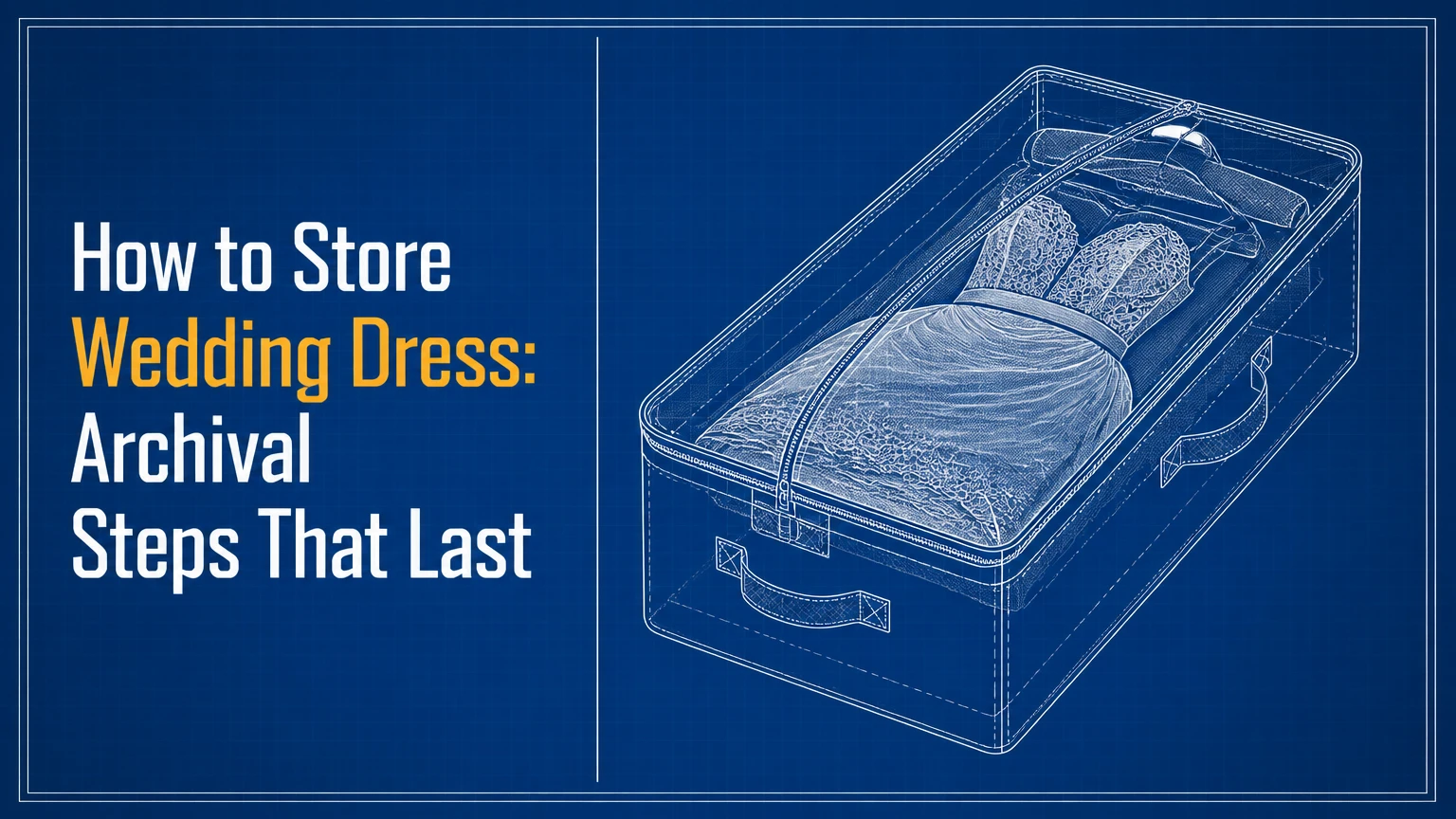
To store a wedding dress safely, have it inspected and professionally cleaned, wrap it in unbuffered acid-free tissue, then place it in an archival box or breathable cotton-muslin garment bag. Keep the gown away from light, plastic, heat, and moisture at 60°F-72°F and approximately 45%-55% relative humidity.
Key Facts at a Glance
- Clean a wedding dress as soon as practical, ideally within six months, because sweat, sugar, alcohol, and makeup can oxidize into permanent brown or yellow stains.
- An archival box is usually safest for heavy, beaded, layered, or silk gowns because folding removes long-term shoulder and seam strain.
- A padded hanger and breathable muslin bag suit lightweight gowns that need regular access or may be resold.
- Do not vacuum-seal a wedding dress. Compression traps residual moisture, creates hard creases, and can damage natural fibers and embellishments.
- Store the gown in a dark, stable interior space at 60°F-72°F with relative humidity near 45%-55%.
- White cotton gloves, acid-free tissue, and an inventory photograph reduce handling damage and make future inspection easier.
Why Wedding Dresses Deteriorate
Wedding dresses deteriorate through oxidation, acidic contact, light exposure, unstable humidity, heat, and mechanical stress. The most damaging stains are often invisible immediately after the ceremony because perspiration, alcohol, body oils, and sugary drinks remain in the fibers before discoloration appears.
Silk, cotton, rayon, and linen are especially vulnerable to oxidation and hydrolysis, although polyester gowns can also yellow through finishes, stains, adhesives, and mixed-fiber components. Beading creates another risk: moisture and unsuitable solvents can loosen coatings, cloud sequins, or affect metallic threads.
Ordinary cardboard can release acidic compounds as it ages. Some plastics also trap moisture or transfer plasticizers and other contaminants. Archival packaging reduces those risks, but “acid-free” alone does not guarantee safe storage if the box is kept in a damp basement or exposed to sunlight.
The National Park Service’s textile-care guidance emphasizes stable temperature and humidity, low light, minimal handling, and suitable support materials. Those controls matter more than an attractive presentation box.
When Should You Clean a Wedding Dress?
A wedding dress should be assessed immediately after the event and cleaned within six months whenever possible. Earlier cleaning is preferable after outdoor ceremonies, red-wine spills, beach weddings, or prolonged wear because soil can migrate deeper into hems and seams.
Do not mistake a dress that looks clean for a clean dress. Clear champagne, perspiration, skin oils, and white cake frosting may leave little visible evidence while still undergoing oxidation. Waiting several years can turn a removable residue into a restoration problem.
A gown that has already been stored for years still deserves professional assessment. A textile conservator or experienced bridal cleaner may improve yellowing, but aggressive whitening can weaken fibers, alter color, or damage antique lace. Restoration is not always reversible.
Before You Start
Prepare the gown, packaging, storage location, and documentation before folding or hanging the dress. The typical preparation takes 30-60 minutes, excluding professional cleaning, and costs approximately $25-$100 for materials or $400-$1,000 or more for professional cleaning and preservation.
| Requirement | Typical specification | Why it matters |
|---|---|---|
| Cleaning window | Same week to 6 months | Reduces stain oxidation |
| Archival tissue | 10-20 sheets, acid-free and lignin-free | Cushions folds and reduces creases |
| Storage box | 18 x 24 x 6 inches or larger | Prevents compression of layered fabric |
| Garment bag | 100% cotton muslin, 48-72 inches long | Blocks dust while allowing airflow |
| Hanger | Wide, padded, load-rated for gown weight | Reduces shoulder deformation |
| Gloves | White, clean cotton gloves | Limits oil transfer |
| Storage temperature | 60°F-72°F | Avoids heat-driven aging |
| Relative humidity | 45%-55%, stable | Limits mold and fiber movement |
Document the Dress First
Photograph the front, back, hem, neckline, underarms, train, label, and every detachable accessory before cleaning. Record existing marks, loose beads, missing buttons, and tears in a dated inventory.
Documentation protects against misunderstandings with a cleaner and helps identify later changes. A resale listing, insurance claim, or family archive also benefits from photographs taken before the dress is folded.
How to Store a Wedding Dress Step by Step
Step 1: Inspect the Gown and Accessories
Inspect the hem, bodice, underarms, neckline, train, bustle points, and lining under bright neutral light. Remove detachable belts, veils, overskirts, sleeves, and jewelry before selecting a cleaning method.
Look for red wine, grass, mud, makeup, perspiration, body oil, adhesive, fake-tan residue, and crushed foliage. Do not scrape dried food or rub a stain because friction can spread it and break fragile fibers.
You will know this step is complete when: every stain, loose trim, and detached accessory is recorded in photographs and notes.
Common mistake: assuming a dry-looking hem needs no treatment. Outdoor soil can contain moisture and salts that continue damaging fibers after the gown returns to the closet.
Step 2: Choose a Specialist and Cleaning Method
Choose a cleaner who handles bridal gowns, silk, lace, beading, and mixed materials rather than sending the dress through ordinary commercial dry cleaning. Ask who inspects the dress, which process fits each component, how stains are tested, and whether the gown is packed only after a final inspection.
Cleaning may involve wet-cleaning, solvent-based cleaning, hand treatment, or a combination. The correct process depends on dye stability, fiber content, adhesives, sequins, metallic thread, painted details, and the manufacturer’s care label.
Request a written condition report and photographs of significant embellishments. A reputable provider should explain limitations instead of promising that every stain will disappear.
You will know this step is complete when: the cleaner has identified the fibers, embellishments, risks, process, price, and liability terms.
Common mistake: choosing the lowest advertised price without asking who performs the inspection or how the dress is packaged afterward.
Step 3: Let the Dress Dry and Cool Completely
Allow a cleaned gown to dry and cool completely before packaging. The exact time varies, but professional cleaners commonly need several days to complete cleaning, drying, inspection, and packing, while full preservation services often take 4-10 weeks.
Never seal a gown that feels cool-damp, smells strongly of solvent, or contains damp tissue. Residual moisture inside an enclosed container can encourage mildew and cause dye transfer.
You will know this step is complete when: the gown feels dry at the hem, lining, seams, and dense beadwork, and no solvent or damp odor remains.
Common mistake: packing the dress immediately after pickup because the outside feels dry while the layered lining remains damp.
Step 4: Pad Every Fold with Acid-Free Tissue
Lay the gown on a clean white sheet or other lint-free surface. Place loose, soft folds rather than sharp creases, and add crumpled acid-free tissue inside sleeves, bodice cups, pleats, and folded train sections.
Use unbuffered tissue for silk, wool, feathers, and other protein-based materials unless a conservator specifies otherwise. Buffered tissue is often appropriate for some cellulose fibers, but mixed-fiber gowns require professional judgment.
Do not stuff the box tightly. The tissue should support the fabric without forcing the lid upward or compressing beads against adjacent layers.
You will know this step is complete when: no fold has a hard edge, heavy decorations are not pressing directly against fabric, and the box closes without force.
Common mistake: using newspaper, colored tissue, scented paper, or ordinary gift wrap. Ink, dyes, acids, and fragrance compounds can transfer into pale textiles.
Step 5: Select the Storage Method
Select an archival box for heavy, structured, beaded, or long-term heirloom gowns. Select hanging storage for lightweight dresses that need access, short-term storage, resale photography, or future alterations.
Use a wide padded hanger only when the shoulder seams and fabric can support the gown’s weight. Place the garment inside a breathable cotton-muslin bag, then keep the hanger supported by a closet rod that will not bend under the load.
Interior hanging loops can reduce strain on the shoulder seams, but they should not carry a very heavy skirt indefinitely. A large ballgown may weigh enough to stretch satin, silk, or narrow straps even on a padded hanger.
You will know this step is complete when: the dress is fully supported, dust-covered, uncompressed, and protected from direct light.
Common mistake: using the dress’s thin satin hanger loops as the primary support for months or years.
Step 6: Label and Place the Container
Label the outside of the box with the gown owner, designer, cleaning date, fiber notes, and accessory list. Avoid attaching adhesive labels directly to the dress or placing inked paper in contact with the textile.
Store the container on a shelf in an interior closet, not on a floor where plumbing leaks or condensation can reach it. Leave space around the box or garment bag so air can circulate and the package can be removed without dragging it across other items.
You will know this step is complete when: the storage location is dark, dry, stable, accessible, and documented.
Common mistake: placing the dress in an attic because it is “out of the way.” Attics experience heat spikes, cold cycles, roof leaks, and large humidity changes.
Which Storage Method Is Best?
An archival box is generally the best long-term option for a heavy or embellished gown, while hanging muslin storage is better for a lightweight dress that will be inspected, altered, worn, or sold. The correct choice depends on weight, fiber, embellishment, access, and available environmental control.
| Criterion | Archival box | Hanging muslin bag | Vacuum-sealed bag |
|---|---|---|---|
| Typical material | Acid-free board, archival tissue | Cotton muslin, padded hanger | Polyethylene or nylon plastic |
| Best gown weight | Heavy, 8-20+ pounds | Light, under approximately 8 pounds | None recommended |
| Crease exposure | Medium, if folded with tissue | Low, if supported correctly | High, compressed creases |
| Shoulder strain | Minimal | Medium to high over years | None, but compression damage |
| Access frequency | Every 1-2 years | Monthly or seasonally | Very low |
| Typical material cost | $40-$150 | $25-$100 | $10-$40 |
| Long-term verdict | Preferred for heirlooms | Preferred for accessible lightweight gowns | Avoid |
Archival Box Storage
Box storage protects heavy skirts, dense beadwork, silk satin, and structured bodices from continuous gravitational load. Fold the gown loosely around acid-free tissue, place the heaviest sections near the base, and avoid stacking accessories on top of fragile beading.
A viewing window is not automatically a benefit. Acetate can be safer than ordinary plastic, but any window admits light and reduces the box’s protective barrier. A fully opaque archival box is preferable for a decades-long heirloom.
Inspect the box after six months, then every one to two years. Refold along slightly different lines if the textile and conservator’s instructions permit it, because one permanent fold can become a weak point.
Hanging Muslin Storage
Hanging storage keeps a lightweight gown accessible and reduces folding, but gravity remains a mechanical hazard. Use a wide padded hanger, support the bodice, and place heavy trains or overskirts in a separate tissue-lined box instead of allowing the hanger to carry everything.
Cotton muslin blocks dust while permitting moisture exchange. A breathable nonwoven polypropylene cover can also work when it is clean, stable, and designed for textile storage, but a sealed dry-cleaning bag is unsuitable.
Hanging is a practical choice for a simple polyester slip dress or lightweight lace gown. It is a poor choice for a 15-pound ballgown, a bias-cut silk dress, or a gown with narrow shoulder straps.
Why Vacuum Sealing Is a Poor Choice
Vacuum sealing is unsuitable for wedding dresses because it removes structural support while pressing fibers, trims, and embellishments together. The plastic barrier also traps any moisture that remains after cleaning, and the compressed folds can become difficult to relax.
Vacuum storage may save space for ordinary, dry, durable textiles during short transport, but a wedding gown is a layered and decorated object with uncertain moisture content. Space efficiency does not compensate for irreversible creasing, mildew, crushed beadwork, or fiber distortion.
Where Should You Store the Dress?
Store a wedding dress in an interior closet or climate-controlled room, away from windows, radiators, exterior walls, plumbing, and high-traffic storage areas. The target environment is 60°F-72°F with relative humidity near 45%-55%, and stability matters more than achieving a perfect single reading.
| Location | Typical temperature or humidity issue | Main risk | Recommendation |
|---|---|---|---|
| Interior closet | 60°F-72°F, usually stable | Limited space | Preferred |
| Bedroom wardrobe | 60°F-75°F, moderate variation | Light and compression | Suitable with clearance |
| Attic | 40°F-120°F seasonal range | Heat, leaks, humidity | Avoid |
| Basement | 45%-70% RH or higher | Mold and condensation | Avoid |
| Garage | 35°F-110°F seasonal range | Dust, pests, fumes | Avoid |
| Climate-controlled storage | Approximately 60°F-75°F | Access and cost | Suitable if monitored |
A small digital hygrometer costs approximately $10-$30 and provides useful warning data. If readings remain above 60% RH, improve dehumidification or relocate the gown. Do not place a desiccant packet inside the box as a substitute for room-level humidity control.
How Much Does Wedding Dress Preservation Cost?
Wedding dress preservation typically costs $400-$1,000 or more through a specialist, while a professionally cleaned gown stored with a DIY archival kit commonly costs $150-$250. Pricing rises with silk, intricate lace, extensive beadwork, multiple layers, stains, restoration, oversized boxes, and additional accessories.
| Service level | Typical price | Typical turnaround | Best use |
|---|---|---|---|
| Local bridal cleaning | $150-$400 | 1-4 weeks | Clean gown, owner supplies storage |
| Mail-in DIY preservation kit | $150-$250 | 4-10 weeks | Budget-conscious long-term storage |
| Boutique preservation | $400-$1,000+ | 4-10 weeks | Complex or valuable gowns |
| Textile restoration | $600-$2,000+ | 2-16 weeks | Yellowing, mold, tears, antique fabric |
| Archival supplies only | $40-$150 | 1-3 days | Already-clean gown, informed owner |
Ask whether the quoted price includes stain testing, cleaning, repairs, acid-free materials, accessories, photographs, insurance, return shipping, and future inspection instructions. A warranty may cover packaging defects but rarely guarantees that an old stain will disappear or that fabric will never yellow.
What Should You Do With Accessories?
Store veils, detachable sleeves, belts, gloves, petticoats, and shoes separately when their materials or shapes differ from the gown. Wrap each textile accessory in acid-free tissue, place small pieces in an archival folder or shallow box, and keep shoes away from the dress because leather dyes and adhesives can transfer.
Do not place metal jewelry, bouquets, pressed flowers, or food-related keepsakes inside the gown box. Metals can corrode, flowers can retain moisture, and organic materials can attract pests. A separate labeled archive preserves the memory without exposing the dress to unnecessary contaminants.
Record the accessory location in the gown inventory. Future owners should be able to identify every component without repeatedly unfolding the main dress.
Common Mistakes and How to Fix Them
The Dress Is in a Plastic Garment Bag
Remove the plastic bag and replace it with clean cotton muslin. If the gown feels damp or smells musty, do not seal it in a box; arrange an inspection with a bridal cleaner or textile conservator.
The Dress Was Stored in an Attic or Basement
Move the gown to a climate-controlled interior room. Examine the box, tissue, hem, and lining for condensation, spotting, insects, or odor before opening and repacking it.
The Dress Has Yellowed
Do not apply chlorine bleach, household stain remover, or oxygen cleaner at home. Professional wet-cleaning restoration can sometimes reduce yellowing, but treatment must be tested because silk dyes, lace finishes, and aged fibers may react unpredictably.
Mold or Mildew Is Present
Do not shake, brush, wash, or vacuum a moldy wedding dress indoors. Isolate the container from other textiles and contact a textile-restoration specialist because mold remediation requires controlled handling and may involve health hazards.
The Preservation Box Got Wet
Use clean gloves, move the gown away from the wet packaging, and separate damp layers in a dry, low-light area while arranging professional advice. Replace every damp tissue sheet and inspect for dye bleed, odor, and mold before reboxing.
Beads or Sequins Are Loose
Stop folding across the damaged area. Photograph the condition and ask a bridal seamstress or conservator to stabilize the embellishment before cleaning or storage.
How Do Storage Plans Change by Situation?
Destination Wedding
Carry the gown in the cabin in a breathable garment bag whenever airline policy and space allow. Do not rely on a first-class closet because crew decisions and closet availability vary; use a structured carry-on strategy and keep the dress out of checked luggage.
After returning home, hang the dress temporarily in a clean, dry room, inspect the hem and bodice, and arrange cleaning rather than placing travel-worn fabric directly into long-term storage.
Family Heirloom
Choose professional cleaning and an opaque archival box for a gown intended to last across generations. Request unbuffered tissue for silk or wool, a condition report, a complete accessory inventory, and written instructions for inspection.
Do not assume a sealed box can be forgotten forever. Inspect the exterior every year and the interior approximately every one to two years, using gloves and minimal handling.
Resale or Future Wear
Use hanging muslin storage when the gown is lightweight and likely to be photographed, altered, or tried on within the next few months. Keep the original label, measurements, alterations, cleaning receipt, and accessory list together because those records improve resale accuracy.
For a heavy gown, boxed storage is safer even when resale is planned. Repeated hanging can deform the shoulders before a buyer sees the dress.
Budget-Conscious Storage
A professionally cleaned gown can be stored safely without an expensive boutique package if the owner buys genuine acid-free tissue, an appropriately sized archival box, and a clean breathable cover. Verify the materials rather than trusting the word “preservation” in a product title.
The least expensive safe plan is usually professional cleaning plus owner-controlled archival packing. Home stain removal is where many budget plans become expensive restoration projects.
What Do Textile Professionals Inspect During Preservation?
A competent preservation provider examines more than visible stains. The provider should assess fiber content, dye stability, seam strength, bead attachment, adhesive areas, metal trims, lining condition, and previous alterations before selecting a process.
Ask these questions before authorizing work:
- Will the gown receive a written condition report?
- Will the cleaner test dyes and embellishments before treatment?
- Which areas will be wet-cleaned, solvent-cleaned, or hand-treated?
- How will the gown be supported inside the package?
- Are tissue and board acid-free and lignin-free?
- Are accessories included in the quoted price?
- What happens if a stain cannot be removed safely?
- Does the service provide photographs and shipping insurance?
- Can the package be reopened for inspection without damaging it?
- What humidity and inspection schedule does the provider recommend?
A provider who promises guaranteed stain removal without discussing fiber and dye risks is giving incomplete advice. Preservation is risk management, not a promise that every original condition can be erased.
Frequently Asked Questions
Can I Store My Wedding Dress Without Cleaning It?
You can store a gown temporarily for a few days, but uncleaned long-term storage is unsafe. Sweat, body oil, alcohol, sugar, grass, and makeup can oxidize invisibly and cause permanent discoloration. Keep the gown dry and ventilated while arranging professional inspection, then clean it before archival packing.
Is a Wedding Dress Better Folded or Hung?
A heavy or highly embellished wedding dress is usually safer folded with acid-free tissue because hanging concentrates weight at the shoulders and seams. A lightweight gown can hang in a breathable muslin bag when a wide padded hanger supports the structure and the storage period is monitored.
Can I Use a Regular Plastic Storage Bin?
A regular plastic bin is not the preferred long-term container for a wedding dress. Plastic can trap moisture, restrict ventilation, and press against folded fabric. An archival box with acid-free tissue is safer, while a breathable muslin bag is suitable for an appropriately supported lightweight gown.
How Often Should I Open a Preserved Wedding Dress?
Inspect the exterior annually and the gown approximately every one to two years if the package is designed to be reopened. Use clean gloves, photograph the condition, check for odor or moisture, and refold only when necessary. Follow a conservator’s instructions for antique or fragile textiles.
Can I Store the Veil Inside the Wedding Dress Box?
You can store a veil inside the same archival box when the veil is clean, dry, and wrapped separately in acid-free tissue. Keep shoes, flowers, jewelry, damp accessories, and dyed materials outside the gown package because they can transfer contaminants or attract pests.
How Long Can a Wedding Dress Stay in Storage?
A properly cleaned and packaged wedding dress can remain in storage for decades, but no package eliminates maintenance. Stable temperature, controlled humidity, low light, suitable tissue, and periodic inspection determine longevity. Reassess the gown after moving homes, water damage, pest activity, or major climate changes.
The Bottom Line
To store a wedding dress safely, clean it promptly, document its condition, use acid-free tissue, and choose the container according to the gown’s weight and future use. Heavy heirloom gowns generally belong in an opaque archival box; lightweight dresses needing access can hang in breathable muslin. Keep either option dark, dry, stable, and away from plastic, attics, basements, and vacuum compression. Following these controls is the practical answer to how to store wedding dress for long-term protection.