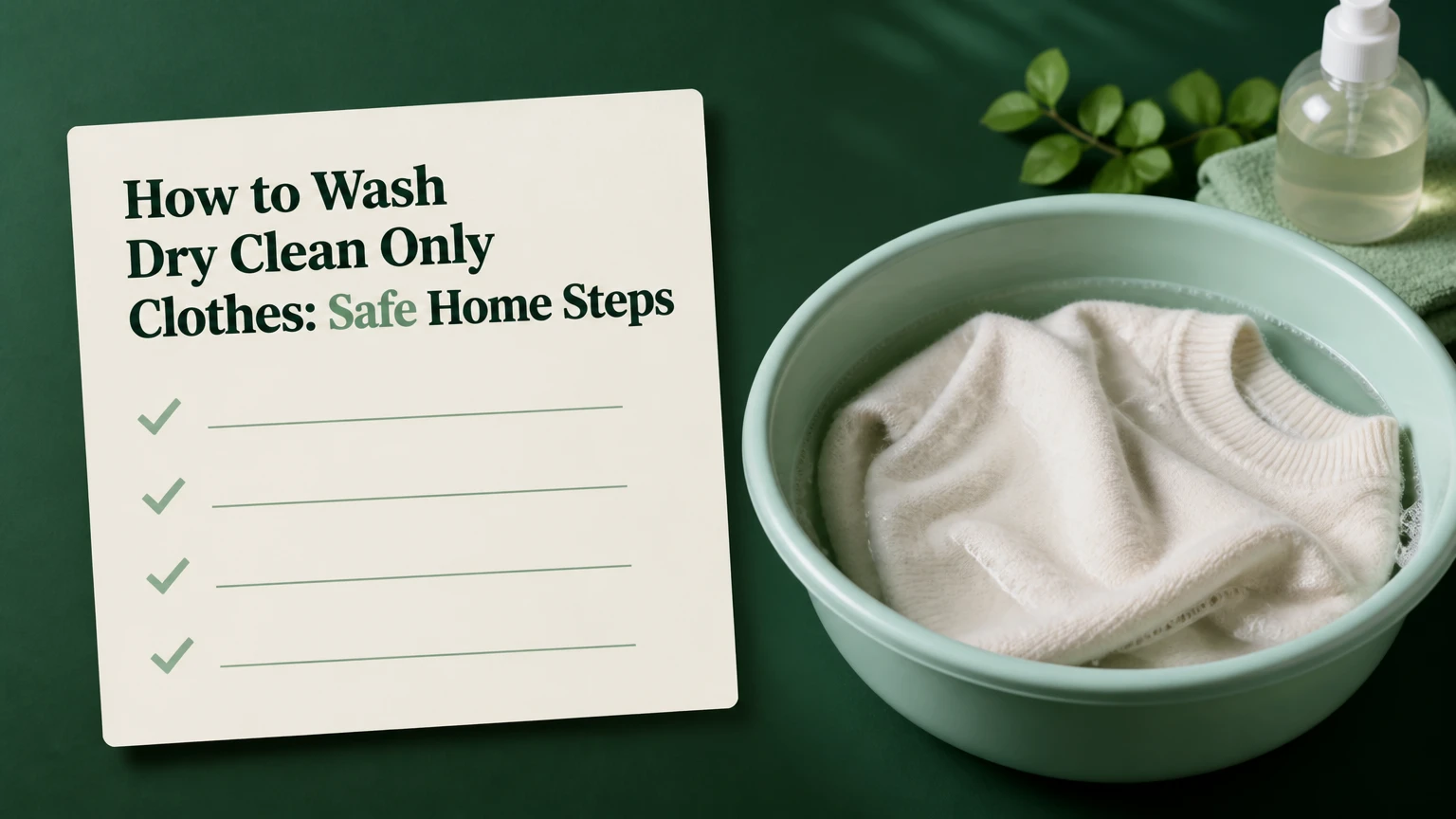
You can wash some dry-clean-only clothes at home, but only after checking the fiber, colorfastness, lining, trim, and garment structure. For low-risk, unstructured items, careful cold-water hand washing followed by towel pressing and flat drying is the safest home method; suits, leather, suede, rayon, pleats, and valuable embellished garments should go to a professional.
Key Facts at a Glance
- “Dry clean only” warns that water, agitation, heat, dye movement, or garment construction may cause damage.
- Fiber content alone does not determine safety; a silk scarf and a lined silk jacket have very different washing risks.
- Cold water reduces shrinkage and dye transfer, but cold water does not make every dry-clean-only garment washable.
- Never wring, twist, tumble-dry, or hang a wet knitted garment because weight and heat can permanently change its shape.
- A home dry-cleaning kit refreshes lightly soiled clothing but usually cannot remove heavy oil, perspiration buildup, or set-in stains.
- Professional wet cleaning uses controlled water-based equipment and is not the same as putting a labeled garment in a household washer.
What Does “Dry Clean Only” Mean?
“Dry clean only” means the manufacturer has identified professional solvent cleaning as the safest tested care method, or has not guaranteed that ordinary washing will preserve the garment. The label accounts for more than fiber: it can reflect dyes, finishes, linings, adhesives, pleats, padding, and dimensional stability.
Dry cleaning is called “dry” because the process does not use water as the primary cleaning liquid. Commercial machines circulate a liquid solvent, extract it, and dry the garment in a controlled system. Traditional operations used perchloroethylene, commonly called perc; many cleaners also use hydrocarbon solvents, siloxane-based solvents, or other systems depending on local regulations and equipment.
Water affects textiles differently from dry-cleaning solvent. Water can swell some fibers, mobilize loose dye, relax stabilizing finishes, and change the tension between outer fabric and inner components. Mechanical movement then adds friction and stretching. The label therefore describes a risk profile, not a guarantee that a household wash will fail.
The Federal Trade Commission’s Care Labeling Rule requires manufacturers and importers to provide care instructions with garments, but a care label is not a damage waiver for every possible home method. It is a practical instruction based on the garment’s tested care pathway. Treat “dry clean only” as a stop-and-assess signal.
Can You Wash Dry-Clean-Only Clothes at Home?
Yes, some unstructured garments can tolerate hand washing, especially when the care label identifies washable-looking fibers such as wool, cashmere, silk, polyester, or nylon. Home washing remains a calculated risk because a garment may bleed, shrink, lose sheen, develop rings, or dry with a different shape even when the fabric itself survives.
Use the following decision gate before adding water:
- Read the entire label, including lining and trim information.
- Identify the fiber percentages, not just the most prominent fiber.
- Check whether the garment has a lining, shoulder pads, interfacing, pleats, beading, leather trim, or glued decoration.
- Look for stains that may require solvent treatment.
- Test a hidden seam for dye transfer and water spotting.
- Consider the garment’s value and whether a failed experiment is acceptable.
A low-cost polyester camisole has a different risk profile from a silk evening dress. The garment’s construction is often more important than its fiber name.
Home-washing risk guide
| Garment or material | Typical home risk | Safer decision | Main failure mode |
|---|---|---|---|
| Unlined polyester blouse | Low to moderate | Cold hand wash after test | Water rings or finish change |
| Silk scarf | Moderate | Hand wash only if label and dye test permit | Bleeding, sheen change |
| Wool sweater | Moderate | Cold hand wash, reshape flat | Felting, shrinkage, stretching |
| Cashmere knit | Moderate to high | Hand wash only for low-value, stable knit | Felting and distortion |
| Rayon or viscose dress | High | Professional cleaner | Shrinkage and wet distortion |
| Lined silk jacket | High | Professional cleaner | Lining mismatch and bubbling |
| Tailored wool suit | Very high | Professional cleaner | Fused or canvassed structure changes |
| Leather or suede coat | Very high | Leather specialist | Water marks, stiffness, oil loss |
What Should You Check Before Washing?
Inspect the garment in daylight and record its original dimensions before washing. Measure the body length, chest or waistband, sleeve length, and hem width on knitted garments; these measurements help you reshape accurately if the fabric relaxes.
Before You Start
| Requirement | Typical specification |
|---|---|
| Time | 10-15 minutes washing, 12-24 hours drying |
| Difficulty | Moderate for stable fabric, high for knits or silk |
| Water | 5-8 liters of cold or cool water |
| Detergent | 1 teaspoon pH-neutral delicate wash |
| Equipment | Clean basin, white towel, mesh rack or drying surface |
| Temperature | Preferably 20-30°C, never hot |
| Prerequisite | Hidden-seam colorfastness and water-spot test |
Remove jewelry, empty pockets, close zippers, and fasten hooks so they cannot snag the fabric. Do not presoak a garment with unknown dye stability. Long soaking gives dyes, adhesives, and water-sensitive finishes more time to move.
How do you test for colorfastness?
Place a white cotton swab or white cloth against an inside seam. Moisten it with cool water containing a tiny amount of delicate detergent, then press rather than rub for 10 seconds. If color transfers, stop. A second test on the garment’s outer fabric can reveal whether the surface develops a darker ring or halo.
A successful test does not guarantee a successful wash. It only indicates that the tested area did not show immediate dye movement or water marking. Test silk, dark wool, saturated red garments, navy garments, and printed fabrics particularly carefully.
How to Hand-Wash a Dry-Clean-Only Garment
Hand washing is the lowest-agitation household method for a permitted garment, and the complete process usually takes 15 minutes of active work plus 12-24 hours of flat drying. Cold water, a small detergent dose, minimal movement, towel extraction, and accurate reshaping determine the result.
Step 1: Fill a Clean Basin
Fill a cleaned sink or basin with enough cold water to let the garment move freely, usually 5-8 liters for one blouse or sweater. Use water around 20-30°C, and avoid temperature swings between washing and rinsing because sudden changes can encourage shrinkage or distortion in animal fibers.
You’ll know it worked when: the basin contains clear water without detergent foam before the garment enters.
Common mistake: Washing in a sink containing bleach, cleaning spray, food residue, or cosmetic oils. Rinse the basin first.
Step 2: Mix Delicate Detergent
Add about 1 teaspoon of pH-neutral detergent designed for wool, silk, or delicate fabrics. Disperse the detergent completely before submerging the garment. Standard laundry detergent may contain enzymes, brighteners, fragrance, or alkaline builders that can affect protein fibers and dark dyes.
You’ll know it worked when: the detergent is evenly diluted and no concentrated liquid sits on the fabric.
Common mistake: Adding extra detergent because the garment looks dirty. Excess soap is harder to rinse and can leave stiffness or residue.
Step 3: Submerge Without Scrubbing
Lower the garment into the water and press it down gently until saturated. Let it rest for 2-5 minutes, then move it slowly through the water for approximately 1-2 minutes. Do not scrub collars, rub underarms, brush the surface, or knead the garment.
You’ll know it worked when: surface soil releases into the water without visible fuzzing, stretching, or dye clouds.
Common mistake: Treating a delicate garment like a towel. Friction can create pills, shine, or localized fading before the garment appears clean.
Step 4: Rinse With Matching Temperature
Drain the basin and refill it with cool water at approximately the same temperature. Press the garment up and down to release detergent, then repeat with fresh water until the rinse water looks clear and the fabric no longer feels slippery.
You’ll know it worked when: no foam remains when the garment is pressed under the water.
Common mistake: Holding the garment by one end while rinsing. Wet fabric can stretch under its own weight, especially wool, cashmere, and knitted rayon.
Step 5: Extract Water With a Towel
Support the entire garment with both hands and lift it from the basin. Place it on a clean white towel, roll the towel around it, and press firmly along the roll. Use a second dry towel if the first becomes saturated.
You’ll know it worked when: the garment is damp rather than dripping, with no need to twist it.
Common mistake: Wringing the garment. Twisting can permanently distort seams, knit columns, hems, and delicate surface finishes.
Step 6: Reshape While Damp
Lay the garment flat on a dry towel or mesh rack. Align shoulder seams, side seams, cuffs, collar, waistband, and hem with their original dimensions. Smooth wrinkles with your palms rather than pulling one area aggressively.
You’ll know it worked when: the garment’s measured length and width match the prewash dimensions.
Common mistake: Hanging a wet sweater, dress, or loosely woven item. Gravity can lengthen the shoulders and create pointed hanger marks.
Step 7: Air-Dry Flat
Dry the garment flat in a ventilated room away from radiators, hair dryers, fireplaces, and direct sunlight. Turn it once after several hours if the underside remains damp. Drying may take 12-24 hours, and dense wool can take longer.
You’ll know it worked when: the seams, waistband, and thick areas are completely dry and the fabric has returned to its intended shape.
Common mistake: Using a tumble dryer to finish the process. Heat and tumbling can shrink wool, set wrinkles, distort fusible components, and alter synthetic finishes.
Which Fabrics Can Be Hand-Washed?
Wool, cashmere, silk, linen, cotton, polyester, and nylon may tolerate hand washing under specific conditions, but the label, weave, dye, finish, and construction still control the decision. A fiber category is not a universal permission slip.
| Fiber or textile | Water behavior | Recommended home method | Important limitation |
|---|---|---|---|
| Wool | Can felt and shrink with heat or friction | Cold hand wash, flat dry | Avoid agitation and temperature change |
| Cashmere | Absorbs water and becomes heavy | Short cold wash, towel press | High stretching and pilling risk |
| Silk | Usually stable in cool water, but dyes vary | Brief hand wash if tested | Sheen, bleeding, and water spots |
| Cotton | Can shrink, crease, or release dye | Cold hand wash for unstructured items | Pressing may be needed |
| Linen | Water-safe fiber with high wrinkling | Cold gentle wash | Shape and finish may change |
| Polyester | Low water absorption and low shrinkage | Hand wash or cautious machine cycle | Coatings and blends can react differently |
| Nylon | Generally water-stable | Cold hand wash | Heat can deform the fiber |
| Rayon or viscose | Weakens substantially when wet | Professional care preferred | Shrinkage, stretching, and distortion |
Wool and cashmere
Wool and cashmere knits can often be hand-washed even when the label says dry clean only, but felting is irreversible once heat, moisture, and friction compress the scales on the fibers. Keep the wash brief, use cool water, and reshape the item before the knit dries.
Do not use hair conditioner as a routine detergent substitute. If a wool garment has shrunk slightly, a lukewarm soak with a small amount of wool wash may relax it enough for careful reshaping, but stretching cannot reliably restore severe shrinkage or correct felting.
Silk
Silk can survive cool hand washing, but silk garments may show altered sheen, color migration, or water rings. A silk blouse with a stable solid dye is a better candidate than a dark printed dress with shoulder pads and a lining.
Never spot-rub silk aggressively. Blot from the outside of a stain toward the center, and send oil, perfume, makeup, and perspiration stains to a cleaner when the garment is valuable.
Rayon, viscose, and modal
Rayon, viscose, and modal are high-risk when wet because many constructions lose strength and dimensional stability during washing. A viscose dress may emerge shorter, wider, twisted at the seams, or permanently limp even after a cold, gentle wash.
The common claim that these fibers always shrink “multiple sizes” is too absolute. Results vary by fiber processing, weave, finishing, and garment construction, but the risk is high enough that a dry-clean-only rayon garment should normally remain with a professional.
Which Garments Should Go to a Professional?
Tailored, lined, coated, heavily decorated, or water-sensitive garments should be professionally cleaned. Professional care is the safer choice for suits, structured jackets, leather, suede, fur, pleated garments, wedding clothing, and items with adhesive-backed interlinings.
| Garment feature | Why household water is risky | Appropriate specialist |
|---|---|---|
| Canvas or fusible suit jacket | Layers can shrink at different rates | Professional dry cleaner |
| Shoulder pads and sleeve heads | Padding can shift or collapse | Professional dry cleaner |
| Pleats | Water and heat can relax set pleats | Cleaner experienced with pleating |
| Leather or suede | Water can cause rings, stiffness, and texture change | Leather and suede specialist |
| Beads, sequins, or feathers | Moisture and agitation can loosen attachments | Couture or specialty cleaner |
| Waxed or coated fabric | Detergent can strip or cloud the finish | Brand-approved specialist |
| Fur or shearling | Water can mat fibers and affect the hide | Furrier or leather specialist |
| Vintage textiles | Fibers and dyes may be weakened by age | Textile conservator |
Leather is not automatically destroyed by every contact with water, but uncontrolled soaking can remove oils, create tide marks, stiffen the hide, and damage suede nap. The practical home-care rule remains simple: do not wash leather or suede in a basin unless the manufacturer specifically provides that method.
Why are suits and lined jackets different?
A tailored jacket contains several materials that respond differently to water and drying. The outer wool, cotton, or synthetic shell may survive, while the lining, canvas, shoulder padding, sleeve head, thread, and fusible adhesive change at different rates.
That mismatch can produce bubbling, puckering, twisted lapels, shortened hems, or a jacket that no longer hangs correctly. Pressing cannot always reverse those changes. Professional cleaners can inspect construction and select solvent, wet-cleaning, pressing, and finishing methods accordingly.
Can You Machine-Wash Dry-Clean-Only Clothes?
Machine washing is appropriate only for a low-value, unstructured garment whose fiber, dye, trim, and construction have already passed inspection. A cold delicate cycle reduces mechanical stress, but it does not remove the manufacturer’s warning or guarantee against shrinkage and distortion.
If you accept the risk, use this limited method:
- Close fasteners and turn the garment inside out.
- Place it in a mesh laundry bag with similar lightweight items.
- Select cold water and the shortest delicate, hand-wash, or wool cycle.
- Choose the lowest available spin, ideally below 400 revolutions per minute.
- Use about 1 teaspoon of delicate detergent for a small load.
- Remove the garment immediately when the cycle ends.
- Towel-press and flat-dry it instead of using a dryer.
Do not machine-wash structured jackets, rayon dresses, beaded items, silk with unstable dye, pleated skirts, leather, or garments with prominent surface coatings. The washer’s repeated movement and extraction can cause more damage than a brief hand wash.
How Do Home Dry-Cleaning Kits Compare?
At-home dry-cleaning kits use a pretreated sheet or cloth and a heated household dryer to refresh garments. They can reduce light odor, surface wrinkles, and minor water-based soil, but they are not equivalent to commercial dry cleaning and are a poor choice for garments that cannot tolerate dryer heat.
| Method | Active time | Typical total cost | Best use | Main limitation |
|---|---|---|---|---|
| Cold hand wash | 15-25 minutes | $0.50-$2 per item | Stable unstructured fibers | High handling risk |
| Machine delicate cycle | 5-10 minutes | $0.25-$1 per item | Sturdy low-value synthetics | Agitation and spin |
| Home dryer kit | 5-10 minutes | $2-$4 per load | Odor and wrinkle refresh | Heat and weak stain removal |
| Professional dry cleaning | 1 visit | $4-$35 per garment, typical | Structured or valuable clothing | Cost and transport |
| Professional wet cleaning | 1 visit | $6-$40 per garment, typical | Selected water-sensitive clothing | Not available everywhere |
Avoid a dryer kit when a garment has a visible oil stain, because heat may set the stain and make later removal more difficult. Never use a kit on leather, fur, heavily embellished clothing, or anything marked with a manufacturer warning against tumble drying.
How Much Do the Options Cost and How Long Do They Take?
Typical professional cleaning costs range from approximately $4-$10 for a silk blouse or shirt, $15-$35 for a two-piece suit, and $18-$45 for a heavy coat in markets using comparable United States pricing. Local labor, garment size, stain treatment, pressing, pickup service, and specialty materials can change the final price substantially.
| Item or service | Typical price range | Typical turnaround |
|---|---|---|
| Silk blouse or dress shirt | $4-$10 | 24-48 hours |
| Two-piece tailored suit | $15-$35 | 24-72 hours |
| Winter coat | $18-$45 | 2-5 days |
| Home dry-cleaning kit | $2-$4 per load | 30-40 minutes |
| Hand washing at home | $0.50-$2 per item | 12-24 hours |
| Express professional service | Extra $5-$20 | 4-8 hours |
These are planning ranges, not universal prices. A cleaner may charge more for leather, wedding clothing, couture finishes, rush service, or stain testing. The cheapest method becomes expensive if shrinkage destroys a $200 garment.
How Should You Handle Stains and Odors?
Treat fresh water-based spots by blotting, but send oil, dye, ink, adhesive, and unknown stains to a cleaner when the garment is valuable or labeled dry clean only. Friction spreads stains, and household heat can permanently set many oily or protein-based marks.
Use a white absorbent cloth and blot from the outside of the mark toward the center. Do not apply bleach, hydrogen peroxide, alcohol, nail-polish remover, baking soda paste, or undiluted vinegar without confirming fiber compatibility. Home remedies can alter dye, strip coatings, or leave a larger ring than the original stain.
For odor without visible soil, air the garment inside out for several hours in shade. A fabric steamer may relax wrinkles and reduce some odor on suitable textiles, but keep the steamer away from leather, suede, glued decorations, and water-sensitive finishes. Steam does not remove accumulated body oil.
Common Mistakes and How to Fix Them
The garment shrank
If wool or cashmere shrank slightly, soak it in cool to lukewarm water with wool wash for 10-20 minutes, then towel-press and gently reshape it to the recorded measurements. Do not pull hard or use high heat. Severe felting, major shrinkage, or distortion usually requires a textile repair specialist, and complete restoration may be impossible.
The garment developed white residue
Re-rinse the item in water matching the original wash temperature and press it gently through a towel. Detergent residue usually results from overdosing or incomplete rinsing. Do not automatically add half a cup of vinegar, because concentrated acid can affect dyes, elastane, metal components, and some finishes.
The fabric has water rings
Water rings often result from uneven wetting or localized rubbing. For a valuable silk, rayon, or tailored garment, stop experimenting and take it to a professional. Rewetting the entire garment can make the ring less visible on some washable fabrics, but it can also spread dye or enlarge the damage.
The sweater stretched
Lay the sweater flat while damp and reshape it section by section. If the shoulders have already lengthened, steam may relax some fibers, but aggressive pulling or hanging will worsen the distortion. Future washes require full support during lifting and drying.
The color bled
Stop washing and keep the garment wet until you can separate the transferred dye from unaffected sections, but do not use a commercial color remover on silk, wool, rayon, or embellished clothing without specialist advice. Once dye has migrated and dried, home correction becomes unreliable.
The jacket bubbled or puckered
Do not iron the jacket aggressively. Bubbling indicates that outer fabric, lining, or interlining changed dimensionally, and pressing may flatten the surface temporarily while worsening the underlying mismatch. A cleaner or tailor can determine whether reshaping, relining, or replacement is practical.
What Is the Lower-Risk Care Strategy?
The lowest-risk strategy is to reduce washing frequency and clean according to soil, odor, and garment use rather than washing after every wear. Air a garment after use, brush away dry surface soil with a suitable clothes brush, spot-blot promptly, and store it dry with enough space for ventilation.
Use professional cleaning for structure, high value, difficult stains, and water-sensitive materials. Use hand washing for tested, unstructured garments where the cost of failure is acceptable. Use a dryer kit only for refreshing compatible items, not for stain removal or garments that prohibit tumble drying.
Professional wet cleaning is a separate service from household washing. It uses controlled detergent dosing, programmable mechanical action, moisture extraction, drying, and finishing equipment. Ask the cleaner whether the garment is suitable for wet cleaning; the service is not automatically safe for every dry-clean-only label.
Frequently Asked Questions
Can I wash a dry-clean-only shirt with no detergent?
You can rinse a low-risk, unstructured shirt in cool water, but water alone will not remove body oil, sunscreen, or greasy food residue. For silk, wool, cashmere, polyester, or nylon, a small dose of pH-neutral delicate detergent usually cleans more effectively than plain water while reducing residue compared with standard laundry detergent.
How often should dry-clean-only clothes be cleaned?
Clean a garment when it has visible soil, persistent odor, or substantial body-oil buildup rather than after every wear. A suit worn over a shirt may need professional cleaning once or twice per season, while a silk blouse worn directly against skin may need care sooner. Airing and spot treatment extend intervals.
Can I iron a dry-clean-only garment after washing?
Ironing is safe only when the fabric and finish permit it, and the garment must be completely dry first. Use the lowest suitable temperature, place a pressing cloth between iron and fabric, and avoid direct heat on silk prints, synthetics, coatings, glued trim, and velvet. A steamer is often gentler for wrinkles.
Does cold water make dry-clean-only clothing safe to wash?
Cold water lowers the risk of shrinkage, dye release, and fiber damage, but it does not eliminate those risks. Cold water cannot prevent a rayon garment from distorting, a jacket interlining from bubbling, or a pleated skirt from losing its shape. Construction and finish remain decisive.
Can I wash a dry-clean-only garment if the label says polyester?
Polyester is usually more water-stable than wool, silk, or rayon, but the garment may contain a lining, coating, pleats, or adhesive components that are not water-safe. A simple unlined polyester top may tolerate cold hand washing after a hidden-seam test. A structured polyester blazer should go to a professional.
What should I tell the dry cleaner?
Tell the cleaner about every stain, home treatment, spill, and previous wash attempt. Identify perfume, oil, ink, adhesive, or dye transfer specifically, because the cleaner’s treatment choice depends on the stain chemistry. Point out loose beads, weak seams, missing buttons, and existing discoloration before the garment is accepted.
The Bottom Line
How to wash dry clean only clothes safely depends on the whole garment, not its fiber label alone. Hand-wash only tested, unstructured items in cool water with a small amount of delicate detergent, minimal agitation, towel extraction, and flat drying. Choose professional care for rayon, leather, suede, pleats, structured jackets, valuable garments, and difficult stains.