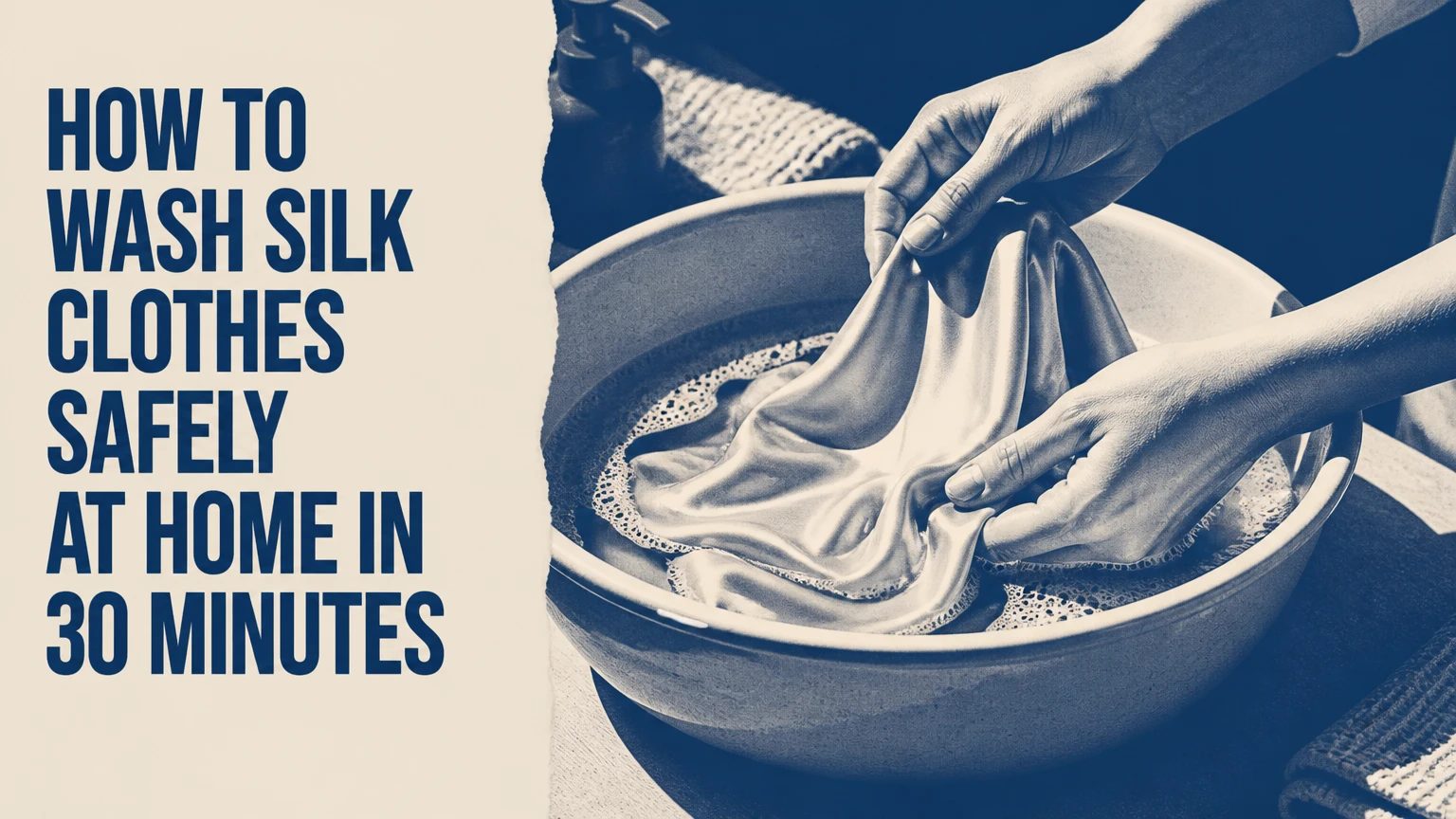
Silk clothes are safest when washed according to their care label in cool water, with a small amount of pH-neutral liquid detergent and minimal friction. For washable silk, gently hand-wash for about 5 minutes, rinse without twisting, remove water with a towel, and air-dry away from heat and direct sunlight.
Key Facts at a Glance
- Washable silk normally needs cool water between 20°C and 30°C, unless the care label specifies another method.
- Silk detergent or a mild wool wash is safer than biological, enzyme-based, alkaline, or bleach-containing laundry products.
- Wet silk is weakest when stretched, so do not wring, twist, scrub, or lift a heavy garment from one shoulder.
- Flat drying is safer for wet silk than hanging, because water can lengthen or distort unsupported fabric.
- A “dry clean only” label, unstable dye, lining, interfacing, pleats, heavy beading, or severe stain makes professional cleaning the safer choice.
- Typical home hand-washing cost is under $1 per garment, while professional dry cleaning commonly costs $10-$30.
Before You Wash Silk
Prepare the garment and washing area before adding water. Silk care fails most often because a person discovers a loose button, unstable dye, or unsuitable detergent after the fabric is already wet.
Read the Care Label First
The care label is the controlling instruction because silk garments differ in weave, dye, finish, lining, and construction. A washable silk blouse and a tailored silk jacket may contain the same fiber but require different cleaning methods.
Look for these instructions:
| Label or garment feature | Recommended method | Reason |
|---|---|---|
| “Hand wash,” 30°C basin symbol | Hand-wash at 20-30°C | The garment is designed for controlled water cleaning |
| “Machine wash,” silk or delicate cycle | Mesh bag, cold cycle, low spin | The manufacturer has tested limited mechanical action |
| “Dry clean only” | Professional cleaner | Construction, dye, or finish may not tolerate water |
| Lined jacket or suit | Dry clean unless label permits water | Interfacing and lining can shrink differently |
| Sequins, beads, metallic thread | Specialist cleaner | Embellishments can snag, tarnish, or bleed |
| Vintage, painted, or hand-dyed silk | Textile specialist | Dye and finish may be unusually unstable |
Close zippers, fasten hooks, remove detachable belts, and empty pockets. Turn printed or dark silk inside out, but do not turn a heavily embellished item inside out if the decoration can catch.
Test for Colorfastness
Dab a hidden seam with a white cloth dampened with cool water. Press rather than rub, then inspect the cloth after 10 seconds. Dye transfer means home washing carries a high risk of streaks, pale patches, or color migration.
A colorfastness test is useful but not definitive. Some dyes bleed only after detergent is added, while some water-sensitive finishes develop rings during drying. Stop and use a cleaner if the test shows transfer or if the garment has a high-contrast print.
Gather the Correct Tools
Use a clean basin, white towel, mesh laundry bag for machine washing, and a padded drying surface. White materials make dye transfer visible and reduce the risk of colored towel dye transferring to pale silk.
| Tool or material | Typical quantity | Function |
|---|---|---|
| Cool water | 4-8 liters | Provides enough room for free movement |
| Silk or wool detergent | 2.5-5 milliliters | Cleans without excessive alkalinity or foam |
| Clean white towels | 1-2 towels | Removes water without twisting |
| Soft mesh bag | 1 garment per bag | Reduces machine snagging and abrasion |
| Padded drying rack or towel-covered surface | 1 surface | Supports silk while it dries |
| White cotton cloth | 1 cloth | Tests dye stability and spot treatments |
How to Wash Silk Clothes by Hand
Hand-washing is the safest home method for a washable silk blouse, camisole, scarf, pillowcase, or lightweight dress because the washer does not add uncontrolled friction. Allow 20-30 minutes in total, although the garment usually spends only 3-5 minutes in the detergent bath.
Step 1: Fill a Clean Basin
Fill a basin with cool or lukewarm water at approximately 20-30°C. Water should feel neither hot nor noticeably warm to your hand, because heat increases the risk of shrinkage, finish change, and dye movement.
Mix detergent into the water before placing silk inside. Use approximately 2.5 milliliters, or half a teaspoon, for 4 liters of water; concentrated products may require less.
You will know the bath is ready when the detergent is dispersed and no thick streaks remain. A common mistake is pouring detergent directly onto dry silk, which can create a concentrated pale or dark mark.
Step 2: Submerge and Move the Garment Gently
Place the garment fully under the water and press it down with open hands. Swirl it slowly for 3-5 minutes, then leave it still for another 2 minutes if it has body odor or light perspiration.
Do not scrub collars, rub underarms, brush the surface, or knead the fabric. Silk fibers can develop permanent abrasion, fuzzing, or uneven sheen from localized friction even when the stain appears minor.
The garment is adequately cleaned when the water has reached all surfaces and odor has reduced. Agitating longer than 5 minutes rarely improves cleaning but increases handling damage.
Step 3: Rinse Until the Water Runs Clear
Drain the wash water and refill the basin with cool water. Lift the garment with both hands, lower it into the rinse water, and press gently; repeat until no visible detergent remains.
Two or three rinses are typical for a lightly soiled item. Heavy detergent residue can leave silk stiff, dull, or slightly sticky after drying.
Avoid holding wet silk from one narrow shoulder or sleeve. The garment is ready for water removal when the rinse water contains no visible foam and the fabric no longer feels slippery from soap.
Step 4: Remove Water Without Wringing
Lay the rinsed garment flat on a clean white towel. Roll the towel and garment together from one end, then press the roll gently with your hands for 10-20 seconds.
Unroll and repeat with a dry towel if the silk remains saturated. Never twist the garment, hang it while dripping wet, or squeeze it into a tight ball.
The correct endpoint is damp silk that no longer releases a stream of water when pressed. A frequent mistake is using a high-pressure spin cycle to save time, which can set wrinkles and pull seams.
Step 5: Reshape and Air-Dry
Lay silk flat on a dry towel or mesh rack in its natural dimensions. Align side seams, smooth the hem, and reshape collars before leaving the garment to dry indoors away from radiators, heaters, windows with direct sun, and strong airflow.
Flat drying is especially important for charmeuse, satin, chiffon, bias-cut garments, sweaters, and heavy silk bedding. A padded hanger is acceptable only after most water has been removed and the item is light enough not to stretch.
Silk is dry when the thickest seam and waistband feel completely cool and dry. Do not use a tumble dryer, even on low heat, unless the garment manufacturer explicitly permits it.
What Detergent Is Safe for Silk?
A pH-neutral liquid detergent labeled for silk or wool is the best routine choice because silk is a protein fiber that can be weakened by strong alkalinity and protease enzymes. Use the smallest stated dose, since excess detergent is difficult to rinse from tightly woven fabric.
| Product type | Silk suitability | Typical use | Main risk |
|---|---|---|---|
| Silk detergent | Preferred | 2.5-5 ml per 4 liters | Overdosing leaves residue |
| Mild wool wash | Usually suitable | Label dose, often 5 ml | Fragrance or additives may irritate |
| Ordinary non-biological liquid detergent | Conditional | Half normal dose | Some formulas remain too alkaline |
| Biological or enzyme detergent | Avoid | 0 ml | Protease can attack protein fibers |
| Baby shampoo | Emergency-only | 1-2 drops in 4 liters | Conditioners and fragrance can coat silk |
| Chlorine or oxygen bleach | Avoid unless label says otherwise | 0 ml | Can weaken, yellow, or alter dye |
Baby shampoo is not a preferred silk cleaner. It may be less aggressive than laundry powder, but many formulas contain conditioners, fragrance, oils, or surfactants that leave a film. Test an inconspicuous area and use a dedicated silk wash when possible.
White vinegar is also optional, not a universal silk treatment. It can help neutralize alkaline residue in some rinse systems, but vinegar does not reliably restore silk shine, and concentrated acid can affect dyes or finishes. Never combine vinegar with bleach.
Can Silk Go in the Washing Machine?
Silk can go in a washing machine only when the care label explicitly permits machine washing. Use a mesh bag, a cold silk or delicate cycle, low spin, and a small load; machine washing remains riskier than hand-washing because friction and drum movement are less controllable.
Machine-Washing Settings
| Setting | Safer specification | Avoid |
|---|---|---|
| Water temperature | Cold or 20°C | 30°C-plus hot cycles |
| Cycle | Silk, hand-wash, or delicate | Cotton, intensive, sanitary |
| Spin speed | 400-600 rpm maximum | 800-1,400 rpm |
| Load size | 1-3 lightweight items | Full drum or heavy towels |
| Detergent | 2.5-5 ml silk wash | Powder, pods, enzyme detergent |
| Protection | One mesh bag per item | Loose washing with zippers |
Place the garment inside a loosely packed mesh bag. Wash silk with similarly lightweight, smooth items, never with denim, towels, hook-and-loop fasteners, or garments with exposed metal.
Remove silk immediately when the cycle ends. Reshape it while damp and dry it flat. The machine method is convenient for robust silk twill, some sandwashed silk, and labeled silk bedding, but it is a poor choice for chiffon, bias-cut satin, vintage silk, or structured garments.
Which Silk Cleaning Method Should You Choose?
Hand-washing is the best general home method, machine washing is acceptable for label-approved robust items, and dry cleaning is safer for structured or unstable garments. The deciding factors are care-label permission, garment construction, dye stability, embellishment, and stain severity.
| Method | Typical cost | Typical time | Best candidates | Main failure risk |
|---|---|---|---|---|
| Hand wash | $0.25-$1 | 20-30 minutes | Blouses, scarves, camisoles | Wringing or poor drying |
| Machine wash | $0.15-$0.75 | 35-60 minutes | Label-approved twill, bedding | Friction, pulls, deep wrinkles |
| Dry cleaning | $10-$30 | 1-3 days | Suits, lined dresses, unstable prints | Solvent odor or finish change |
| Specialist textile cleaning | $25-$100-plus | 3-14 days | Vintage, painted, heirloom silk | Cost and limited availability |
When Is Dry Cleaning the Better Choice?
Choose professional cleaning for a “dry clean only” garment, tailored jacket, lined dress, silk velvet, pleated item, garment with glued interfacing, or piece with beads, sequins, metallic thread, or extensive color contrast.
Tell the cleaner about oil, perfume, perspiration, ink, dye transfer, and previous spot treatments. A cleaner needs the stain history because applying water or heat after an unsuccessful home treatment can make the mark harder to remove.
Dry cleaning is not automatically harmless. Solvents, pressing, and repeated finishing can alter delicate coatings, so use a cleaner experienced with silk rather than requesting generic cleaning for a valuable garment.
How Often Should Silk Clothes Be Washed?
Wash silk after heavy perspiration, visible soil, food contact, or strong odor; otherwise, a lightweight blouse may need cleaning after 1-3 wears, while a scarf worn over clothing may need cleaning every 4-8 wears. Silk pillowcases typically need washing every 3-7 days because they contact skin, hair, and facial products.
| Item | Typical interval | Wash sooner when | Practical care between wears |
|---|---|---|---|
| Silk blouse | Every 1-3 wears | Underarm sweat or deodorant marks | Air for 12-24 hours |
| Silk camisole | Every 1 wear | Direct skin contact | Do not store damp |
| Silk scarf | Every 4-8 wears | Makeup, rain, food, perfume | Fold loosely |
| Silk pillowcase | Every 3-7 days | Oily skin or hair products | Keep two or more cases |
| Silk duvet cover | Every 1-2 weeks | Night sweating or illness | Air before remaking |
| Silk suit jacket | After 3-8 wears | Stains or odor | Brush lint, air overnight |
Overwashing is also damaging because each wetting, drying, and pressing cycle adds handling. Airing silk removes some odor, but it does not replace washing after sweat, body oils, or stains.
How Do You Remove Stains From Silk?
Treat a fresh stain by blotting immediately with a dry white cloth, then follow the care label and fabric-specific method; do not scrub, apply an enzyme stain remover, or pour water onto an unknown mark. Oil, makeup, ink, and dye-transfer stains often require a professional cleaner.
Stain Response by Type
| Stain | First action | Home treatment limit | Safer next step |
|---|---|---|---|
| Water-based drink | Blot from the outside inward | Cool-water rinse if washable | Cleaner if ring remains |
| Oil or butter | Lift excess with a blunt edge | Do not add powder or solvent | Professional spot treatment |
| Makeup | Blot, do not spread | Avoid rubbing foundation into weave | Cleaner for set marks |
| Blood | Cold-water blot only | No hot water or bleach | Professional cleaning |
| Ink | Isolate garment | Do not use alcohol casually | Cleaner immediately |
| Dye transfer | Keep garment damp only if label permits | Do not wash repeatedly | Specialist cleaner |
Do not use baking soda, lemon juice, hydrogen peroxide, chlorine bleach, or undiluted vinegar as improvised silk remedies. These products can change pH, alter dye, or create a larger ring than the original stain.
How Should Silk Be Dried and Ironed?
Dry silk indoors with low handling and no direct heat, preferably flat until it is nearly dry. Iron silk inside out on the lowest setting recommended by the label, using a pressing cloth when the fabric is dry or when the finish is especially glossy.
| Finish or garment | Drying position | Iron approach | Heat guidance |
|---|---|---|---|
| Lightweight blouse | Flat or supported mesh | Inside out | About 110°C, label permitting |
| Satin or charmeuse | Flat, away from sun | Pressing cloth, no steam first | Lowest silk setting |
| Scarf | Flat with edges aligned | Short passes on reverse | Low heat |
| Silk twill | Flat or broad padded hanger when nearly dry | Reverse side | Low to medium only if labeled |
| Structured jacket | Professional finishing preferred | Cleaner’s press | Follow garment label |
A hanger can leave shoulder points and lengthen wet fabric. A hot iron can flatten the pile of silk velvet, create permanent glazing on satin, or set wrinkles into fabric that dried unevenly.
Steam is not automatically safer. Excess steam can create water spots or relax creases unevenly, so test inside a hem and keep the iron moving.
What Causes Silk to Shrink, Fade, or Feel Stiff?
Silk shrinkage and texture change usually result from heat, agitation, alkaline detergent, uneven wetting, or incorrect drying rather than water alone. Water temporarily changes the fiber’s physical state, while heat and mechanical stress can lock in distortion, dullness, or seam puckering.
Silk Became Stiff
Stiffness usually indicates detergent residue, mineral deposits, or a finish that changed during washing. Rinse a label-approved washable item twice in cool water, press water out with a towel, and dry it flat.
Do not automatically add vinegar. If the stiffness remains, stop home treatments because the coating or fiber may have been altered.
Silk Has Water Rings
Water rings occur when part of the fabric becomes wet and dries at a different rate from the surrounding area. For washable silk, re-wet the entire affected panel evenly with cool water, then dry the garment flat; spot-wetting the ring again usually makes the boundary more visible.
Silk Looks Dull
Dullness can come from residue, abrasion, heat, or iron glazing. Rinse residue from washable silk, avoid brushing the surface, and press the reverse side through a thin cloth at the lowest label-approved temperature.
Silk’s original sheen cannot always be restored after fiber abrasion or heat damage. A new shine created by aggressive ironing may actually be flattened fibers, not healthy fabric.
Silk Shrunk or Seams Puckered
Home washing cannot reliably reverse heat-set shrinkage or differential shrinkage between silk, lining, and interfacing. Do not stretch the garment aggressively while wet, because that can distort the grain and enlarge stress at seams.
A professional cleaner or tailor may improve shape, but restoration is not guaranteed. This is one reason the care label matters more than a generic silk-washing recipe.
Silk Has a Pull or Snag
Do not cut the loose thread. Turn the garment inside out and use a fine needle to ease the thread back toward the wrong side, then stop if the weave has opened or the snag runs across a seam.
Silk Care Rules for Specific Items
Silk items need different handling because weight, weave, surface finish, and construction change the damage risk. Pillowcases and scarves are often washable, while lined dresses and silk suits need label-led professional care.
Pillowcases and Bedding
Wash silk pillowcases inside out in a mesh bag on a cold delicate cycle only when the label permits machine washing. Use a small detergent dose, wash every 3-7 days, remove immediately, and dry flat or over a broad support after towel-pressing.
Large sheets can twist around the agitator or create heavy wet loads. Hand-washing a fitted silk sheet is laborious, so a specialist cleaner may be more practical if the care label excludes machine washing.
Silk Blouses and Dresses
Lightweight, unlined blouses are the best candidates for careful hand-washing. Check underarms, cuffs, and neckline because deodorant, body oil, and makeup may need targeted professional treatment.
A lined dress should not be treated like a simple blouse. The outer silk may survive water while the lining, seam tape, fusible interfacing, or dye does not.
Scarves and Silk Ties
Wash a scarf only if its label permits it, and dry it flat with the edges aligned. Silk ties are commonly cut on the bias and may contain interlining, so dry cleaning or careful spot treatment is safer than immersion.
Never wring a scarf to remove water. Never hang a wet tie by its narrow end.
Silk Sarees and Vintage Silk
A silk saree may include zari, embroidery, contrast borders, unstable dyes, or starch finishes that make generic washing advice unsafe. Use a specialist familiar with Indian textiles for valuable sarees, heirlooms, hand-painted silk, and vintage garments.
Common Mistakes and How to Fix Them
- Using hot water: Stop the cycle, rinse in cool water if the label permits, and dry flat without stretching. Heat-set shrinkage may be permanent.
- Applying detergent directly: Rinse the area promptly in cool water. Do not rub the concentrated mark.
- Wringing or twisting: Lay the garment flat and towel-roll it. Reshape gently while damp.
- Using biological detergent: Rinse thoroughly and stop further enzyme exposure. A cleaner may be needed if weakening or discoloration appears.
- Hanging dripping-wet silk: Transfer the garment to a flat towel or mesh surface. Align seams before drying.
- Ironing the right side: Turn the garment inside out and use a pressing cloth. Glazing from high heat may not reverse.
- Treating one spot repeatedly: Stop when the stain spreads or a ring forms. Additional home chemistry increases damage risk.
One practitioner rule is worth remembering: if a garment is expensive enough that replacement would be painful, do not experiment on its visible surface. Test a hidden seam, follow the label, and stop after one controlled treatment.
Time and Cost by Cleaning Method
Home washing is inexpensive, but the true cost includes drying space, detergent, and the risk of damaging a garment that cannot be replaced. Professional cleaning costs more but can be economical for tailored, embellished, or high-value silk.
| Cleaning scenario | Typical direct cost | Active time | Total turnaround | Best decision |
|---|---|---|---|---|
| Light silk blouse, hand-washed | $0.25-$1 | 10 minutes | 4-12 hours drying | Wash at home if labeled |
| Two silk pillowcases, machine-washed | $0.30-$1.50 | 5 minutes | 2-6 hours drying | Machine wash if permitted |
| Silk scarf, hand-washed | $0.10-$0.50 | 8 minutes | 4-12 hours drying | Hand-wash if colorfast |
| Lined silk dress, dry-cleaned | $15-$35 | 5 minutes drop-off | 1-3 days | Professional cleaner |
| Vintage or embellished silk | $25-$100-plus | 10 minutes drop-off | 3-14 days | Textile specialist |
Frequently Asked Questions
Can I Wash Silk With Regular Laundry Detergent?
Use regular detergent only if the formula is mild, non-biological, liquid, and permitted by the garment label. Dedicated silk or wool detergent is safer because ordinary products may contain enzymes, optical brighteners, fragrance, or alkaline builders that can affect silk fibers and dyes.
Can I Use Fabric Softener on Silk?
Avoid fabric softener unless the garment manufacturer specifically permits it. Fabric softener can leave a coating that changes absorbency, dulls the surface, attracts residue, and interferes with the natural hand of silk. Proper rinsing is a better way to remove detergent film.
Can I Wash White Silk With Colored Silk?
Do not combine white silk with colored silk unless each item has passed a colorfastness test and the label permits the same method. Wash white silk separately for the first few cleanings because dye release can occur even when a dry garment appears stable.
Can Silk Be Washed in Cold Water Only?
Cold water is the safest default for washable silk, but the care label may permit a controlled 30°C wash. Water temperature alone does not prevent damage: detergent chemistry, friction, spin speed, dye stability, and drying position also determine the result.
How Do I Store Silk After Washing?
Store completely dry silk folded loosely in a cool, dark, ventilated drawer or wardrobe. Avoid plastic bags for long-term storage, direct sunlight, damp closets, rough cardboard, and tight clips that can leave pressure marks or attract moisture-related mildew.
Is Dry Cleaning Always Safer Than Hand-Washing Silk?
Dry cleaning is safer for structured, embellished, lined, unstable, or label-restricted silk, but it is not automatically safer for every item. Solvents and pressing can alter some finishes, so a cleaner experienced with silk should follow the manufacturer’s instructions and inspect the garment before treatment.
The Bottom Line
The safest answer to how to wash silk clothes is to read the care label, test for dye transfer, use 20-30°C water and a pH-neutral silk detergent, and handle the garment with almost no friction. Hand-wash suitable items for 3-5 minutes, towel-press instead of wringing, reshape, and air-dry flat away from sunlight and heat. Choose machine washing only when expressly permitted, and send structured, embellished, unstable, or valuable silk to an experienced professional.