Carpet cleaning is generally safe for kids when the cleaner uses a labeled product correctly, removes cleaning solution thoroughly, ventilates the room, and dries the carpet completely before children return. The main risks are wet surfaces, chemical vapors, residue, burns, slips, and hidden moisture, not the act of removing ordinary dirt.
Key Facts at a Glance
- Hot water extraction is usually suitable for children’s carpets when the carpet manufacturer permits wet cleaning and the technician performs adequate extraction and drying.
- A carpet should be dry before crawling, playing, or sleeping on it. Typical professional drying takes 6-12 hours, while over-wet carpet can remain damp for 24 hours or longer.
- Fragrance-free does not automatically mean non-toxic. Read the product label and Safety Data Sheet, and follow the stated re-entry instructions.
- Heat does not prove that a carpet is disinfected. A carpet-cleaning wand may use hot water, but contact temperature, exposure time, fiber type, and extraction determine the result.
- EPA Safer Choice identifies products whose ingredients meet EPA safety criteria for their intended use. The label does not mean a product can be applied without ventilation or dilution.
- Lead dust, pesticide residue, sewage, and visible mold require hazard-specific controls. Routine carpet cleaning alone cannot certify that these contaminants are gone.
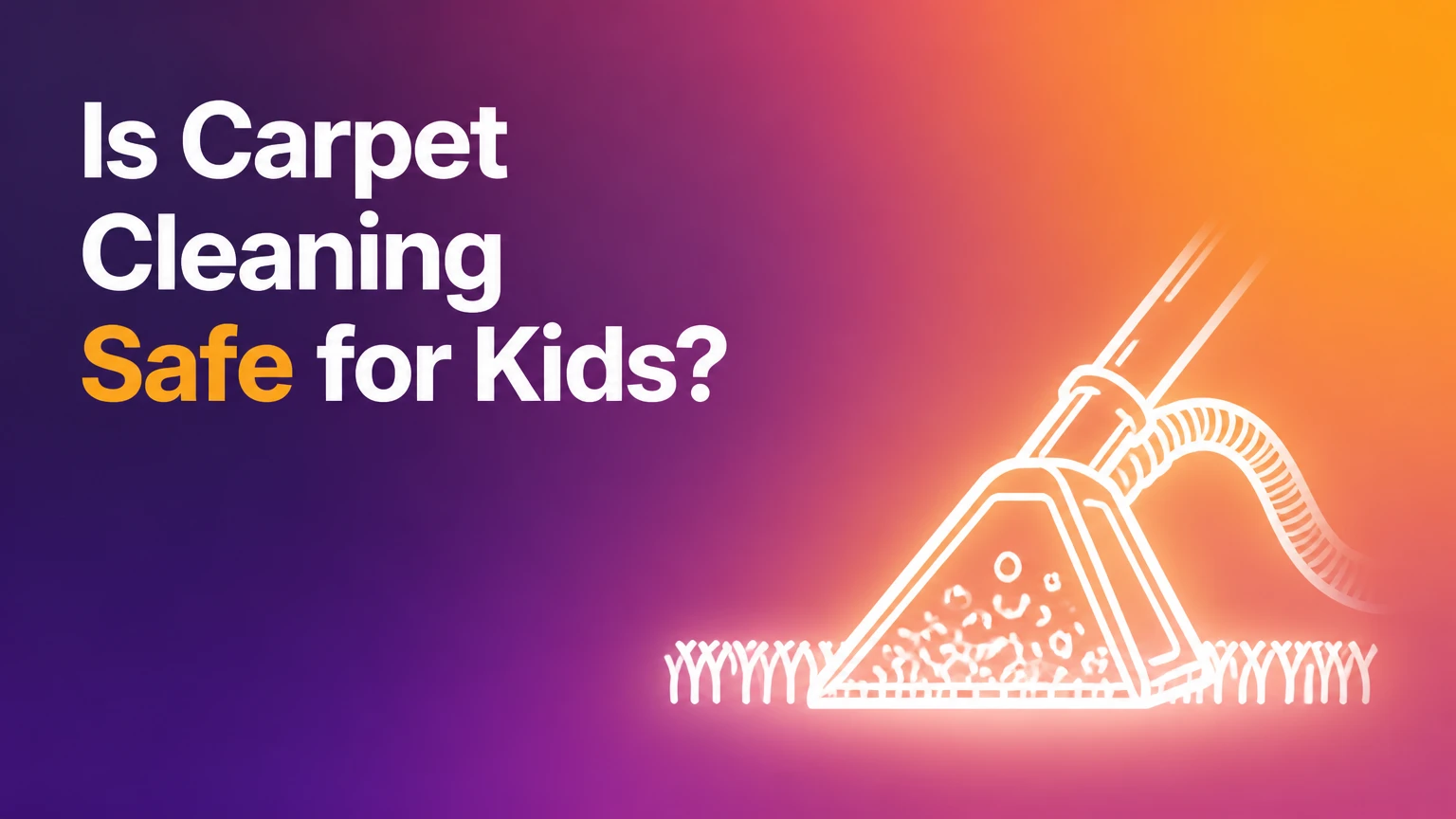
Is Carpet Cleaning Safe for Kids?
Carpet cleaning is safe for most children after the carpet has dried and the cleaning product’s re-entry directions have been met. Families should use greater caution when a child has asthma, eczema, chemical sensitivity, or a compromised immune system because fragrances, aerosols, dampness, and residual products can aggravate symptoms.
Children spend more time close to carpet than adults do. Crawling, floor play, hand-to-mouth behavior, and contact with toys placed on the floor increase exposure to settled dust. The American Academy of Pediatrics has linked indoor environmental exposures with respiratory and allergic effects, but a clean carpet is not automatically healthier if cleaning creates persistent dampness or strong fumes.
The safety question therefore has four parts:
- What contamination is present?
- Which process and chemical will be used?
- How much solution will remain after extraction?
- When will the carpet be fully dry and adequately ventilated?
A child should not enter during application, while a machine is operating, or while the carpet is wet. Keep toys, pacifiers, and blankets away from the work area until surfaces are dry.
Why Can Carpet Cleaning Help Children?
Carpet cleaning can reduce accumulated soil and some allergen-bearing particles, but it cannot eliminate every allergen or guarantee a lower asthma risk. Removal works best when cleaning is combined with frequent HEPA-filtered vacuuming, humidity control, prompt spill treatment, and source control for pets, leaks, and smoke.
The U.S. Environmental Protection Agency recommends source control, ventilation, and filtration as the main indoor-air-quality strategies. Cleaning can remove settled material from carpet, yet agitation may temporarily redistribute particles into the air. A sealed HEPA vacuum and ventilation reduce that secondary exposure.
Carpet is a reservoir, not a single contaminant. Typical household carpet may contain:
| Contaminant | Common route onto carpet | What cleaning can do | What it cannot prove |
|---|---|---|---|
| House-dust particles | Skin, clothing, outdoor soil | Remove loose and embedded soil | Eliminate all dust exposure |
| Pet dander | Shedding and air circulation | Extract some deposited dander | Remove dander from upholstery and air |
| Dust-mite debris | Humid rooms and fabric dust | Reduce surface loading | Eradicate mites without moisture control |
| Mold growth | Leaks, flooding, condensation | Remove limited surface soil | Remediate contaminated padding or subfloor |
| Pesticide residue | Outdoor shoes and yard treatments | Remove some particulate residue | Decontaminate chemically affected materials |
| Lead-containing dust | Older paint, renovation, soil | Potentially remove surface dust under controls | Confirm lead clearance without testing |
Lead and pesticide contamination change the procedure. Do not dry-brush, aggressively agitate, or use a household vacuum on suspected lead dust before receiving qualified advice. The EPA’s lead-safe work practices and local public-health guidance take priority over ordinary carpet maintenance.
How Does Child-Safe Carpet Cleaning Work?
A child-safe carpet-cleaning process combines controlled product application, mechanical soil removal, high-quality extraction, ventilation, and moisture verification. The process is safe because exposure is controlled, not because every “green” or natural ingredient is harmless.
A typical professional workflow uses the following sequence:
- Inspect the carpet. The technician identifies fiber type, backing, stains, colorfastness, delamination risk, and previous chemical treatments.
- Remove dry soil. A HEPA-equipped vacuum collects loose particulate before moisture turns it into slurry.
- Test the solution. A hidden area is checked for dye bleeding, browning, texture changes, and odor.
- Apply the minimum effective pre-spray. The product label determines dilution, dwell time, ventilation, and protective measures.
- Agitate where appropriate. Brush action improves soil release, but delicate wool and loose pile need gentler handling.
- Rinse and extract. The machine removes suspended soil and cleaning solution through multiple vacuum passes.
- Dry the carpet. Air movers, ventilation, and reasonable indoor humidity shorten drying time.
- Inspect before re-entry. The carpet should feel dry rather than cool and wet, show no pooling, and have no persistent irritating odor.
The EPA’s mold guidance states, “The key to mold control is moisture control.” That principle applies after carpet cleaning: rapid drying matters more than a marketing claim about plant-derived ingredients.
What Should a Professional Cleaner Tell Parents?
A reputable cleaner should identify the exact product, dilution, method, expected drying period, and re-entry instruction before work begins. “Non-toxic” without a product name or label is not a useful safety specification.
Ask for:
- Product name and manufacturer
- Current label and Safety Data Sheet
- Fragrance and solvent information
- Carpet fiber compatibility
- Estimated moisture and drying time
- Extraction equipment type
- Air-movement plan
- Procedure for padding or subfloor moisture
- Instructions for children with asthma or allergies
A technician should not promise that hot water “sanitizes” every carpet. Carpet fibers, padding, and subfloors are porous, and many organisms require validated disinfectant concentrations and contact times that ordinary carpet extraction does not provide.
Which Carpet Cleaning Method Is Safest for Kids?
Hot water extraction is usually the best general-purpose option for a family home when the carpet tolerates moisture and the operator extracts thoroughly. Low-moisture methods may be safer for a household that cannot keep children away for many hours, but they can leave particulate or polymer material that still requires complete vacuuming.
| Method | Typical drying or re-entry time | Residue and exposure profile | Best fit |
|---|---|---|---|
| Hot water extraction | 6-12 hours | Low residue with a thorough rinse and extraction | Deep routine cleaning |
| Encapsulation | 1-4 hours | Polymer residue remains until vacuumed | Maintenance cleaning and moderate soil |
| Dry compound | 30-90 minutes | Powder must be fully vacuumed | Short access windows |
| Carpet shampooing | 4-12 hours | Higher risk of sticky detergent residue | Older systems or limited use |
| Steam vapor cleaning | 1-3 hours on some surfaces | May leave little liquid, but limited soil removal | Spot work and hard surfaces |
“Steam cleaning” commonly refers to hot water extraction in residential marketing. True steam vapor cleaning is a different low-moisture process and is not automatically better for carpet soil, allergens, or child safety.
Does Hot Water Extraction Kill Dust Mites and Germs?
Hot water extraction can remove dust, allergen-bearing particles, and microorganisms suspended in the extracted liquid, but ordinary carpet cleaning should not be described as sterilization. A machine’s water temperature is not the same as the temperature maintained throughout the carpet for a validated microbial kill time.
The Centers for Disease Control and Prevention distinguishes cleaning from disinfection: cleaning removes dirt and some germs, while disinfection uses a product intended to kill specified pathogens on a surface. Use a registered disinfectant only when the label permits carpet or soft-surface application.
For routine family carpets, removal and drying are usually more important than adding a sanitizer. Disinfectants can increase residue, odor, irritation, and fiber damage when used outside their label directions.
Which Carpet-Cleaning Chemicals Should Parents Avoid?
Parents should avoid products with undisclosed ingredients, strong fragrances, unvented solvent fumes, or directions that conflict with the carpet manufacturer. No universal “dangerous ingredients” blacklist accurately predicts risk because concentration, exposure route, ventilation, and intended use determine the hazard.
Use the label and SDS to check for:
| Product feature | Primary concern | Safer purchasing question |
|---|---|---|
| Added fragrance or perfume | Odor sensitivity and respiratory irritation | Is an unscented version available? |
| Solvent-heavy spotter | Vapor and skin exposure | Is water-based extraction suitable? |
| Quaternary ammonium disinfectant | Residue and respiratory irritation | Is disinfection actually required? |
| Optical brightener | Residual product and unnecessary exposure | Does the formula clean without brighteners? |
| High-alkaline detergent | Skin, fiber, and residue concerns | What rinse neutralizes the product? |
| Aerosol or powdered application | Airborne inhalation during use | Can the product be applied without airborne dust? |
The EPA Safer Choice label is more useful than the words “natural,” “organic,” or “baby-safe.” Safer Choice evaluates ingredients and product performance for specified uses, but parents still need to follow the label, keep children away during use, and allow the carpet to dry.
Citrus terpenes can irritate skin or trigger fragrance sensitivity. Baking soda can leave particulate residue if overapplied. Hydrogen peroxide can bleach or discolor fibers. Vinegar can damage some carpet fibers, affect dyes, and fail to remove a sticky detergent film. Natural does not mean universally suitable.
How Long Should Kids Stay Off a Cleaned Carpet?
Children should stay off carpet until it is fully dry, the room has been ventilated, and the product label’s re-entry period has passed. Typical professional extraction requires 6-12 hours, while thick pile, humid weather, dense padding, poor airflow, or over-wetting can extend drying beyond 24 hours.
Use these practical checks:
- Press a clean, dry towel firmly into the carpet for 10 seconds.
- Check whether the towel remains dry.
- Feel the pile and backing for cool, wet areas.
- Confirm that no room-wide chemical odor remains.
- Keep furniture legs and toys off damp sections.
- Use fans without creating a trip hazard.
A carpet can feel dry on top while padding remains wet underneath. If dampness, musty odor, or bubbling persists after 24 hours, contact the cleaner. If the area remains wet for 48 hours, request moisture assessment and consider professional water-damage advice rather than applying more chemicals.
Is Carpet Cleaning Safe for Babies and Crawling Toddlers?
Carpet cleaning is safe for babies and toddlers after complete drying and ventilation, but crawling children need stricter access control than older children. Infants contact the pile with hands, knees, clothing, and toys, so families should use a dry, clean play surface until the carpet passes the towel test.
For a nursery or playroom:
- Remove toys, bottles, bedding, and floor mats before cleaning.
- Ask for fragrance-free, low-residue products.
- Keep the crib and changing supplies outside the work area.
- Request extra extraction passes rather than extra detergent.
- Ventilate without exposing the child to outdoor pollution or extreme temperatures.
- Wait until the carpet is dry and odor-free.
A washable play mat can reduce direct contact during the drying period. Do not place a baby on a damp rug merely because the surface feels only slightly cool.
What Changes for Children With Asthma, Allergies, or Eczema?
Children with asthma, allergies, or eczema may need fragrance-free products, stronger ventilation, and a longer observation period after cleaning. Carpet cleaning does not replace asthma medication, dust-mite control, medical evaluation, or an allergy-management plan.
| Child or household condition | Preferred control | Avoid or reconsider |
|---|---|---|
| Asthma | Sealed HEPA vacuuming, low odor, dry carpet | Aerosols, fragrance, airborne powders |
| Dust-mite allergy | Moisture control below roughly 50% indoor relative humidity | Repeated wet cleaning without drying |
| Eczema or sensitive skin | Fragrance-free rinse, dry clothing, clean play mat | Residual detergent and scented deodorizer |
| Immune suppression | Professional assessment for mold or sewage | DIY disturbance of contaminated padding |
| Newborn in nursery | Schedule cleaning before occupancy and dry fully | Same-day crawling on damp carpet |
The American Lung Association advises reducing irritants and controlling indoor pollutants for people with asthma. A child who develops coughing, wheezing, eye irritation, rash, or breathing difficulty after cleaning should leave the area. Seek urgent medical care for breathing difficulty, and contact Poison Control in the United States at 1-800-222-1222 for suspected product exposure.
Is Professional Carpet Cleaning Safer Than a DIY Rental Machine?
Professional cleaning is often safer for large areas, delicate fibers, severe soil, or homes where drying failure would create a health risk. A rental machine can work for a small synthetic carpet when the operator uses the correct solution, avoids over-wetting, and makes slow extraction passes.
| Factor | Professional service | DIY rental machine |
|---|---|---|
| Typical United States cost | $40-$90 per room for routine work | $35-$60 per day, plus solution |
| Equipment recovery | High-powered vacuum system | Variable, often lower recovery |
| Drying control | Air movers and trained extraction | Household fans and ventilation |
| Fiber assessment | Technician inspection | Homeowner judgment |
| Main failure mode | Excess solution or rushed work | Over-wetting and inadequate passes |
| Suitable access window | Usually 6-12 hours | Often 12-24 hours |
Typical United States prices vary by region, furniture, stairs, soil level, and minimum service charge. A whole-home appointment may cost less per room than a single-room visit, while stain treatment, odor work, and moving furniture add fees.
A DIY rental is a poor choice for suspected mold, sewage, lead dust, pesticide contamination, saturated padding, or wool carpet that lacks a suitable cleaning specification. The machine may spread contamination or force moisture into the backing.
Can Carpet Cleaning Cause Mold or Residue Problems?
Carpet cleaning can cause mold or residue problems when the operator applies too much solution, fails to extract it, blocks airflow, or cleans contaminated padding without addressing the moisture source. Sticky residue also attracts soil, creating a rapidly re-soiled surface that transfers material to hands and clothing.
| Warning sign after cleaning | Likely cause | Parent action |
|---|---|---|
| Musty odor after 12-24 hours | Damp padding or subfloor | Request moisture inspection |
| Crunchy or sticky pile | Detergent residue | Ask for a controlled rinse and extraction |
| Strong perfume odor | Fragrance or deodorizer | Ventilate and restrict access |
| Browning or dye bleed | Fiber or backing reaction | Stop home remedies and call cleaner |
| Persistent cough or eye irritation | Airborne irritant or odor | Leave room and seek medical advice if needed |
| Wrinkles or bubbles | Excess moisture or delamination | Document condition and contact technician |
Do not pour vinegar, bleach, baking soda, or peroxide onto the entire carpet to correct a cleaning failure. Home remedies can create new residue, discoloration, or chemical interactions. A professional rinse extraction is usually more predictable.
What If the Carpet Smells Strongly After Cleaning?
A strong odor means the area needs ventilation and restricted access, not air freshener. Open windows when outdoor conditions permit, operate exhaust fans, and follow the product label; keep children and pets away until the odor has dissipated and the carpet is dry.
If symptoms occur, move the child to fresh air. Call emergency services for severe breathing problems, confusion, collapse, or facial swelling. For a swallowed product or skin exposure, use the product label and Poison Control instructions rather than inducing vomiting or applying a neutralizer.
Which Carpet Is Easiest to Clean Safely?
Synthetic nylon and polyester carpets generally tolerate routine hot water extraction better than many natural fibers, but the manufacturer’s care code controls the method. Wool, viscose, jute, silk blends, and carpets with unstable dyes need fiber-specific cleaning because excess moisture can cause shrinkage, browning, bleeding, or texture change.
Before booking, identify:
- Fiber: nylon, polyester, polypropylene, wool, viscose, or blend
- Backing: woven, latex, glued, or delamination-prone
- Installation: wall-to-wall, loose rug, or carpet tile
- Age and warranty instructions
- Previous stain protectors or deodorizing treatments
- Water damage or visible microbial growth
A carpet technician should perform a small colorfastness test. Parents should not select a method solely because it has the shortest drying time. A fast process that leaves dust, powder, or residue can create more direct child exposure than a carefully extracted process that takes longer.
A Parent’s Safe Carpet-Cleaning Checklist
Use the following checklist before children return to the room:
- Confirm the carpet fiber and manufacturer cleaning code.
- Obtain the product name, label, and SDS.
- Choose fragrance-free, low-residue chemistry when practical.
- Remove children, pets, toys, food, and bedding.
- Ask how the technician will protect padding and subfloor.
- Request thorough extraction and air movement.
- Measure drying by touch and towel testing, not by a promised clock time.
- Ventilate according to the product label and household air-quality conditions.
- Keep children away while odor, dampness, or visible residue remains.
- Document any symptoms, stains, bubbling, or persistent moisture.
Three Practitioner Rules That Prevent Most Problems
More detergent does not mean cleaner carpet. Extra detergent increases rinse demand and residue risk. Soil suspension followed by complete extraction is more valuable than a heavily foamed application.
A dry pass is more useful than a deodorizer. Additional vacuum-only passes remove moisture and suspended soil; fragrance can mask a damp or contaminated backing.
The carpet surface is not the whole system. Padding and subfloor can hold water after the pile feels dry. A musty smell is a moisture signal, not a stain to cover.
Frequently Asked Questions
Can kids sleep in a room after carpet cleaning?
Kids can sleep in a professionally cleaned room once the carpet is fully dry, ventilation is complete, and the cleaning product label allows re-entry. For a child with asthma or chemical sensitivity, wait until there is no noticeable odor and consider using another room overnight if drying or ventilation is uncertain.
Is dry carpet cleaning safer than wet cleaning for children?
Dry carpet cleaning can reduce the waiting period, but it is not automatically safer. Powder and encapsulation products require complete vacuum removal, and airborne particles may irritate sensitive airways. Wet extraction is often preferable for embedded soil when the operator controls moisture and achieves complete drying.
Can carpet cleaner residue make a child sick?
Carpet-cleaner residue can irritate skin, eyes, or airways, particularly when detergent, fragrance, or disinfectant remains in the pile. A child who develops symptoms should leave the area, while parents should ventilate and contact a healthcare professional or Poison Control for suspected exposure.
How often should a family have carpets professionally cleaned?
Many households schedule professional cleaning every 12-18 months, with more frequent cleaning for heavy traffic, pets, spills, or allergy concerns. Vacuum high-traffic areas at least weekly, treat spills promptly, and correct humidity or leaks instead of using frequent wet cleaning as a substitute for source control.
Should carpets be removed if a child has asthma?
Carpet removal is not automatically necessary for a child with asthma. A well-maintained carpet with effective vacuuming, low indoor humidity, minimal fragrance, and no moisture damage may be acceptable. Removal becomes more reasonable when carpet or padding remains damp, moldy, persistently dusty, or impossible to clean effectively.
Is carpet cleaning safe for kids with pets at home?
Carpet cleaning is generally safe for kids and pets after drying, but animals should also remain out of the area during application and until the product label permits re-entry. Pet urine in padding may require replacement or specialized treatment, because surface cleaning alone can leave odor and contamination below the pile.
The Bottom Line
Is carpet cleaning safe for kids? Usually, yes, when the process uses a suitable product, controlled moisture, thorough extraction, ventilation, and complete drying. Hot water extraction is a strong general choice for compatible carpet, while low-moisture methods suit short access windows. Avoid unsupported “natural” claims, keep children away from damp or odorous carpet, and treat mold, lead, pesticide, sewage, and persistent moisture as separate hazards requiring specialized advice.