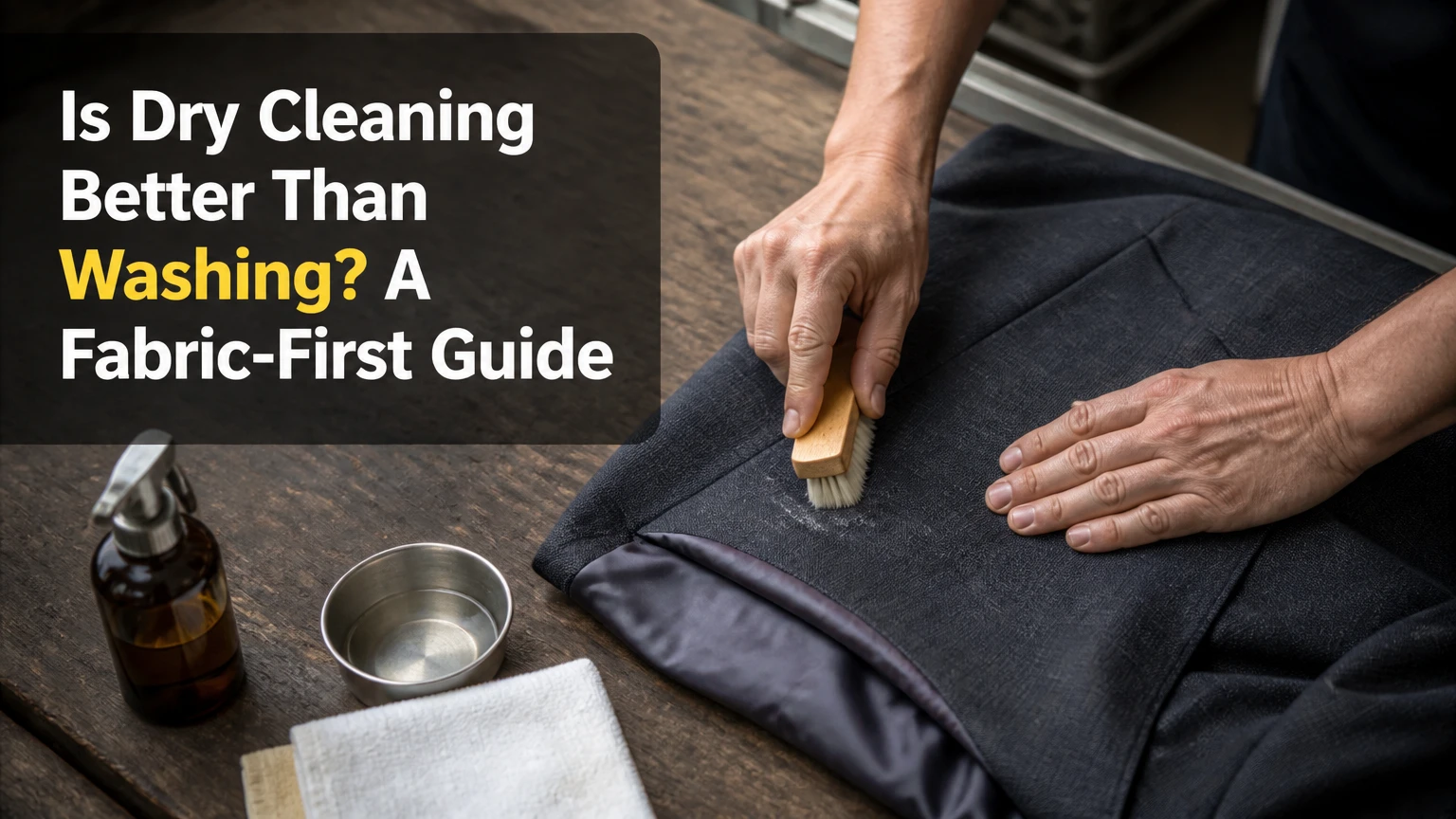
Dry cleaning is better than washing for structured, water-sensitive garments and oily stains, while washing is better for washable everyday clothing, sweat, mud, and water-soluble soil. Neither method is universally superior: the correct choice depends on the care label, fiber, garment construction, dye stability, stain chemistry, heat, and mechanical agitation.
Key Facts at a Glance
- Dry cleaning uses a liquid solvent rather than water, so it can reduce swelling and distortion in wool, silk, rayon, and tailored garments.
- Washing usually removes sweat, salt, mud, and water-soluble food residue more effectively than solvent cleaning.
- “Dry clean” and “dry clean only” are not identical instructions; the latter signals that home washing may create unacceptable risk.
- A care label does not guarantee that a garment will survive every professional process; trims, dyes, adhesives, and linings can still react.
- Typical home washing costs less than $2 per load in utilities and detergent, while professional dry cleaning commonly costs $3-$7 for a shirt and $15-$30 for a two-piece suit.
- Steaming, airing, brushing, and spot treatment can reduce cleaning frequency, which often protects garments better than either repeated washing or repeated dry cleaning.
What Is the Difference Between Dry Cleaning and Washing?
Dry cleaning removes soil with a liquid organic solvent, mechanical action, moisture control, and finishing equipment. Washing uses water, detergent, agitation, rinsing, extraction, and usually heat or air drying. The key difference is not whether the garment becomes wet, because dry-cleaning solvent is also a liquid; the difference is the liquid’s chemistry and its effect on fibers, dyes, finishes, and construction.
Water is polar, which makes it effective against salts, sugars, perspiration residue, and many water-based soils. Water can also swell some fibers, mobilize unstable dyes, and disturb the dimensions of wool, rayon, viscose, or interlinings. Dry-cleaning solvents dissolve many oils and greases while causing less swelling in certain fibers, although they do not remove every type of soil.
How does each cleaning process work?
Professional dry cleaning normally follows inspection, tagging, pre-spotting, solvent cleaning, extraction, drying, post-spotting, pressing, and final inspection. A technician’s stain diagnosis matters because protein, tannin, oil, ink, and adhesive stains require different treatments.
Washing begins with sorting, label-based temperature selection, detergent dosing, agitation, rinsing, spinning, and drying. Water temperature, cycle length, drum friction, spin speed, and dryer heat each affect the result. A cold, gentle wash and air drying present a very different risk profile from a hot, heavy-duty wash followed by high-heat tumble drying.
Which Method Is Safer for Clothing?
Dry cleaning is generally safer for tailored construction and water-sensitive fibers, while gentle washing is generally safer for durable, washable fabrics exposed to sweat and frequent body contact. Professional cleaning can still damage fragile dyes, coatings, buttons, sequins, leather trims, or adhesive-backed details, so the label and garment design remain decisive.
| Garment or material | Usually preferred method | Main reason | Main failure risk |
|---|---|---|---|
| Cotton T-shirt | Cold machine wash | Removes sweat and water-soluble soil | Shrinkage or print cracking from heat |
| Wool suit jacket | Professional dry cleaning or tested wet cleaning | Protects tailored shape and controls moisture | Fusible or canvas distortion |
| Silk blouse | Label-directed dry cleaning or professional wet cleaning | Limits uncontrolled swelling and dye movement | Water rings, color bleed, seam puckering |
| Polyester sportswear | Machine wash, usually cold | Releases perspiration and detergent-washable soil | Odor retention from fabric finish |
| Rayon or viscose dress | Label-directed professional cleaning | Fiber strength changes when wet | Stretching, shrinkage, or distortion |
| Linen shirt | Cold or lukewarm washing | Water-based soil responds well | Wrinkling and dimensional change |
| Leather or suede jacket | Specialist leather cleaning | Water and standard solvents can damage finish | Stiffness, dye loss, or rings |
| Sequined or beaded eveningwear | Specialist cleaner after inspection | Protects trims and backing | Melted, loosened, or solvent-sensitive decoration |
The Federal Trade Commission’s Care Labeling Rule requires care instructions on many garments sold in the United States, but a label is a recommended method rather than a promise of unlimited durability. A responsible cleaner should inspect the item, identify risks, and tell you when a stain or trim may not respond safely.
Does dry cleaning prevent shrinkage?
Dry cleaning can reduce shrinkage risk for some garments, but it cannot guarantee zero shrinkage. Water-related shrinkage depends on fiber type, yarn tension, fabric finishing, temperature, agitation, and drying; solvent cleaning can still cause dimensional change through heat, steam, pressing, or tension during finishing.
The frequently repeated claim that water causes every natural fiber to shrink by 10-20% and that dry cleaning keeps shrinkage below 1% is too broad to apply to ordinary garments. Some poorly finished wool or rayon items can change dramatically in water, while preshrunk cotton may change only slightly. A cleaner’s process and the garment’s original finishing history matter more than a universal percentage.
Which Fabrics and Garments Favor Dry Cleaning?
Structured garments, fragile surface finishes, and fibers with high wet-distortion risk usually favor professional dry cleaning or controlled professional wet cleaning. Durable cotton, linen, polyester, nylon, acrylic, and many washable blends usually favor water-based laundering because body soil and detergent-compatible stains respond better to water.
Dry cleaning is commonly appropriate for wool jackets, tailored trousers, formalwear, pleated garments, velvet, some silks, acetate linings, and clothing with internal structure. The recommendation becomes stronger when the garment contains shoulder pads, chest canvas, fusible interlinings, permanent pleats, multiple layers, or contrasting panels.
Washing is normally appropriate for T-shirts, underwear, towels, socks, denim, cotton bedding, athletic clothing, and washable synthetic outerwear. Hand washing is often preferable for delicate knits and lace when the label permits it, but hand washing does not remove the risk of dye bleeding, stretching, water rings, or poor drying.
Why does garment construction matter more than fiber alone?
Garment construction determines whether moisture and agitation can alter shape, bonding, or internal support. A wool shell may tolerate carefully controlled wet cleaning, yet the same wool in a fused suit jacket can develop bubbling when heat or water weakens the adhesive between layers.
| Construction feature | Water-washing risk | Dry-cleaning consideration | Practical decision |
|---|---|---|---|
| Fused jacket front | Adhesive bubbles or delamination | Lower moisture exposure, but heat still matters | Use label-directed professional care |
| Canvas chest piece | Shrinkage or shape loss | Gentle solvent process preserves tailoring | Avoid home washing |
| Pleated skirt | Pleats relax or shift | Finishing can restore pleats | Use specialist pressing |
| Waterproof coating | Coating may crack or strip | Solvent compatibility varies | Ask for coating-safe service |
| Elastic waistband | Heat accelerates elasticity loss | Solvent may leave finish intact | Cold wash and air dry if labeled |
| Bonded seams | Adhesive can soften or separate | Some solvents also attack adhesive | Require inspection before cleaning |
| Leather trim | Water staining or stiffness | Standard dry cleaning may extract oils | Use a leather specialist |
One practitioner rule is especially useful: if a garment must look three-dimensional when worn, treat its construction as more important than its fiber label. A “100% wool” T-shirt and a “100% wool” suit do not have the same cleaning risk.
Which Method Removes Different Stains?
Washing is usually better for sweat, salt, mud, and water-based residue, while dry cleaning is usually better for oils, grease, cosmetics, and many solvent-soluble stains. Neither process automatically removes an old or chemically altered stain, and applying heat before treatment can make some stains permanent.
| Stain or soil | More suitable first method | Why | Immediate action |
|---|---|---|---|
| Perspiration and body salt | Washing or professional wet cleaning | Water dissolves salts and many sweat residues | Rinse or launder according to label |
| Mud | Washing after drying and brushing | Water and detergent suspend mineral soil | Let mud dry, brush, then wash |
| Cooking oil | Dry cleaning or solvent spot treatment | Nonpolar solvent dissolves oily soil | Blot, do not rub or heat |
| Foundation makeup | Dry cleaning or tested spot treatment | Waxes and oils resist plain water | Blot excess and identify product |
| Red wine | Label-directed wet treatment | Water-based components may respond to controlled treatment | Blot promptly, avoid dryer heat |
| Blood or egg | Cool-water treatment or professional wet cleaning | Protein can set with heat | Keep cold, never iron or tumble dry |
| Ink | Specialist solvent treatment | Ink formulas vary widely | Isolate garment and disclose ink type |
| Candle wax | Mechanical removal plus specialist treatment | Wax melts and spreads under heat | Harden, lift surface wax, avoid ironing |
Tell the cleaner what caused the stain, when it occurred, and whether anyone has already applied detergent, bleach, alcohol, heat, or a home remedy. “Unknown brown mark” gives a technician less useful information than “coffee with milk, treated with dish soap yesterday.”
Can You Wash a Dry-Clean-Only Garment?
You should not routinely wash a garment labeled “dry clean only,” because the manufacturer has identified washing as an unacceptable care risk under the garment’s tested or intended conditions. A garment labeled “dry clean” may have more flexibility, but washing remains a personal risk decision unless the manufacturer provides a washable alternative.
Care labels often address the complete garment, not merely the dominant fiber. A silk dress may include unstable dye, a rayon lining, glued decoration, or a fused waistband that makes washing unsafe even when silk itself can sometimes be hand washed.
If a valuable garment lacks a label, ask a cleaner to inspect a hidden area or consult the brand. Home testing is most defensible for inexpensive, simply constructed items with no lining, trim, pleats, or tailoring. Even then, water can produce localized rings or color migration that a small hidden test fails to predict.
What does “dry clean” versus “dry clean only” mean?
“Dry clean” identifies a suitable professional method, while “dry clean only” warns against using other methods without accepting a significant risk of shrinkage, distortion, bleeding, or finish damage. Label wording differs by jurisdiction, so the country of sale determines the precise legal interpretation.
The safest response is to follow the strongest instruction on the label and disclose the garment’s value or sentimental importance. A cleaner may recommend professional wet cleaning instead of solvent cleaning, but that recommendation should follow inspection and, where appropriate, testing.
How Much Do Dry Cleaning and Washing Cost?
Home washing typically costs about $0.50-$2.00 per load for detergent, water, and electricity, excluding the purchase and maintenance of the machine. Typical US dry-cleaning prices range from $3-$7 for a shirt, $7-$12 for trousers, $15-$30 for a two-piece suit, and $20-$40 for a winter coat.
| Item | Home washing cost | Professional dry-cleaning cost | Typical turnaround |
|---|---|---|---|
| Cotton shirt | $0.50-$2.00 per load share | $3-$7 | 1-3 days |
| Trousers | $0.50-$2.00 per load share | $7-$12 | 1-3 days |
| Two-piece suit | $0.50-$2.00 per load share | $15-$30 | 2-5 days |
| Winter coat | $1-$4 for home specialist care | $20-$40 | 3-7 days |
| Silk blouse | $0.50-$2.00 per load share | $5-$12 | 1-4 days |
| Bedding set | $3-$10 at home or laundromat | $20-$60 professionally | 1-4 days |
Local pricing changes with region, garment size, stain treatment, pickup service, rush service, and specialty finishing. Professional wet cleaning may cost less or more than solvent cleaning depending on the provider’s equipment and labor.
A useful cost calculation includes garment replacement. Spending $20 to clean a $300 jacket may be economical if cleaning preserves its shape, while spending $6 to wash a $15 shirt may be irrational if the shirt’s label prohibits washing and the item is difficult to replace.
How Long Do the Methods Take?
A home wash commonly takes 45-120 minutes in the machine, but air drying can extend the total time to 4-24 hours. Professional dry cleaning commonly takes 1-3 days, while specialty stain treatment, leather cleaning, weddingwear, and heavy finishing can require 5-14 days.
Dry cleaning takes longer because inspection, stain treatment, solvent recovery, drying, pressing, and quality control occur in sequence. Same-day service may be available, but speed can limit stain dwell time and finishing attention. Ask whether an express order receives the same inspection and post-spotting process as standard work.
Which Method Has the Lower Environmental Impact?
Neither dry cleaning nor washing is automatically the environmental winner. Home washing consumes water and electricity, while solvent cleaning involves chemical production, machine energy, waste management, and transport; garment longevity can outweigh a single cleaning cycle when a professional process prevents premature replacement.
The U.S. Environmental Protection Agency has identified perchloroethylene, commonly called PERC, as a hazardous air pollutant and has regulated its use in dry-cleaning facilities. Modern cleaners may use hydrocarbon solvents, siloxane-based products, liquid carbon dioxide, or professional wet cleaning, but environmental performance depends on equipment, solvent handling, energy source, wastewater treatment, and local rules.
| Method | Primary resource or chemistry | Typical household or facility burden | Best lower-impact practice |
|---|---|---|---|
| Cold machine wash | Water and detergent | Electricity, wastewater, microfiber release | Full loads, cold water, line dry |
| Hot machine wash | Water, detergent, heat | Higher energy demand | Reserve heat for hygiene needs |
| Tumble drying | Heated air | Often the largest home-laundry energy use | Air dry when fabric permits |
| PERC dry cleaning | Recovered chlorinated solvent | Regulated chemical and facility energy | Use a compliant facility |
| Hydrocarbon cleaning | Petroleum-derived solvent | Solvent production and machine energy | Choose closed-loop equipment |
| Professional wet cleaning | Water and controlled detergent | Water, wastewater, and energy | Use precise low-moisture cycles |
| Liquid CO₂ cleaning | Pressurized carbon dioxide | High equipment and energy requirement | Use only where properly managed |
The most defensible environmental routine is to wash washable garments in full cold loads, air dry when practical, avoid unnecessary re-cleaning, and select a transparent cleaner that explains its solvent recovery and waste practices.
What Alternatives Exist?
Professional wet cleaning is the strongest mainstream alternative to conventional dry cleaning for selected garments because computerized machines control water level, temperature, detergent, agitation, extraction, and drying. Garment steaming, airing, brushing, and spot cleaning are maintenance methods rather than replacements for soil removal.
| Alternative | Suitable use | Typical time | Important limitation |
|---|---|---|---|
| Professional wet cleaning | Selected wool, silk, and tailored garments | 1-3 days | Requires trained operator and testing |
| Hand washing | Labeled knits, lace, and delicate basics | 20-45 minutes plus drying | Shape can change during drying |
| Garment steaming | Wrinkles, light odor, surface refresh | 5-15 minutes | Does not remove embedded soil |
| Clothes brushing | Lint, dust, loose surface particles | 2-5 minutes | Cannot treat stains or sweat salts |
| Home dry-cleaning kit | Light refresh of compatible items | 20-40 minutes | Not equivalent to professional stain work |
| Specialist leather cleaning | Leather, suede, shearling | 5-14 days | Expensive and unsuitable for ordinary textiles |
A garment steamer cannot sanitize every fabric or remove oil, and a home dry-cleaning kit cannot reproduce professional pre-spotting, solvent filtration, pressing, or inspection. These options are useful when the garment is lightly worn and structurally sound, not when it contains visible soil or a serious stain.
How Should You Choose for Common Situations?
The best method changes with wear frequency, garment value, stain type, and construction. Use the care label as the first filter, then ask whether the garment needs soil removal, odor refreshment, shape preservation, or specialist stain treatment.
For suits and corporate clothing
Dry clean a wool suit when visibly soiled or typically after several wears, often around 4-5 wears for a lightly worn office suit, while airing, brushing, and steaming between uses. Do not dry clean automatically after every wear because repeated solvent exposure, pressing, and handling can accelerate surface wear.
Spot-clean washable shirts frequently because collars and cuffs collect water-soluble perspiration. Dry cleaning a shirt may improve pressing and remove oily collar soil, but it is not inherently more hygienic than laundering.
For delicate silk and rayon
Follow the label and use a cleaner experienced with silk, rayon, and viscose. Professional wet cleaning can work well, but uncontrolled home soaking may cause water rings, stretching, dye migration, or seam puckering.
For activewear and underwear
Wash activewear, underwear, socks, and towels according to their labels because water and detergent remove perspiration, salts, and body soil more directly. Use the lowest effective temperature, avoid excess detergent, and dry synthetic performance fabrics promptly to reduce odor retention.
For vintage, wedding, and sentimental garments
Use a textile or specialty cleaner before attempting any treatment. Old dyes, degraded elastic, oxidized fibers, sequins, metallic threads, and historic adhesives may fail in both water and solvent, so the correct decision may be limited cleaning, archival stabilization, or no cleaning.
What Mistakes Damage Garments Most Often?
The most damaging mistakes are heat-setting stains, washing structured clothing, overusing detergent, ignoring hidden trims, and storing freshly cleaned clothes in airtight plastic. These errors can create permanent color, shape, adhesive, or odor problems before a professional has an opportunity to correct them.
- Heat-setting a stain: Do not iron or tumble dry stained clothing. Heat can set protein, sugar, resin, and some dye-based marks.
- Washing a tailored jacket: Water, agitation, and drying can shrink layers at different rates, producing bubbling or puckering that pressing cannot fully reverse.
- Overloading the washer: Leave enough room for garments to circulate; a tightly packed drum reduces rinsing and increases friction.
- Using excess detergent: Follow the product dose for load size and water hardness. Residue can trap odor and attract soil.
- Applying bleach casually: Chlorine and oxygen products have different fiber and dye effects. Test only when the label and colorfastness support their use.
- Leaving garments in plastic: Remove retail or cleaner bags after transport and store clothing in breathable conditions to reduce trapped moisture and odor.
- Failing to identify stains: The cleaner needs the stain source, age, and previous treatments to select compatible chemistry.
A counterintuitive professional rule is that repeated cleaning is often less harmful than delayed stain treatment. Fresh oil, wine, and protein stains give a technician more options; an old stain that has oxidized or endured dryer heat may be impossible to remove without damaging the fabric.
Which Method Should You Choose?
Choose washing for labeled washable basics, sweat-soiled garments, towels, bedding, denim, and activewear. Choose dry cleaning for tailored garments, water-sensitive materials, oily stains, and items whose labels prohibit washing. Choose professional wet cleaning when a qualified provider confirms that controlled water treatment is safer for the specific garment.
- Budget-conscious household: Wash durable clothing in full cold loads and air dry when practical. Reserve professional cleaning for structured or high-value items.
- Corporate professional: Air suits between wears, wash shirts according to their labels, and dry clean tailored jackets only when soil or odor requires it.
- Eco-conscious consumer: Ask local cleaners about PERC phase-out, solvent recovery, wet cleaning, and wastewater practices; reduce total cleaning frequency through airing and brushing.
- Sensitive-skin household: A properly rinsed, fragrance-free wash may be preferable for washable clothing. Air out professionally cleaned garments if solvent odor remains.
- Frequent traveler: Use a steamer for wrinkles, spot-clean promptly, and pack a breathable garment bag. Do not assume a hotel laundry service understands complex tailoring.
- Owner of luxury or sentimental clothing: Obtain an inspection and written risk assessment before treatment, especially for vintage dyes, bonded construction, leather, or sequins.
The Bottom Line
Is dry cleaning better than washing? Dry cleaning is better when water, agitation, or heat threatens the garment, and washing is better when the clothing carries sweat, salts, mud, or water-soluble soil. The safest decision follows the care label, fiber, construction, dye stability, stain chemistry, and garment value rather than choosing one method for an entire wardrobe.
How often should a suit be dry cleaned?
A lightly worn wool suit often needs professional cleaning after about 4-5 wears, but visible stains, strong odor, spills, or heavy perspiration justify earlier treatment. Airing the suit overnight, brushing surface dust, using a steamer for wrinkles, and rotating jackets can reduce unnecessary cleaning.
Can dry cleaning remove sweat odor?
Dry cleaning can reduce oily body soil and some odor compounds, but water-based perspiration salts may respond better to professional wet cleaning or laundering when the label permits. Persistent odor can also come from bacteria, fabric finishes, lining contamination, or incomplete drying rather than insufficient solvent cleaning.
Is hand washing better than dry cleaning for wool?
Hand washing is better only when the wool garment is labeled washable or a qualified professional approves it. Wool can felt, shrink, stretch, or develop water marks when temperature and agitation vary; a structured wool jacket also contains construction materials that hand washing cannot protect.
Can I use vinegar instead of detergent?
Vinegar is not a substitute for detergent because its acidity does not provide the same soil-suspending and surfactant action. Never mix vinegar with chlorine bleach, and do not rely on vinegar to remove oily stains, disinfect every garment, or correct residue caused by excessive detergent.
Are home dry-cleaning kits as effective as professional dry cleaning?
Home kits can refresh lightly worn, compatible garments and reduce wrinkles, but they do not match professional dry cleaning for grease, ink, set-in stains, tailored pressing, or risk assessment. Do not use a home kit as a substitute for specialist treatment on leather, weddingwear, sequined garments, or valuable tailoring.
Should clothes be washed before or after dry cleaning?
A garment should normally receive the care method appropriate to its label and soil, not both methods automatically. Washing before dry cleaning can spread or set a stain, while dry cleaning before washing can be pointless for a washable garment dominated by perspiration and salt. Tell the cleaner what has already been done.