Dry cleaning is generally safe for garments when a trained professional uses the correct process, but human and environmental safety depend on the solvent, equipment, ventilation, and handling. PERC, also called perchloroethylene or PCE, presents more concern than professional wet cleaning or liquid carbon dioxide, so ask which method your cleaner uses before handing over delicate clothing.
Key Facts at a Glance
- Dry cleaning immerses garments in liquid solvent; the process is not literally dry.
- PERC is classified by the U.S. Environmental Protection Agency as likely to be carcinogenic to humans.
- Professional wet cleaning uses computer-controlled water washing and specialized detergents, not chlorinated solvent.
- A strong chemical odor after pickup indicates a handling or drying problem, not a normal quality standard.
- Dry-cleaned garments should be removed from the delivery bag and aired in a well-ventilated place before storage.
- A “dry-clean only” label describes the manufacturer’s tested care method, not proof that every alternative method will damage the garment.
What Does Dry Cleaning Actually Do?
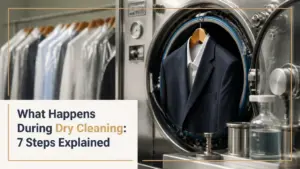
Dry cleaning is a textile-cleaning process that uses a liquid chemical solvent instead of a conventional water-and-detergent wash. Garments are placed in a rotating machine, saturated with solvent, gently agitated, spun to remove liquid, dried with warm air, and pressed into shape.
The process is called “dry” because water is largely absent from the cleaning bath. The clothing is still immersed in liquid. Traditional solvents dissolve oily contamination, including skin oils, automotive grease, cosmetics, and some food fats, while detergent additives help suspend water-based soils such as sweat and sugar.
Water can make some fibers swell and change shape. Wool, silk, rayon, acetate, and structured interlinings can shrink, felt, bleed dye, wrinkle permanently, or lose their original drape when washed incorrectly. Dry cleaning reduces those water-related risks, although solvent cleaning can still damage dyes, coatings, adhesives, buttons, and fragile decorations.
How does the dry-cleaning process work?
A professional dry cleaner normally completes five controlled stages: inspection, pre-spotting, solvent cleaning, post-spotting, and finishing. Correct stain identification matters because protein, tannin, oil, ink, and adhesive stains respond to different treatments.
- Inspection and tagging: The cleaner records the garment, checks seams and closures, notes existing damage, and attaches an identification tag.
- Pre-spotting: A technician applies a targeted agent to visible stains, using tools such as a spotting board, steam, air, or suction to loosen contamination.
- Solvent cleaning: A sealed machine circulates filtered solvent through the garments, extracts it by spinning, and recovers vapor during drying.
- Post-spotting: The technician reinspects the garment and treats remaining marks manually when the fabric and dye can tolerate another application.
- Finishing: Steam, pressing, tensioning, or a form finisher restores shape, crease lines, collar roll, and surface appearance.
Modern closed-loop machines reclaim most solvent rather than releasing a full load into the air. Recovery efficiency does not make a hazardous solvent harmless, however, because maintenance, sludge disposal, leaks, and workplace exposure still matter.
Is Dry Cleaning Safe for People?
Dry cleaning is usually low-risk for a customer who occasionally collects properly processed clothing, but repeated exposure to PERC deserves caution. The highest routine exposure occurs among workers, people living above or beside poorly controlled facilities, and customers who receive garments with significant residual solvent.
The EPA’s Integrated Risk Information System describes PCE as “likely to be carcinogenic to humans.” That classification concerns long-term hazard, not a prediction that one cleaned jacket will cause cancer. Risk combines hazard with dose, frequency, route of exposure, and ventilation.
A garment with a faint, temporary solvent smell is not automatically dangerous. A strong chemical odor, wet-feeling fabric, headache, dizziness, or throat irritation indicates that the item should not be worn immediately. Remove the plastic covering, place the garment outdoors or in a well-ventilated area away from ignition sources, and contact the cleaner if the odor persists.
Who should reduce solvent exposure most carefully?
Children, pregnant people, people with asthma, people with migraine or chemical sensitivity, and workers handling many garments should minimize avoidable exposure. No special panic response is justified for a normally processed occasional garment, but choosing a PERC-free cleaner is a sensible precaution when alternatives are available.
Do not store solvent-smelling clothing in a nursery, bedroom closet, car passenger compartment, or poorly ventilated apartment. Do not place freshly returned garments next to food, medication, pet bedding, or heating equipment.
Is PERC Dry Cleaning Safe?
PERC dry cleaning is effective and widely regulated, but it is not the lowest-exposure choice. PERC is nonflammable and excellent at dissolving oils, yet the chemical is a volatile organic compound that can escape through equipment leaks, waste handling, ventilation failures, and residual vapor in garments.
The EPA’s 2024 risk-management rule under the Toxic Substances Control Act restricts PCE uses and establishes phaseouts and transition periods. The exact deadline depends on the use, business category, and applicable rule provisions, so the often-repeated December 2034 date should not be treated as a universal deadline for every dry cleaner or every jurisdiction. State and local restrictions can be earlier.
A PERC facility is not automatically operating illegally or irresponsibly. A compliant shop may use sealed equipment, leak detection, vapor controls, employee training, and documented waste management. Customers still have a reasonable basis for choosing a method with less hazardous-solvent exposure.
What are the main dry-cleaning methods?
The table separates solvent identity from safety claims. “Alternative” does not mean “risk-free,” and “green” is not a regulated safety guarantee.
| Method | Main cleaning medium | Typical safety and handling profile | Main limitation |
|---|---|---|---|
| PERC/PCE | Chlorinated solvent, perchloroethylene | Human carcinogenicity concern; requires vapor and waste controls | Regulatory phaseout and indoor-air concerns |
| Professional wet cleaning | Water, biodegradable detergent, controlled moisture | No PERC solvent; lower chemical exposure when operated correctly | Poor technique can shrink or distort sensitive garments |
| Liquid carbon dioxide | Recovered CO2 under pressure | Nonflammable process fluid with little conventional solvent residue | Specialized machinery is rare and expensive |
| Hydrocarbon solvent | Petroleum-derived aliphatic solvent | Flammable or combustible; lower toxicity profile than PERC, but still a VOC | Fire controls and petroleum-related emissions remain relevant |
| Silicone solvent, such as D5 | Decamethylcyclopentasiloxane | Gentle on many garments; environmental persistence is debated and regulated differently by region | Not universally available and not environmentally impact-free |
Is professional wet cleaning safer than PERC?
Professional wet cleaning is generally the preferred low-exposure option when the cleaner has the equipment and skill to control water, temperature, agitation, extraction, and drying. Computer-controlled washers use short cycles, measured detergent, moisture sensors, and specialized finishing to handle garments labeled “dry clean only.”
Wet cleaning is not simply putting a suit into a household washing machine. Excess heat can shrink wool, aggressive agitation can felt fibers, and uncontrolled drying can distort a jacket’s canvas, chest piece, or shoulder structure. A qualified operator may still recommend conventional solvent cleaning for a garment whose construction has not been tested in water.
Is liquid carbon dioxide completely risk-free?
Liquid carbon dioxide avoids PERC’s toxicological profile and is nonflammable in the cleaning system, but the process is not risk-free in every sense. High-pressure equipment requires specialized engineering, trained operators, inspection, and safe depressurization.
Carbon dioxide systems also consume energy for compression and recovery. Calling the method “carbon neutral” without a life-cycle assessment is too broad. The process can have a strong environmental profile, but electricity use, equipment manufacture, transport, and the source of recovered CO2 still affect total impact.
How do hydrocarbon and silicone methods compare?
Hydrocarbon solvents can be a practical bridge away from PERC, especially for oil-rich soils and garments that need solvent cleaning. They remain combustible or flammable under relevant conditions and should not be described as non-toxic simply because their acute toxicity is generally lower than PERC’s.
Silicone-based D5 systems are gentle and have low odor in many operations. Environmental regulators and scientific reviewers have raised concerns about persistence and aquatic effects, with restrictions differing between the United States, the European Union, and other jurisdictions. Ask what product is used instead of accepting “eco-cleaning” as a sufficient answer.
Which Dry-Cleaning Method Is Safest?
For most households, professional wet cleaning is the safest widely available choice when the garment can tolerate controlled water processing. Liquid carbon dioxide has a favorable exposure profile but is uncommon. Hydrocarbon and silicone methods can reduce some PERC concerns, while PERC remains the option requiring the greatest attention to ventilation and regulatory controls.
| Decision factor | Professional wet cleaning | Liquid CO2 | Hydrocarbon | PERC/PCE |
|---|---|---|---|---|
| Water used in process | Yes, controlled | No | No | No |
| Chlorinated solvent used | No | No | No | Yes |
| Flammability concern | Low in normal washing | Low in cleaning fluid | Present, depends on formulation | Low flammability |
| Availability in typical U.S. markets | Moderate | Low | Moderate | High but declining |
| Best soil profile | Sweat, food, mixed soils | Oils and delicate garments | Oils, grease, mixed soils | Strong oil and grease removal |
| Main consumer concern | Incorrect drying or shrinkage | Rare local availability | Combustibility and VOCs | PCE exposure and residue |
| Typical recommendation | First choice where qualified | Excellent specialist option | Acceptable with controls | Use only with strong controls and airing |
How can you identify a genuinely safer cleaner?
Ask the shop six specific questions before ordering service:
- Which cleaning method is used on this garment? Request the solvent or process name.
- Is the facility PERC-free? “Green” alone does not answer the question.
- Do you perform professional wet cleaning? Ask whether operators are trained for wool, silk, tailoring, and structured garments.
- How are solvent odors controlled? Look for sealed machines, ventilation, and a clear answer about drying and recovery.
- Will you inspect buttons, coatings, and adhesives? This matters for vintage clothing and embellished fashion.
- What happens if the garment has a reaction or pre-existing defect? A written claims policy is more useful than a verbal promise.
A cleaner who cannot identify the process, explain odor control, or inspect the garment carefully is a poor choice for expensive clothing. A nearby PERC-free claim deserves verification, because some stores send garments to an off-site plant using a different method.
How Much Does Dry Cleaning Cost and How Long Does It Take?
Typical U.S. consumer prices range from about $6-$10 for a shirt, $8-$15 for trousers, $15-$30 for a two-piece suit, and $20-$40 for a dress or heavy coat. A comforter or duvet commonly costs $30-$60. Local labor rates, fabric complexity, stain treatment, pressing, pickup service, and regional rent can move prices substantially.
Standard turnaround is usually 2-4 business days. Same-day or next-day service commonly adds about 20%-50%, although wedding dresses, leather, suede, restoration, and difficult stain work can require a week or longer.
| Garment or service | Typical price range | Typical turnaround | Main price variable |
|---|---|---|---|
| Shirt or blouse | $6-$10 | 2-3 business days | Laundering versus solvent cleaning |
| Trousers or skirt | $8-$15 | 2-3 business days | Creases, lining, and stain treatment |
| Two-piece suit | $15-$30 | 2-4 business days | Jacket structure and pressing |
| Dress or heavy coat | $20-$40 | 3-7 business days | Beading, lining, length, and finish |
| Comforter or duvet | $30-$60 | 4-7 business days | Fill material and size |
| Express service | Base price plus 20%-50% | Same or next day | Capacity and local demand |
Prices are decision data, not safety evidence. A more expensive cleaner may be charging for careful inspection and finishing, while a low-cost cleaner may use a centralized plant with a process you have not verified.
How Often Should You Dry-Clean Clothes?
Wool suits often need professional cleaning only two or three times per season when they are brushed, aired, and spot-treated between uses. Cleaning after every wear can shorten garment life through repeated solvent action, pressing, heat, abrasion, and handling.
Use visible soil, odor that airing does not remove, sweat accumulation, spills, and manufacturer instructions as the decision points. A blazer worn indoors for two hours does not need the same schedule as a hospitality uniform worn through a hot shift.
Between cleanings, hang tailored clothing on a broad wooden or shaped hanger, empty pockets, brush off surface dust, and allow at least overnight airing. A garment steamer can relax wrinkles, but steam does not remove grease and should not be applied aggressively to silk, velvet, leather, or heat-sensitive trims.
Does dry cleaning disinfect or kill germs?
Dry cleaning is not a substitute for validated disinfection. Solvent exposure, mechanical action, heat, drying, and pressing may reduce some microorganisms, but ordinary dry-cleaning cycles are not standardized as sterilization or hospital disinfection procedures.
For clothing exposed to pathogens, follow the relevant public-health or manufacturer guidance. Laundering with an appropriate detergent and temperature may be the better documented method when the textile permits it. Do not send contaminated medical or biological material to a retail cleaner without disclosure.
What Garments Should Not Be Dry-Cleaned?
Care labels, fiber content, construction, dye stability, and trim determine whether dry cleaning is appropriate. Leather, suede, fur, rubberized coatings, waterproof membranes, heat-transfer prints, foam laminates, and some bonded fabrics may react badly to solvent, heat, or pressing.
“Dry clean only” means the manufacturer has identified dry cleaning as the tested or safest labeled care method under the applicable care-label system. It does not mean every dry cleaner can process the garment safely, nor does it prohibit a specialist from using a validated wet-cleaning process.
Tell the cleaner about:
- Invisible stains, especially oil, wine, milk, blood, ink, or adhesive.
- Perfume, deodorant, sunscreen, and self-tanning products.
- Loose buttons, cracked coating, torn lining, fragile sequins, or weakened seams.
- Recent home treatment, including stain pens, bleach, dish soap, or ironing.
- Vintage construction, hand dye, metallic thread, leather trim, or glued embellishment.
A professional cannot guarantee removal without risking dye loss or fiber damage. The safest choice may be to preserve a faint stain rather than destroy the garment while pursuing a perfect result.
What Should You Do If Clothes Smell Like Chemicals?
Remove the plastic bag immediately and hang the garment in moving air for at least several hours, preferably overnight. Do not wear, store, or place the item near children until the odor has dissipated.
A persistent strong odor can result from incomplete drying, solvent contamination, poor storage, or a process problem. Contact the cleaner, describe the odor and pickup time, and request reprocessing or an explanation. Do not mask the smell with perfume, tumble the garment at home, or wash a tailored item without checking its care instructions.
| Symptom after pickup | Likely cause | Immediate action | When to contact cleaner |
|---|---|---|---|
| Strong solvent odor | Incomplete drying or trapped vapor | Remove bag and ventilate overnight | Odor remains after 24 hours |
| Damp or cool fabric | Residual solvent or condensation | Keep away from flame and air out | Fabric remains damp or odor worsens |
| Melted plastic button | Solvent, heat, or pre-existing weakness | Photograph damage and retain receipt | Contact cleaner immediately |
| New shiny press mark | Excess heat or pressure | Do not iron it at home | Request inspection promptly |
| Stain still visible | Wrong treatment, old stain, or dye limitation | Do not apply home remover | Return with stain history |
One practical rule matters more than most home remedies: never iron a stained garment before professional treatment. Heat can set protein, sugar, resin, and unknown chemical residues, reducing the cleaner’s ability to remove them.
Can You Safely Dry-Clean Clothes at Home?
Most household “dry-cleaning kits” are refresh-and-tumble products, not equivalents to a professional solvent machine. They can reduce odor and light wrinkling on some robust garments, but they do not provide controlled stain identification, solvent filtration, shape finishing, or reliable treatment for grease.
Home use is unsuitable for heavily soiled tailoring, silk with unstable dye, beaded clothing, leather, suede, structured jackets, and garments with unknown stains. Follow the kit instructions exactly, ventilate the area, avoid excessive heat, and stop if the fabric bleeds, shrinks, or develops an odor.
For routine maintenance, brushing, airing, careful steaming, and prompt professional spot treatment usually extend wear between full cleanings more reliably than repeated home-kit cycles.
Common Dry-Cleaning Mistakes
Leaving garments in the plastic bag
Plastic packaging protects garments during transport but traps residual vapor and prevents airing. Remove it at home and use a breathable garment cover after the item has aired.
Failing to identify the stain
A technician sees a mark, but the wearer knows whether it came from olive oil, red wine, ink, sweat, or cosmetics. That history determines the safest pre-treatment sequence.
Waiting months to report a spill
Oxidation, heat, sunlight, and repeated wear can make stains chemically harder to remove. Bring stained garments promptly, and identify the substance if known.
Assuming “green” means non-toxic
Marketing terms can describe energy use, plant branding, or a solvent with a lower hazard profile. Request the actual method, such as professional wet cleaning, D5 silicone, hydrocarbon, or PERC.
Cleaning every garment identically
A silk blouse, wool suit, sequined dress, and waterproof shell have different failure modes. Garment-specific inspection is a stronger quality signal than a single shop-wide promise.
FAQ
Is dry cleaning safe during pregnancy?
Occasional use of properly processed garments is unlikely to create the same exposure as working around solvent equipment, but pregnancy is a reasonable period to reduce avoidable PERC contact. Choose professional wet cleaning where suitable, remove packaging, and air garments in a ventilated place before wearing or storing them.
Can dry-cleaned clothes cause skin irritation?
Dry-cleaned clothing can irritate skin when residual solvent, fragrance, detergent, dyes, or finishing agents remain on the textile. Air the garment before use, wear a washable layer underneath, and stop wearing it if itching, rash, headache, or respiratory symptoms occur. Persistent symptoms require medical advice.
Is PERC banned in the United States?
PERC is subject to federal restrictions and phaseouts under the EPA’s 2024 TSCA risk-management rule, but the rules include different transition periods and conditions. State and local governments may impose earlier restrictions. Ask the cleaner for its current process rather than relying on a single nationwide date.
Can dry cleaning remove sweat and deodorant stains?
Dry cleaning can remove oily deodorant ingredients and some sweat-related soils, but water-soluble salts and residues may require specialized detergent or professional wet-cleaning treatment. Tell the cleaner the garment contains sweat or antiperspirant buildup, because repeated heat can discolor or weaken fabric.
Should wool coats be dry-cleaned every year?
A wool coat does not automatically need annual dry cleaning. Clean it when it has visible soil, persistent odor, significant sweat exposure, or a manufacturer-recommended schedule, while brushing and airing it between professional services. Excessive cleaning can add wear through solvent action, pressing, and mechanical handling.
How can I find PERC-free dry cleaning near me?
Search local listings for “professional wet cleaning,” “PERC-free,” or “liquid CO2,” then call the facility and ask which process handles your specific garment. Confirm whether cleaning occurs on-site or at a central plant, because the storefront’s advertised method may not be the plant’s method.
The Bottom Line
Is dry cleaning safe? For clothing, professional dry cleaning can prevent water-related shrinkage and preserve the shape of delicate garments. For people and the environment, safety depends on the cleaning method: professional wet cleaning and liquid carbon dioxide generally offer the lowest concern, while hydrocarbon and silicone systems have distinct trade-offs and PERC requires the greatest caution.
Ask for the solvent name, disclose every stain and defect, remove the plastic bag, and air garments before storage. Those four decisions reduce exposure and prevent more damage than choosing a cleaner based only on a “green” label or the lowest price.