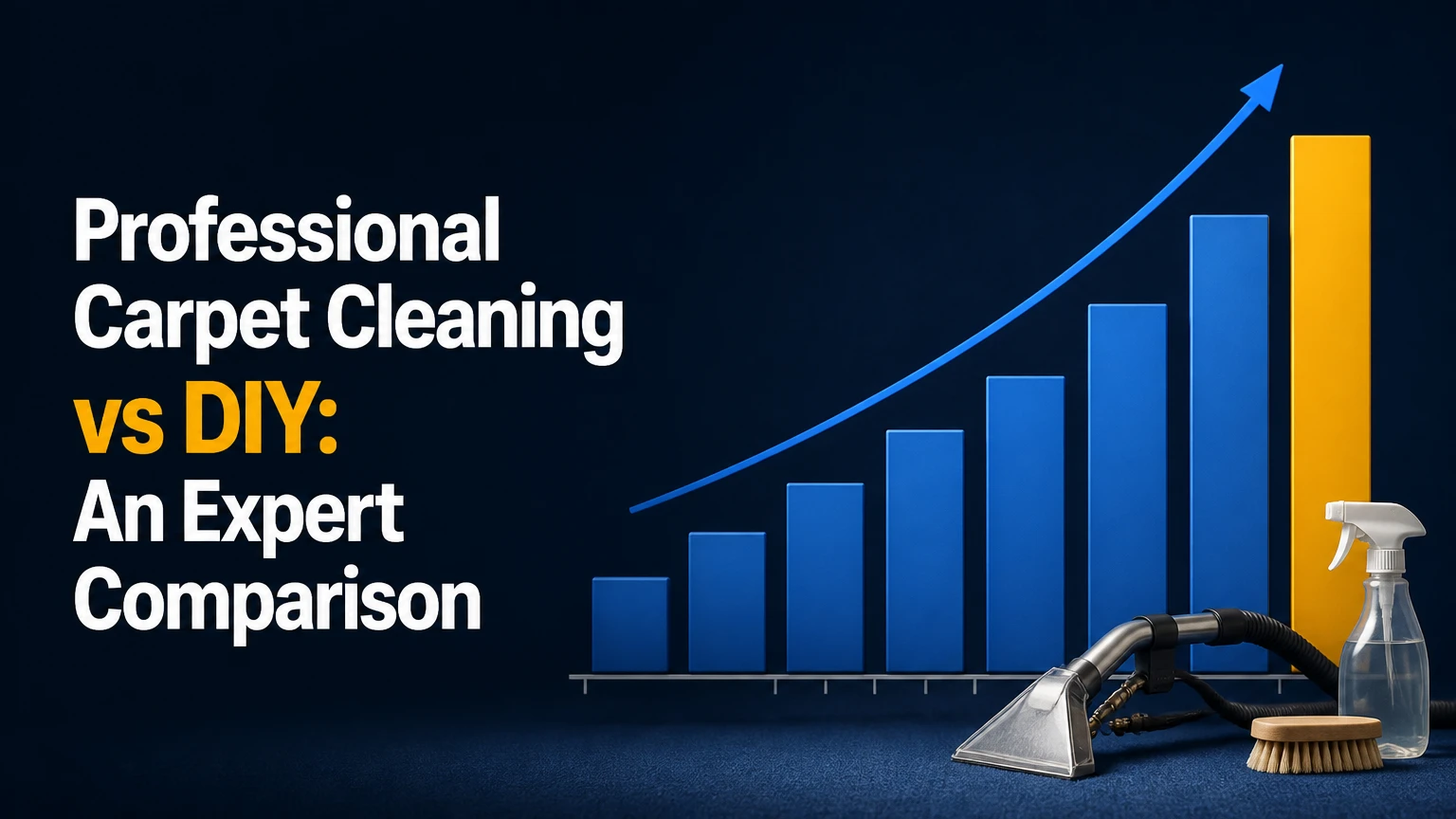
Professional carpet cleaning vs diy comes down to the difference between restorative deep-extraction and surface-level maintenance. Professional carpet cleaning utilizes truck-mounted hot water extraction (HWE) at 240°F and 800 PSI to sanitize fibers and extract deep-set soils. DIY carpet cleaning relies on consumer-grade machines operating at lower temperatures (120°F) and pressures (40 PSI) to handle immediate, localized spills. Choose professional cleaning for annual maintenance and warranty preservation, and reserve DIY machines for emergency spot treatments.
Key Facts / At a Glance
- Temperature: Professional truck-mounted units heat water up to 240°F (115°C) to kill bacteria, while DIY machines rely on domestic hot tap water capped at 120°F (50°C).
- Water Pressure: Professionals inject water at 300–800 PSI; consumer DIY machines generate 20–40 PSI, limiting penetration to the top layer of the carpet pile.
- Extraction Power: Commercial machines provide 130–180 inches of water lift, drying carpets in 4–8 hours. DIY units offer 60–90 inches of lift, requiring 12–24 hours of dry time.
- Chemical Residue: Professionals use an acid-rinse to neutralize alkaline pre-sprays. DIY formulas are typically surfactant-heavy soaps that remain in the carpet, accelerating future re-soiling.
- Warranty Impact: Major carpet manufacturers require professional hot water extraction every 12 to 18 months; using unauthorized DIY rental machines can instantly void your warranty.
Quick Comparison: Pro vs. DIY Specifications
| Feature / Spec | Professional Truck-Mount | Consumer DIY Machine |
| Water Temperature | 200°F – 240°F (93°C – 115°C) | 110°F – 120°F (43°C – 50°C) |
| Pump Pressure | 300 – 800 PSI | 20 – 40 PSI |
| Vacuum Lift | 130 – 180 inches | 60 – 90 inches |
| Base Cost | $150 – $400 (Standard 3-Bed Home) | $35 – $50/day rental + $20–$40 chemical |
| Execution Time | 1 – 2 hours | 3 – 6 hours |
| Drying Time | 4 – 8 hours | 12 – 24 hours |
Equipment Capabilities: Heat, Pressure, and Vacuum Lift
Professional carpet cleaning equipment fundamentally outpaces consumer machinery in thermodynamics, fluid dynamics, and vacuum capability. Truck-mounted systems generate power from a dedicated vehicle engine or diesel burner, pushing water temperatures to 240°F. This thermal energy breaks down heavily oxidized greases and proteins that room-temperature water cannot dissolve, while simultaneously neutralizing dust mites and bacteria.
DIY consumer machines are limited by standard 120V household wall outlets. They cannot heat water internally to boiling points and rely entirely on the temperature of your home’s tap water (max 120°F). Furthermore, DIY machines push water at a mere 20 to 40 PSI, meaning the cleaning solution only reaches the upper third of the carpet pile. Professional units blast water at 300 to 800 PSI, reaching the base of the fibers where abrasive particulate soils hide.
Verdict: Professional equipment wins decisively for deep cleaning, as the combination of high heat and massive PSI flushes out the microscopic sand and grit that physically cut carpet fibers over time.
How Do Chemical Processes and pH Levels Compare?
The chemical application process marks the most significant difference in how these two methods impact the long-term cleanliness of your flooring. Professional technicians utilize a multi-step pH balancing system. First, they apply an alkaline pre-spray to break down traffic-lane soils and body oils. A mechanical counter-rotating brush (CRB) agitates this into the fibers. Finally, the truck-mount injects an acid-rinse agent during the high-pressure flush. This neutralizes the pH, leaving the carpet fibers soft, stabilized, and residue-free.
DIY cleaning methods typically rely on a single-step process where a surfactant-based shampoo is mixed directly into the water tank. Because consumer machines lack the vacuum lift to extract heavy detergents completely, a sticky soap residue is left behind on the fibers. This residue acts as a magnet for new dirt, causing the carpet to look soiled again within a few weeks—a phenomenon known as rapid re-soiling.
Verdict: Professional cleaning extends the life of the carpet through pH-neutral rinsing, whereas DIY methods often accelerate visual degradation by leaving sticky surfactant residues behind.
Financial Metrics: Upfront Pricing vs. Hidden Costs
Hiring a professional cleaning service costs between $0.25 and $0.50 per square foot, resulting in an average bill of $150 to $400 for a standard three-bedroom home. This is a higher immediate out-of-pocket expense compared to renting a machine at a local hardware store, which costs roughly $35 to $50 for a 24-hour period, plus an additional $20 to $40 for proprietary chemical formulas. Purchasing your own upright consumer unit costs between $150 and $300.
However, the true financial comparison must account for hidden risks and secondary costs. A $70 DIY rental can quickly escalate into a $1,500 replacement bill if the operator over-wets the backing, causing delamination (the separation of the primary and secondary carpet backings). Furthermore, DIY cleaning transfers the physical labor and the opportunity cost of a 4-to-6 hour execution time directly to the homeowner.
Verdict: DIY cleaning offers better upfront savings for frequent, small-area maintenance, but professional cleaning provides a better long-term return on investment by preserving the structural integrity of the carpet.
How Long Does Cleaning and Drying Actually Take?
Execution and drying timeframes dictate how long a room remains unusable. Professional technicians can execute a standard home layout in 1 to 2 hours. Because their truck-mounted dual or triple-stage vacuum slots pull 130 to 180 inches of water lift, they extract up to 90% of the moisture introduced. With high-velocity air movers deployed during the grooming phase, professional dry times range from just 4 to 8 hours.
DIY execution takes 3 to 6 hours due to the constant manual refilling and emptying of small water bladders, coupled with the necessity of moving the machine at a very slow pace. Because consumer vacuums only generate 60 to 90 inches of water lift, heavily saturated carpets require 12 to 24 hours to dry entirely. Extended moisture in the padding dramatically increases the risk of mold spore germination and mildew development.
Verdict: Professional services are vastly superior for minimizing household disruption and preventing moisture-related fungal growth.
Risk Factors: Over-Wetting and Warranty Voidance
The most severe risk of DIY carpet cleaning is user error resulting in over-saturation. When a homeowner pulls the spray trigger excessively or moves the rental machine too slowly, water bypasses the carpet fibers and floods the latex adhesive backing and the polyurethane foam pad underneath. This causes permanent buckling, shrinking, and musty odors that cannot be reversed.
Additionally, almost all premium carpet manufacturers (including Shaw, Mohawk, and Stainmaster) require professional hot water extraction every 12 to 18 months as a condition of their warranty. Using an unapproved consumer rental unit, or applying unauthorized chemical brighteners found in over-the-counter shampoos, instantly voids these warranties.
Verdict: Professional cleaning is mandatory for homeowners wanting to maintain their manufacturer warranties and avoid the structural damage associated with DIY over-wetting.
Which Method Should You Choose?
The decision between professional carpet cleaning vs diy depends entirely on your living situation, fiber type, and the specific soil you are attempting to remediate.
The Rental Tenant
Verdict: Use DIY for routine care; hire a Pro for move-out.
Rent a commercial DIY unit for cheap, routine maintenance while living in the unit. However, hire a professional company upon move-out. Property managers look for deep-clean receipts, and a professional receipt guarantees you will not lose your security deposit over floor conditions.
The Pet Owner or Parent
Verdict: Own a DIY spot-cleaner; hire a Pro annually.
Buy a high-end consumer carpet washer ($150–$300) to keep in the closet for the immediate, emergency cleanup of pet urine, vomit, or spilled drinks. Allowing acidic bio-fluids to sit ruins dyes. Use this DIY machine for triage, but schedule a professional steam extraction once a year to flush the biological salts and dander out of the backing.
The Allergy Sufferer
Verdict: Exclusively use Professional Hot Water Extraction.
Consumer units simply do not get hot enough to denature allergen proteins or kill dust mites. You need professional truck-mounted extraction reaching 200°F+ every 6 months to actively improve indoor air quality and extract deep dander that sits below the reach of consumer vacuums.
The Luxury Carpet Owner
Verdict: Exclusively use Professional Cleaning.
If you own premium natural wool, nylon, or triexta carpets, stick strictly to professional companies. Wool fibers are highly sensitive to alkaline pH levels and extreme heat, and can easily felt or shrink if washed with a generic DIY machine. Professionals can utilize low-moisture encapsulation or custom acid-rinses tailored specifically to your fiber type.
Common DIY Failures and Troubleshooting
If you choose the DIY route, avoiding common mechanical and chemical errors is critical.
- Browning / Wicking (Stains reappearing): This occurs when deep dirt wicks up the wet fibers as they dry. Fix: Lightly mist the browned area with a 50/50 mixture of white vinegar and water. Blot it with a white microfiber cloth (never scrub, which frays the fibers), and immediately aim a high-speed floor fan directly at the spot.
- Musty Smells Post-Clean: This indicates the underlying pad remained wet for over 24 hours, initiating bacterial growth. Fix: Run a dehumidifier continuously in the room, lower the AC to 68°F (20°C), and lift the corner of the carpet if necessary to allow airflow directly to the pad.
- Sticky or Crunchy Fibers: Caused by using too much detergent. Fix: Do not add more soap. Perform 2 to 3 “dry passes” (vacuum only) or run the machine again using only plain, hot water to flush the remaining surfactant out of the pile.
Frequently Asked Questions
Is it cheaper to buy a carpet cleaner or hire a professional?
Buying a consumer carpet cleaner ($150–$300) is cheaper upfront than hiring a professional twice a year ($300–$800 annually). However, consumer cleaners only perform surface maintenance. Over a 5-to-10 year period, professional cleaning is cheaper because it physically extends the lifespan of the carpet by removing abrasive sub-surface grit, delaying a $3,000+ carpet replacement.
Can DIY machines remove pet urine odors permanently?
No. DIY machines can remove the visual stain and the top layer of urine, but they lack the pressure to flush the carpet padding where the urine crystallizes. When the humidity in your house rises, those deep-set uric acid crystals off-gas, bringing the smell back. Professionals use sub-surface extraction tools and enzymatic treatments to break down the crystals in the pad.
What is Very Low Moisture (VLM) cleaning compared to steam cleaning?
VLM, or encapsulation cleaning, is a professional method where a crystalizing polymer solution is sprayed onto the carpet and agitated. The polymers bind to dirt particles, dry into brittle crystals in about 1-2 hours, and are simply vacuumed away. It is excellent for commercial glue-down carpets but is generally less effective than hot water extraction (steam cleaning) for deep residential pile.
Why did my carpet get dirtier faster after I cleaned it myself?
You likely used too much chemical solution and failed to extract it completely. Consumer carpet shampoos are heavily alkaline surfactants. If left in the carpet, this soap residue remains sticky when dry and acts like a magnet, pulling dirt off shoes and paws at twice the normal rate.
How often should carpets be professionally cleaned?
The Carpet and Rug Institute (CRI) recommends professional hot water extraction every 12 to 18 months for standard households. Homes with multiple pets, high foot traffic, or residents with severe respiratory allergies should increase this frequency to every 6 to 9 months.