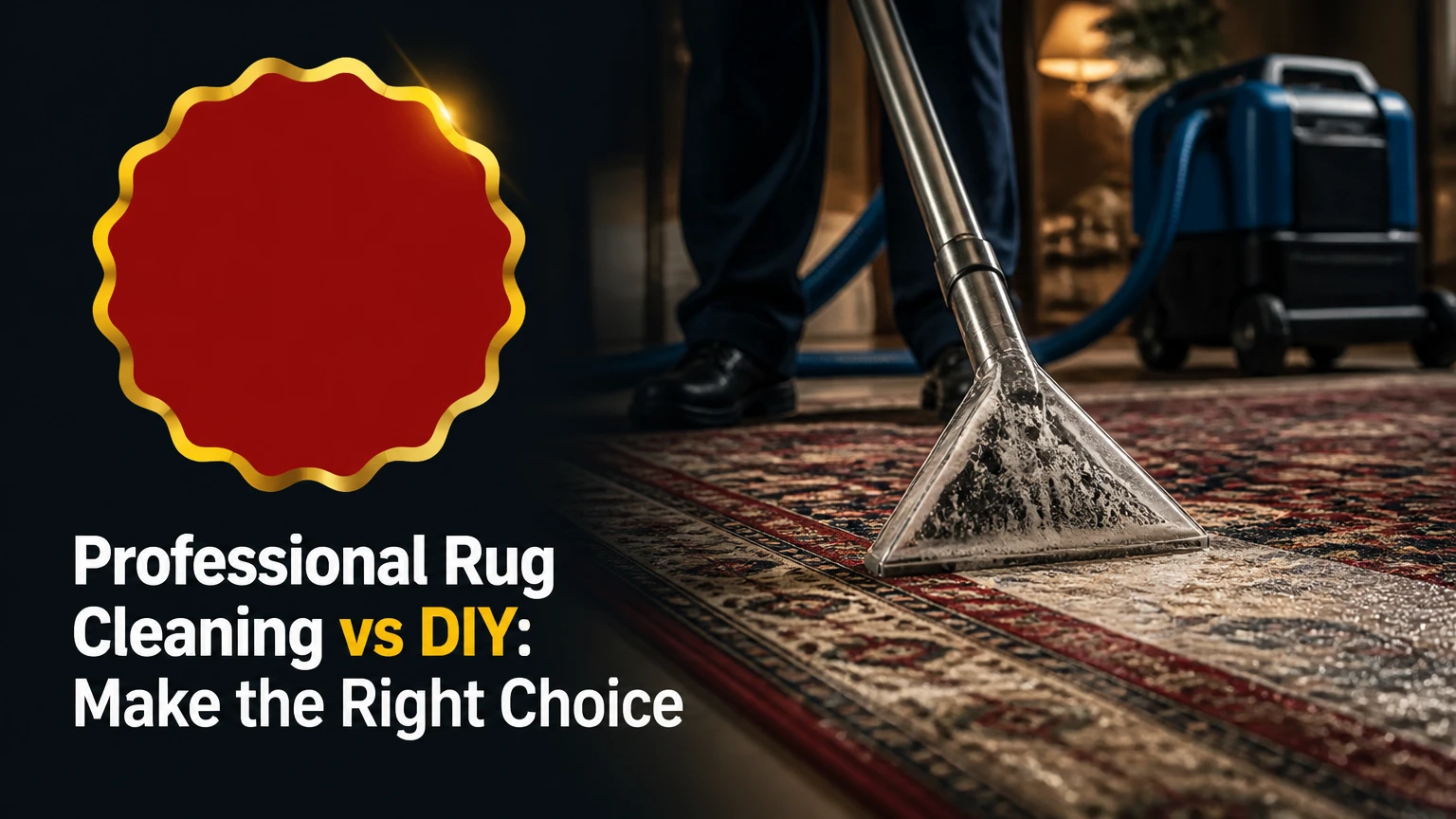
Professional rug cleaning is usually the safer and deeper choice for wool, silk, antique, hand-knotted, tufted, or valuable rugs, while DIY cleaning suits inexpensive, colorfast synthetic rugs with light soil. The deciding factors are fiber, construction, dye stability, contamination, drying access, replacement value, and whether the rug can tolerate full moisture.
Key Facts at a Glance
- Professional rug cleaning commonly costs about $2-$15 or more per square foot, depending on fiber, construction, location, and treatment.
- A consumer extractor can remove surface soil from a colorfast synthetic rug, but it cannot reproduce controlled dusting, washing, rinsing, and drying at a specialist facility.
- Wool, silk, viscose, antique, hand-knotted, and unstable-dye rugs should receive an inspection before wet cleaning.
- Typical DIY cleaning requires 2-4 hours of active work and 24-48 hours of drying, although humidity and rug thickness can extend that period.
- Professional cleaning does not guarantee complete removal of permanent dye stains, old pet urine, discoloration, or foundation damage.
- A hybrid routine is often economical: DIY blotting for fresh spills, professional washing for periodic soil removal and high-risk contamination.
Professional Rug Cleaning vs DIY: Which Wins?
Professional rug cleaning wins for high-value, natural-fiber, structurally complex, heavily contaminated, or difficult-to-dry rugs. DIY cleaning wins for low-cost polypropylene or polyester rugs when the care label permits water, the dyes are stable, and the owner can dry the rug completely within roughly 24 hours.
The comparison is not really “machine versus technician.” It is controlled risk versus household convenience. A professional facility can inspect the foundation, remove dry grit before adding water, choose a detergent system, flush residue, extract moisture, and dry the rug on equipment designed for textiles. A homeowner usually has a rental extractor, household vacuum, spotter, towels, and fans.
The important correction is that professional cleaning is not automatically superior for every rug. A poorly trained cleaner using excessive heat or pressure can damage fibers, just as a careful homeowner can safely clean a labeled machine-washable synthetic mat. Method selection matters more than the word “professional.”
Quick Verdict by User
| User situation | Better first choice | Reason | Typical interval |
|---|---|---|---|
| Inexpensive polypropylene entry rug | DIY extraction | Low replacement value and durable synthetic fiber | 6-12 months |
| Wool Persian rug with stable dyes | Specialist facility | Natural fiber and hand construction need controlled washing | 12-24 months |
| Silk or viscose decorative rug | Specialist inspection | Water and agitation can distort or cause browning | As needed |
| Fresh drink spill on a washable rug | DIY blotting | Fast response limits wicking and residue | Immediately |
| Pet urine in rug foundation | Professional assessment | Odor may reside below the pile and backing | Immediately |
| Flooded rug or wet jute backing | Restoration specialist | Prolonged moisture can cause delamination or mold | Same day |
What Makes Professional Rug Cleaning Different?
Professional rug cleaning combines fiber identification, construction inspection, dry-soil removal, controlled chemistry, appropriate agitation, complete rinsing, water extraction, and managed drying. The process differs from cleaning wall-to-wall carpet because an area rug may contain natural dyes, cotton warps, latex adhesives, jute, fringe, or a separate backing.
How Does a Specialist Facility Clean a Rug?
A competent cleaner normally follows these stages:
- Inspection and documentation: The technician records fiber, dimensions, backing, fringe condition, stains, worn areas, previous repairs, and pre-existing color loss.
- Dye and fiber testing: Small hidden areas are tested for color transfer, browning, bleeding, and chemical sensitivity. A failed test changes the method.
- Dry soil removal: Specialist dusting equipment or controlled air agitation removes abrasive grit from the foundation before wet cleaning.
- Targeted pretreatment: Protein, tannin, oil, and particulate soils receive different products. Pet urine may require a separate decontamination protocol.
- Washing or low-moisture cleaning: The facility chooses immersion, controlled surface washing, extraction, or a low-moisture process according to construction.
- Rinsing and extraction: The cleaner removes suspended soil and detergent residue. Some facilities use a centrifuge, but centrifuge use and extraction percentages are not universal.
- Drying and finishing: Air movement, dehumidification, grooming, fringe care, and a final inspection reduce residual moisture and expose remaining issues.
A centrifuge can remove a large proportion of free water quickly, but claims such as “90-95% extraction in under three minutes” describe particular equipment and operating conditions, not every professional service. Drying still depends on rug thickness, backing, room temperature, airflow, and humidity.
Which Professional Method Fits Each Rug?
| Method | Suitable examples | Moisture exposure | Main limitation |
|---|---|---|---|
| Controlled immersion wash | Stable wool, cotton, many hand-knotted rugs | High, followed by full rinse | Unsafe for unstable dyes or damaged foundations |
| In-plant water extraction | Colorfast synthetic area rugs | Medium to high | May not remove embedded foundation soil as thoroughly as washing |
| Low-moisture compound | Moisture-sensitive commercial rugs | Low | Limited flushing of urine salts and soluble residue |
| Truck-mounted HWE | Some synthetic rugs installed or approved for on-site cleaning | Medium | Pressure, heat, and wet backing can damage unsuitable rugs |
| Hand finishing and grooming | Fringe, cut pile, repaired edges | Minimal | Finishing cannot reverse fiber loss or permanent stains |
“Steam cleaning” usually means hot-water extraction in consumer and service-industry language. Actual steam is not the primary cleaning mechanism for most rugs. The relevant variables are solution temperature, pressure, chemical concentration, dwell time, agitation, extraction, and drying.
Which Rugs Are Safe for DIY Cleaning?
DIY cleaning is generally reasonable for inexpensive, machine-made synthetic rugs with a readable care label, stable color, intact backing, and enough ventilation for complete drying. DIY cleaning is a poor default for silk, viscose, antique, hand-knotted, hand-tufted, braided wool, jute-backed, or visibly damaged rugs.
| Rug type or construction | DIY wet cleaning | Main hazard | Safer decision |
|---|---|---|---|
| Polypropylene, machine-made | Often acceptable | Excess water under latex backing | Low-moisture or controlled extraction |
| Polyester, machine-made | Often acceptable | Flattening and sticky residue | Label-approved extraction |
| Nylon, machine-made | Usually acceptable | Heat-related texture change | Moderate heat and thorough extraction |
| Wool, hand-knotted | Do not improvise | Felting, dye migration, shrinkage | Wool-trained rug specialist |
| Silk or viscose | Avoid wet DIY cleaning | Browning, distortion, cellulosic fiber damage | Specialist inspection |
| Cotton flatweave | Sometimes washable | Shrinkage, dye bleeding | Follow label and test first |
| Jute or sisal | Avoid saturation | Browning, stiffening, odor, mold | Dry or specialist cleaning |
| Hand-tufted rug | Usually avoid saturation | Latex deterioration and delamination | Professional assessment |
| Antique or repaired rug | Avoid DIY wet cleaning | Weak foundation and irreversible loss | Conservation-oriented cleaner |
Rug labels are useful but incomplete. “Washable” may describe the face fiber while ignoring latex, dyes, glued seams, or backing materials. Examine the entire object, not only the pile.
What Equipment Does DIY Rug Cleaning Require?
A basic DIY setup includes a vacuum with the beater bar disabled where appropriate, a white cotton towel, a pH-appropriate low-residue detergent, a measuring spoon, a pump sprayer, an extractor, absorbent towels, fans, and a dehumidifier. A garden hose and driveway are not automatically safe because outdoor dirt, uncontrolled runoff, direct sun, and uneven drying create additional risks.
| DIY option | Typical cost | Active labor | Best use | Primary weakness |
|---|---|---|---|---|
| Hand blotting kit | $10-$30 | 10-30 minutes | Fresh localized spill | Cannot flush deep soil |
| Consumer spot extractor | $80-$180 purchase | 15-45 minutes | Pet or drink spot response | Small tank and limited recovery |
| Full-size extractor rental | $35-$50 per day plus $10-$30 solution | 2-4 hours | Durable synthetic rug | Heavy, slow, and easy to over-wet |
| Household carpet machine | $130-$350 purchase | 2-4 hours | Repeated synthetic-rug cleaning | Weak extraction compared with facility equipment |
| Hose-and-brush washing | $15-$40 in supplies | 3-6 hours | Label-approved outdoor mat | Highest drying and backing risk |
Rental machines can be economical when the rug is inexpensive and the owner already has drying space. They are less economical when transport, detergent, labor, furniture moving, replacement risk, and repeated failed treatments are included.
How Should You Clean a Suitable Rug Yourself?
A suitable synthetic rug can usually be cleaned in eight controlled stages, with 2-4 hours of active work and a drying period that must end with a fully dry backing. The success factor is moisture control, not aggressive scrubbing or extra detergent.
Step 1: Read the Label and Inspect the Rug
Confirm the fiber, washing instructions, backing, and manufacturer restrictions. Photograph existing stains, loose edges, fading, and damaged seams before applying water.
Checkpoint: The rug has an intact backing and a care instruction that permits the planned method.
Common mistake: Treating an unlabeled rug as synthetic because its pile feels coarse.
Step 2: Remove Dry Soil
Vacuum the face slowly in two directions, then vacuum the underside if the construction permits. Disable a rotating brush on looped, shaggy, delicate, or wool surfaces because aggressive beater bars can pull loops and abrade fibers.
Checkpoint: Little loose grit appears when the rug is lifted and gently tapped.
Common mistake: Wetting first, which turns removable dry soil into paste.
Step 3: Test Colorfastness and Chemistry
Mix the detergent at the label dilution. Apply a small amount to a hidden edge, press with a white towel for 30 seconds, and inspect the towel for transferred color or brown residue.
Checkpoint: No visible dye transfers and the test area dries without a ring.
Common mistake: Testing only one light color when dark borders may bleed into the field.
Step 4: Blot and Pretreat Stains
Blot fresh liquid with white towels until transfer decreases. Apply a small amount of compatible spotter to the towel rather than flooding the rug, and work from the outside of a stain toward its center.
Checkpoint: The stain lightens without spreading beyond its original boundary.
Common mistake: Scrubbing a protein stain, which drives contamination deeper into the pile.
Step 5: Apply Minimal Cleaning Solution
Use the extractor’s recommended solution and dilution. Make one controlled wet pass rather than repeated spraying, and keep the solution warm rather than very hot unless the manufacturer specifies otherwise.
Checkpoint: The pile is damp, not saturated, and no liquid pools beneath the rug.
Common mistake: Adding extra shampoo because more foam appears to mean more cleaning.
Step 6: Extract Slowly
Release the spray trigger and make two to four slow dry passes over each wet lane. Empty the recovery tank when necessary so suction remains consistent.
Checkpoint: The recovered water decreases and the rug no longer feels heavy or squelches under pressure.
Common mistake: Moving quickly, leaving detergent and water behind.
Step 7: Dry Both Sides
Elevate the rug on a clean, non-staining surface with airflow above and below. Run fans across the surface, use a dehumidifier indoors, and turn the rug when the upper face feels dry.
Checkpoint: The pile, backing, corners, and seams are dry to the touch, with no cool damp zones or odor.
Common mistake: Laying a wet rug flat on hardwood, which can damage both rug and floor.
Step 8: Groom and Recheck
Brush the pile in its natural direction when appropriate. Inspect for wicking after several hours because stains can return to the surface as hidden moisture evaporates.
Checkpoint: No new rings, tacky residue, sour odor, or dye transfer appears after complete drying.
Common mistake: Applying a second chemical treatment before the first treatment has fully dried.
What Are the Main Risks of DIY Rug Cleaning?
The main DIY risks are dye bleeding, shrinkage, felting, backing failure, browning, detergent residue, incomplete drying, and damage to the floor beneath the rug. These risks rise sharply when the rug contains wool, silk, viscose, jute, latex, unstable dyes, or old repairs.
Professional cleaning reduces process risk but does not eliminate outcome risk. A specialist cannot restore missing pile, reverse sun fading, guarantee removal of a chemically set stain, or make a deteriorated latex backing sound. Ask for a condition report before authorizing treatment.
| Failure mode | Likely cause | Immediate response | When to escalate |
|---|---|---|---|
| Dye transfers to towel | Unstable dye or alkaline product | Stop wet work and blot gently | Any visible bleeding on wool or antique rug |
| Rug curls or shrinks | Excess moisture, heat, or tension | Lay flat without stretching aggressively | Any dimensional change |
| Sticky feel and rapid resoiling | Excess detergent or poor rinsing | Stop adding products and seek rinse advice | Residue remains after drying |
| Sour or musty odor | Slow drying or trapped moisture | Increase airflow and separate from floor | Odor persists after 24 hours |
| Brown water marks | Cellulosic backing or overwetting | Dry quickly without heat blasting | Viscose, jute, or antique construction |
| Latex backing flakes | Age, moisture, or chemical breakdown | Vacuum loose debris carefully | Backing separates or cracks |
Do not automatically flush a rug with vinegar. Vinegar can alter pH, affect dyes, leave an odor, and fail to remove the original detergent. Product labels and the rug manufacturer’s instructions should control chemical selection.
How Do Cost, Time, and Results Compare?
Typical professional rug cleaning costs range from $2-$4 per square foot for many synthetic rugs, $4-$8 for wool or hand-knotted rugs, and $8-$15 or more for silk, antique, or specialty pieces. DIY direct cost is commonly $35-$80 for a rental and solution, but the total economic cost includes labor, transport, drying, and possible replacement.
| Rug example | Professional price range | DIY direct cost | Typical drying or turnaround | Replacement-risk context |
|---|---|---|---|---|
| 5 x 8 synthetic rug, 40 sq. ft. | $80-$160 | $35-$80 | DIY: 24-48 hours; pro: 3-7 days | Usually low |
| 8 x 10 wool rug, 80 sq. ft. | $320-$640 | $35-$80 | DIY: 24-48 hours; pro: 5-10 days | Moderate to high |
| 5 x 8 silk rug, 40 sq. ft. | $320-$600+ | Not recommended | Pro: often 5-10 days | High |
| 9 x 12 hand-tufted rug, 108 sq. ft. | $216-$432+ | $35-$80 | Method-dependent | High if latex is aged |
| Pet-urine treatment | Base price plus about $1-$3 per sq. ft. | Spotter cost varies | Often multiple drying stages | High if foundation is affected |
These are typical planning ranges, not universal quotes. Local labor, pickup distance, rug density, repair needs, stain treatment, and minimum service charges can change the total substantially.
Professional turnaround is often 5-10 business days because pickup, inspection, washing, drying, finishing, and delivery occur in sequence. An on-site cleaner may finish sooner, but on-site speed does not prove that the rug’s backing is dry.
Can Professional Cleaning Remove Pet Urine and Stains?
Professional cleaning can remove much of the odor and soil from pet urine when contamination has not permanently altered the foundation, but no cleaner can guarantee full odor removal from every rug. Urine salts can migrate through the pile, backing, pad, and floor, so surface extraction alone may leave the source intact.
Red wine, coffee, grease, rust, bleach marks, and dye stains behave differently. A trained technician identifies the stain class before selecting an oxidizer, reducing agent, solvent, enzyme, or rinse agent. Some treatments can lighten a stain but also affect the surrounding dye.
For a recent spill, blot immediately with white towels and use only a small amount of label-approved product. Do not apply repeated household chemicals, ammonia, bleach, or strong alkaline cleaners. Layered chemistry makes later professional correction harder.
How Often Should Rugs Be Cleaned?
Most households should vacuum rugs weekly and consider deep cleaning every 12-24 months, with shorter intervals for pets, children, allergies, entryways, and heavy foot traffic. Cleaning frequency should follow soil load and fiber tolerance rather than a universal calendar.
A practical schedule includes weekly vacuuming, immediate spill blotting, quarterly inspection under the rug, and professional cleaning when grit, odor, visible traffic lanes, or recurring stains remain after routine care. High-traffic synthetic rugs may need annual extraction, while lightly used formal rugs may need less frequent service.
The American Lung Association recommends reducing indoor dust and controlling allergen reservoirs, but professional rug cleaning is not a substitute for ventilation, source control, humidity management, or appropriate vacuum filtration. Cleaning can remove deposited soil; it cannot prevent new particles from entering the home.
What Should You Ask a Professional Rug Cleaner?
Ask how the cleaner identifies fiber and construction, whether the rug is washed in a facility, how dyes are tested, how moisture is extracted, and what happens if pre-existing damage is found. A clear process description is more useful than a claim that every rug receives the same “steam cleaning” service.
Use this hiring checklist:
- Does the company clean area rugs separately from wall-to-wall carpet?
- Which method is proposed for this specific fiber and backing?
- Will the technician document dye instability, fringe damage, and repairs?
- Does the quoted price include pickup, delivery, stain treatment, and minimum charges?
- How is the rug dried, and how do you verify the backing is dry?
- What results are excluded for permanent stains, fading, urine, and worn fibers?
- Is repair or conservation advice available if the foundation is weak?
- Does the company carry appropriate liability coverage?
A specialist should explain why a method is suitable, not simply promise a result. Be cautious when a cleaner skips inspection, guarantees complete stain removal, or cannot describe drying controls.
Which Option Should You Choose?
Choose DIY for a Durable, Low-Value Synthetic Rug
DIY is appropriate when the rug is polypropylene, polyester, or nylon; the label permits wet cleaning; the colors pass a hidden-area test; and you have an elevated drying area with fans. The financial advantage is strongest when the rug would cost less to replace than a professional minimum charge.
Do not use this category as permission to clean every “synthetic-looking” rug. Viscose and rayon can resemble cotton or silk while reacting poorly to water and agitation.
Choose Professional Cleaning for Wool or Hand-Knotted Rugs
A wool or hand-knotted rug merits professional cleaning when it has significant soil, pet odor, fringe, unstable dye, valuable provenance, or visible foundation wear. Wool can felt under heat, moisture, friction, and unsuitable pH, while hand-knotting introduces tension and foundation variables that household machines cannot assess.
A professional wash may cost more, but the relevant comparison is the cleaning fee against repair, replacement, or loss of an irreplaceable rug.
Choose Specialist Assessment for Silk, Viscose, and Antiques
Silk, viscose, antique, and fragile rugs should not receive improvised extraction, hose washing, or grocery-store detergent. These materials can develop texture distortion, browning, dye migration, pile distortion, or permanent water marks even when the owner follows apparently gentle steps.
For these rugs, vacuuming with suitable settings and careful spill blotting are safer interim actions than full DIY washing.
Choose a Hybrid Routine for Families With Pets
Families with pets usually benefit from immediate DIY blotting and periodic professional deep cleaning. A small spot extractor can limit fresh liquid spread, while a facility treatment addresses accumulated soil, urine odor, and residue that a portable machine may leave behind.
If urine has soaked through to the pad or floor, remove the rug and pad, ventilate the area, and request an assessment rather than repeatedly wetting the same spot.
What Should You Do After a DIY Cleaning Failure?
Stop adding product when a rug bleeds, curls, smells sour, or remains tacky after drying. Move the rug away from wood flooring, separate wet layers, increase airflow, and photograph the condition before contacting the manufacturer or a qualified cleaner.
Do not iron, steam, stretch, bleach, or place a damaged rug in direct high heat. If the backing is delaminating, the rug is still wet after 48 hours, or odor persists, professional intervention becomes more economical than repeated home treatments.
A failed DIY treatment may be recoverable when the issue is residue or slow drying. It becomes less reversible when dye has migrated, latex has broken down, viscose has distorted, or the foundation has shrunk.
FAQ
Is professional rug cleaning worth the money?
Professional rug cleaning is usually worth the money for wool, silk, antique, hand-knotted, fragile, or expensive rugs because the service controls chemistry, agitation, extraction, and drying. DIY is often the better financial choice for inexpensive, washable synthetic rugs where the replacement cost is close to the professional minimum charge.
Can I use a Rug Doctor on an area rug?
A Rug Doctor or similar rental extractor may work on a colorfast, machine-made synthetic rug with an approved care label. Do not use one on silk, viscose, antique, hand-knotted, jute-backed, or deteriorated latex-backed rugs without specialist approval, because the machine cannot identify construction hazards or guarantee complete drying.
Is steam cleaning safe for a wool rug?
Steam cleaning, usually meaning hot-water extraction, is not automatically safe for wool. A wool rug requires a fiber-appropriate detergent, controlled temperature, limited agitation, thorough extraction, and rapid drying. A wool-trained specialist should inspect the rug before choosing immersion washing, low-moisture cleaning, or extraction.
Can I wash an area rug in a washing machine?
Only wash an area rug in a machine when the manufacturer explicitly allows machine washing and provides load, temperature, detergent, and drying instructions. Small synthetic mats may qualify, but wool, silk, viscose, antique, rubber-backed, and oversized rugs can shrink, distort, shed backing, or overload the washer.
How can I dry a rug faster without damaging it?
Dry a wet rug by elevating it so air reaches both sides, running fans across the pile, using a dehumidifier indoors, and turning the rug during drying. Avoid direct high heat and prolonged sunlight, which can set distortion or fade dyes. The rug is dry only when the backing and seams are also dry.
How do I remove a musty smell from a rug?
A musty smell usually indicates trapped moisture, microbial growth, or contamination in the backing or pad. Separate the rug from the floor, ventilate both sides, and stop applying fragrance or additional detergent. If the smell persists after complete drying, have a professional inspect the rug and underlying pad.
The Bottom Line
Professional rug cleaning vs DIY is a material-and-construction decision, not a simple price contest. Use DIY care for labeled, colorfast synthetic rugs and fresh localized spills; choose a qualified rug specialist for wool, silk, viscose, antique, hand-knotted, damaged, heavily soiled, or urine-contaminated rugs. Protecting the foundation and completing the dry cycle matter more than using the strongest machine.