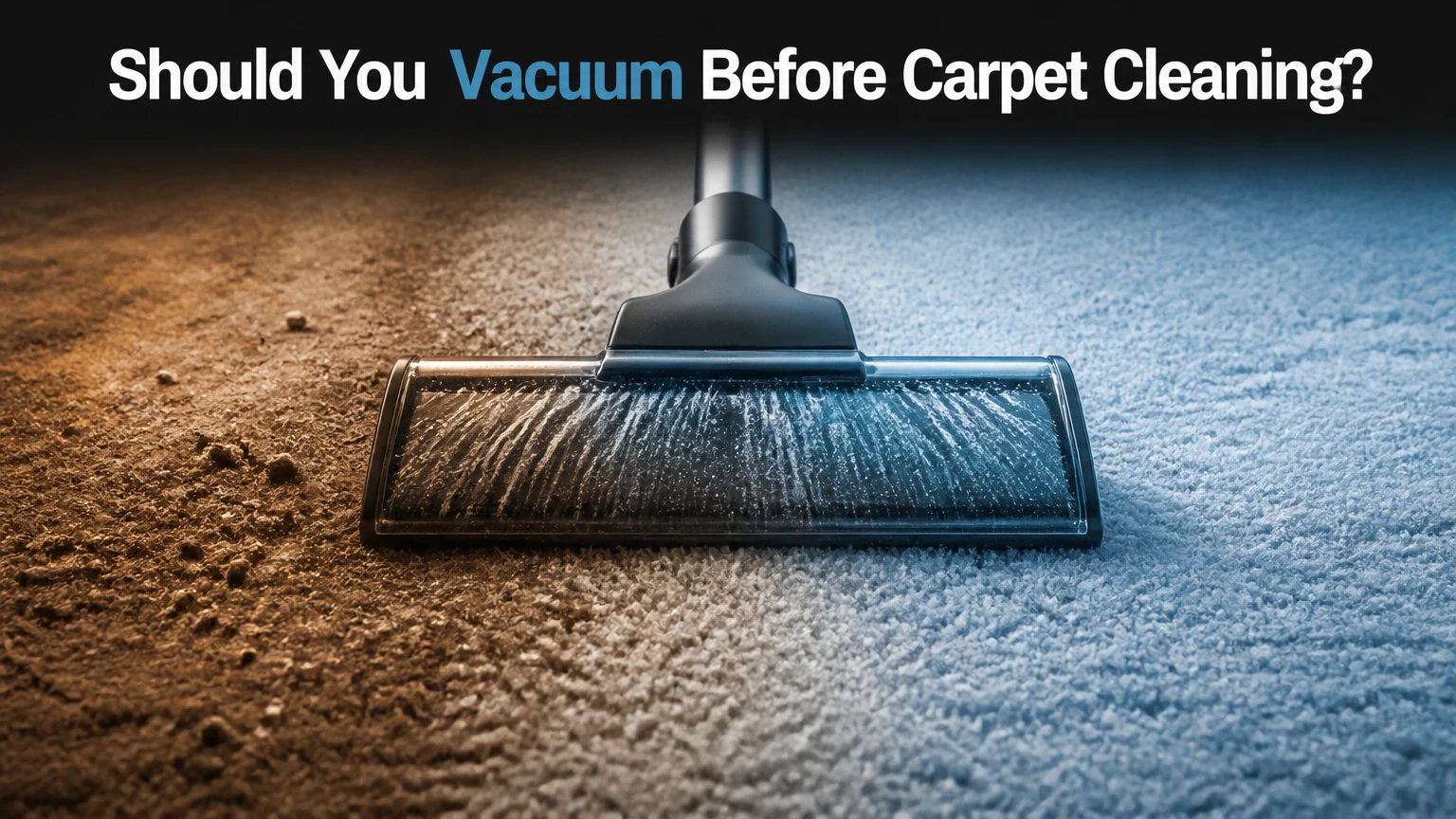
Yes, you must always vacuum before carpet cleaning. Vacuuming removes loose, dry soil that accounts for nearly 80 percent of all carpet dirt. Skipping this preparation step turns that dry dust into a muddy sludge when wet, which permanently damages carpet fibers and heavily clogs extraction machines.
At a Glance:
- Dry soil makes up 75 to 80 percent of total carpet contamination.
- Wet carpet cleaning machines cannot extract dry dirt effectively.
- Failing to vacuum creates a mud-like sludge that pushes deep into the carpet backing.
- Carpet manufacturers mandate pre-vacuuming to maintain warranty coverage.
- Post-cleaning vacuuming is also required after the carpet dries completely.
What happens if you do not vacuum before using a carpet shampooer?
If you skip vacuuming before using a carpet shampooer, the machine will mix water with dry particulate matter to create a heavy mud. This mud sinks directly into the carpet backing and becomes permanently trapped. The liquid cleaner relies on chemical action to break down bonded oils and grease. It is not designed to handle physical debris like hair, sand, and loose skin cells.
When this thick sludge enters your rental or home shampooer, it rapidly clogs the intake nozzles. The water recovery tank will fill with a thick brown slurry. This thick liquid clogs the internal filters and severely reduces the suction power of the machine.
Reduced suction leaves the carpet overly wet. Excess moisture mixed with trapped organic debris takes much longer to dry. This extended drying time creates a perfect environment for mildew, resulting in a persistent wet dog odor. The Institute of Inspection, Cleaning and Restoration Certification (IICRC) 2021 reference guide notes that skipping dry extraction cuts wet cleaning efficiency by half.
Why is dry soil removal necessary before hot water extraction?
Dry soil removal is necessary because 75 to 80 percent of all carpet dirt consists of non-soluble particulate matter like sand and dust. Hot water extraction only targets the remaining 20 to 25 percent of soils, which consist of sticky oils, greases, and dried spills.
Water cannot dissolve sand or hair. Applying water to these physical particulates just makes them heavier and harder to remove. “Attempting hot water extraction without a thorough pre-vacuuming step is like trying to mop a floor before you sweep it,” states John Carter, senior technical trainer at the Carpet and Rug Institute in a 2022 instructional seminar. “You just push wet dirt around.”
By eliminating the loose debris first, the hot water extractor can focus its chemical and thermal energy entirely on the bonded stains. A properly vacuumed floor allows the extraction wand to form a tight seal against the carpet pile, maximizing water recovery and minimizing drying time.
How many vacuum passes are required before deep cleaning?
You need to complete four to six slow vacuum passes over high-traffic areas and two to three passes over lightly used areas before deep cleaning. A single rapid pass only removes surface fluff and leaves heavy sand embedded at the base of the fibers.
| Room Type | Traffic Level | Minimum Passes Required | Directional Approach |
| Hallways & Stairs | Heavy | 5 to 6 passes | Crisscross pattern |
| Living Rooms | Moderate | 4 to 5 passes | Crisscross pattern |
| Bedrooms | Light | 2 to 3 passes | Single direction |
| Under Furniture | Minimal | 1 to 2 passes | Single direction |
To execute a crisscross pattern, vacuum the entire room moving north to south. Then, vacuum the entire room again moving east to west. This multi-directional approach opens the carpet pile and extracts grit that is hiding beneath twisted fibers. Move the vacuum head at a rate of roughly one foot per second. Fast, aggressive pushing fails to give the suction motor enough time to pull heavy dirt from the carpet backing.
What is the correct room preparation sequence before vacuuming?
The correct room preparation sequence requires clearing all floor obstacles, dusting high surfaces, treating spots, and then vacuuming the entire space. Performing these tasks out of order will force you to redo work and will compromise the final cleaning results.
Follow these five preparation steps:
- Remove furniture: Move all chairs, tables, and floor lamps to another room. Place plastic tabs under the legs of heavy items that cannot be moved.
- Pick up hazards: Clear the floor of coins, paper clips, and small toys. These items will destroy the belts and brush rolls of both your vacuum and the extraction machine.
- Dust upper surfaces: Wipe down ceiling fans, window blinds, and baseboards. Dust always settles downward. Cleaning upper surfaces first ensures fallen dust gets picked up during the vacuuming phase.
- Pre-treat stains: Apply your specific spot removers to stubborn stains. Allow the chemical to dwell for the recommended time.
- Perform the pre-vacuum: Execute your slow, multi-directional vacuum passes as the final step before the water extraction begins.
How should you remove pet hair before starting a carpet cleaner?
You should remove pet hair by brushing the carpet with a specialized rubber rake before you begin vacuuming and deep cleaning. Standard vacuums often fail to lift embedded pet hair, and this hair will completely jam the water intake ports of a carpet shampooer.
The friction from a rubber carpet rake generates a small static charge. This charge pulls entangled fur out of the lower carpet pile and clumps it together on the surface. Rake the entire room in short, firm strokes. Pick up the large clumps by hand and throw them in the trash.
Once you remove the bulk of the hair manually, run a vacuum equipped with a motorized brush roll over the area. This two-step process guarantees your liquid extraction machine will not choke on wet fur. Trying to extract dog or cat hair with water leads to a foul smell inside the machine’s recovery tank that is exceptionally difficult to remove.
Do you need to vacuum before using a Rug Doctor or Bissell machine?
Yes, you absolutely must vacuum before using consumer carpet cleaners like a Rug Doctor or a Bissell machine. Consumer rental machines have smaller motors, narrower intake nozzles, and weaker suction than commercial truck-mounted units. They are highly vulnerable to clogging.
If you fail to vacuum, the brush rolls on these machines will tangle with hair within the first five minutes of use. Furthermore, the lint screens inside a consumer shampooer are very small. A dirty, un-vacuumed floor will clog these screens rapidly, cutting off suction and leaving gallons of dirty water trapped in your carpet padding.
Shaw Industries, one of the world’s largest carpet manufacturers, specifies in their 2023 residential care manual that all warranties require a thorough dry vacuuming immediately preceding any wet extraction method. Skipping this step voids the manufacturer guarantee entirely.
Should you vacuum a carpet that is already wet from a leak?
No, you should never use a standard household vacuum on a carpet that is wet from a plumbing leak or a flood. Running a standard domestic vacuum over wet flooring poses a severe risk of electrocution and will permanently ruin the machine’s motor.
Standard vacuums lack the insulated wiring and bypass motors required to handle moisture. Sucking up water will short-circuit the electrical system. In these emergency situations, you must bypass the standard dry vacuuming step entirely.
Instead, use a specialized wet-dry shop vacuum to extract the standing water. If the water damage is extensive, skip do-it-yourself methods and contact a professional water damage restoration team immediately. Once the professional team extracts the water and dries the carpet with industrial fans, regular maintenance vacuuming can resume.
How do you prep Berber and high-pile shag carpets?
You must prep Berber and shag carpets by vacuuming them using suction only, with the rotating brush roll completely disabled. The aggressive spinning action of a beater bar will snag the continuous loops of Berber carpet and severely fray the long yarns of a shag rug.
| Carpet Style | Beater Bar / Brush Roll | Suction Level | Height Adjustment |
| Berber (Loop Pile) | OFF (Strictly prohibited) | High | Medium to High |
| Shag (Frieze/High Pile) | OFF (Strictly prohibited) | Medium | Highest setting |
| Cut Pile (Plush) | ON | High | Medium setting |
| Commercial (Low Profile) | ON | High | Lowest setting |
If your vacuum does not allow you to turn off the brush roll, you cannot use it on loop-pile or long-fiber carpets. You will need to use a canister vacuum with a bare-floor attachment to safely extract the dry soil. Snagging a single Berber loop with a motorized brush can unravel an entire row of carpeting in seconds, creating a bare line across the room that cannot be repaired easily.
Should you vacuum before or after applying spot treatment?
You should always vacuum before applying any liquid spot treatment or chemical stain remover. Spot treatments need direct contact with the stained carpet fibers to work effectively. If the area is covered in loose dirt, the chemical will soak into the dirt instead of penetrating the stain.
Applying liquid stain remover to an un-vacuumed spot also risks making the blemish larger. The liquid will turn the surrounding dust into mud, spreading a dark ring outward from the original spill.
First, vacuum the area thoroughly to remove all unattached debris. Second, apply the spot treatment according to the product instructions. Finally, blot the area with a clean white cloth or proceed with your hot water extraction machine. Never rub a wet stain, as this damages the fiber structure and drives the pigment deeper.
Can a rubber broom replace vacuuming before carpet extraction?
No, a rubber broom cannot replace a vacuum cleaner before hot water extraction. A rubber broom is an excellent supplementary tool for gathering surface pet hair, but it lacks the suction required to pull heavy sand and microscopic allergens out of the carpet backing.
Dry soil consists of distinct layers. Hair and lint sit on the surface, while heavy silica sand falls to the very base of the carpet yarns. A rubber broom only addresses the top layer.
If you rely solely on a broom, the heavy sand remains trapped at the bottom. When the carpet cleaning machine injects pressurized water into the pile, that sand will turn into a gritty sludge. You must use a vacuum to generate the vertical lift necessary to extract particulate matter from the primary backing.
Do professional carpet cleaning services include pre-vacuuming?
Premium professional carpet cleaning services usually include commercial pre-vacuuming in their standard price, but budget-friendly companies frequently expect the homeowner to do it beforehand. The inclusion of this service varies wildly across the industry.
High-end technicians use heavy-duty, dual-motor commercial vacuums to prep the area, ensuring optimal conditions for their truck-mounted extractors. They view dry soil removal as a non-negotiable part of their process.
Conversely, highly discounted services skip the dry extraction step entirely to save time. If you hire a lower-cost independent cleaner, you must perform the pre-vacuuming yourself before they arrive. Always ask the company to clarify their preparation requirements in writing when booking your appointment.
How much extra does professional pre-vacuuming cost?
Professional pre-vacuuming typically costs an additional 10 to 20 cents per square foot if it is not already included in the base cleaning package. For a standard 200-square-foot living room, this adds between $20 and $40 to the total bill.
| Service Component | Average Cost Per Room | Cost Per Square Foot | Who Performs It |
| Furniture Moving (Basic) | $15 to $25 | N/A | Cleaning Technician |
| Pre-Vacuuming Add-on | $20 to $40 | $0.10 to $0.20 | Cleaning Technician |
| Heavy Pet Hair Removal | $30 to $50 | $0.15 to $0.25 | Cleaning Technician |
| DIY Vacuuming | $0 (Time only) | $0.00 | Homeowner |
Many homeowners choose to save money by handling the dry soil extraction themselves. If you choose the do-it-yourself route, ensure you complete the vacuuming less than 24 hours before the technicians arrive to prevent new dirt from accumulating.
Should you vacuum again after the carpet cleaning process?
Yes, you must vacuum again after the carpet cleaning process, but only after the fibers are completely dry. The hot water extraction process agitates the carpet pile and often pushes deep, stubborn soils up to the surface that the machine’s suction did not capture.
During the drying phase, a process called wicking occurs. Moisture travels up the carpet yarns, carrying dissolved dirt to the tips of the fibers. Once the water evaporates, this dirt turns into a dry, powdery residue.
A final post-cleaning vacuum removes this leftover residue. Furthermore, wet cleaning chemicals often leave the carpet pile feeling stiff or crunchy. Running a vacuum over the dried floor breaks up this stiffness, separates the yarn twists, and restores the soft texture of the carpet.
How long must you wait to vacuum a freshly cleaned carpet?
You must wait 6 to 24 hours to vacuum a freshly cleaned carpet, depending on the ambient humidity, airflow, and the specific extraction method used. The carpet must be 100 percent dry to the touch all the way down to the backing before you run a vacuum over it.
Running a heavy upright vacuum over damp carpet causes several severe problems. First, the weight of the machine will crush the wet fibers, permanently altering their texture. Second, the wheels of the vacuum will track household dirt directly into the damp pile, instantly staining the floor you just paid to clean.
Finally, moisture from the carpet can get sucked into the vacuum cleaner. This dampens the internal paper filters, ruining them, and creates a breeding ground for mold inside the dust canister. To speed up the drying timeframe, turn on ceiling fans, open windows, and place box fans aiming directly across the floor.
The Bottom Line
Vacuuming prior to carpet cleaning is not an optional suggestion. It is a mandatory mechanical requirement. Removing the dry particulate matter first prevents the formation of a damaging mud sludge during the wet extraction phase.
Always use slow, multi-directional passes to extract deep sand, and make sure to turn off your brush roll if you are cleaning delicate loop-pile materials. Wait until the freshly cleaned fibers are entirely dry before doing your final post-cleaning vacuum pass. Proper preparation dictates the ultimate success of any floor restoration project.