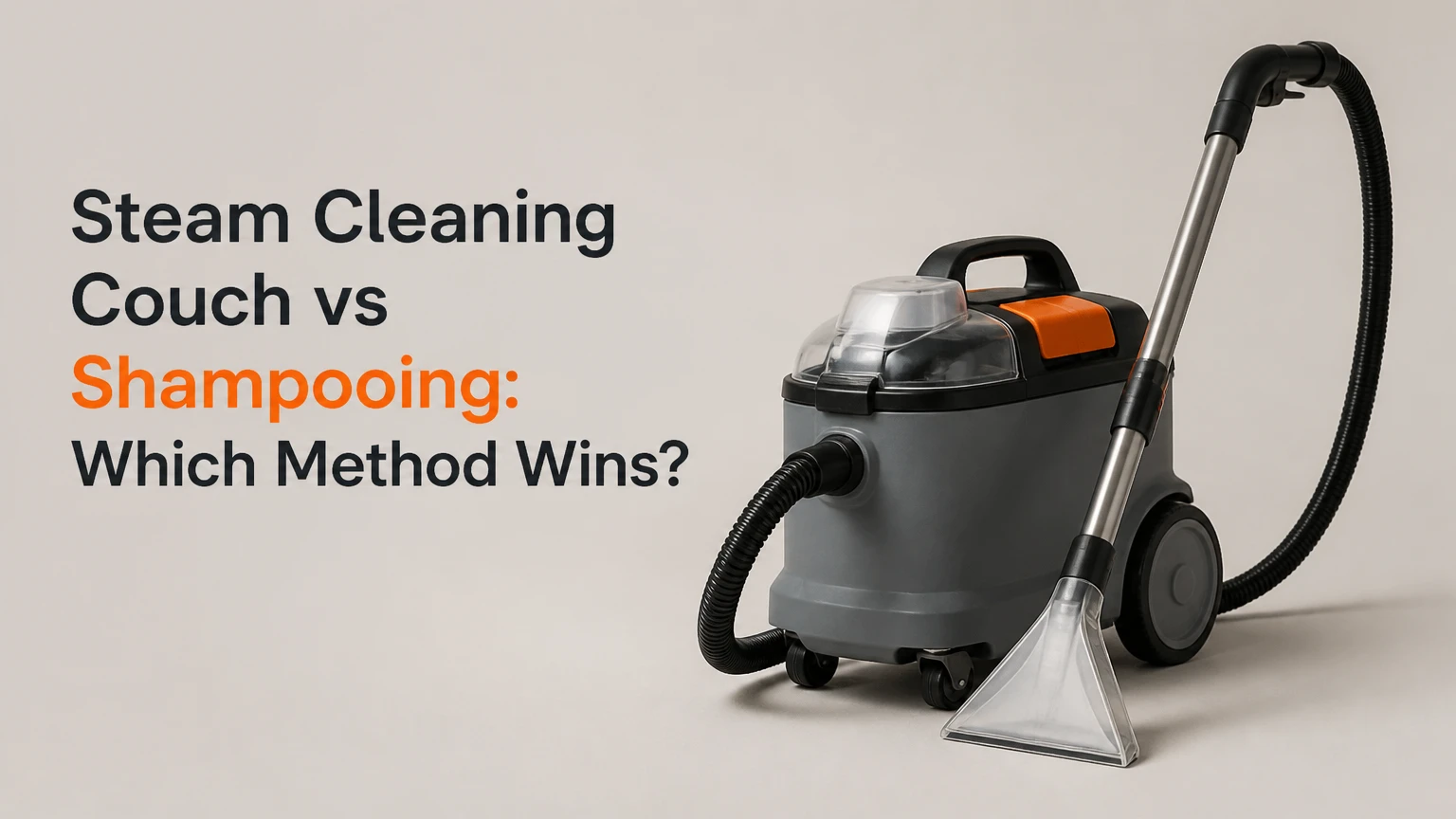
Steam cleaning is usually the better choice for a water-safe couch with embedded dust, body oil, pet dander, and ordinary household soil because hot-water extraction rinses and removes contaminants with relatively little residue. Shampooing is more useful for targeted, greasy discoloration, but it requires careful dilution, agitation, rinsing, and longer drying.
Key Facts at a Glance
- The upholstery care code, not the stain alone, determines whether water-based cleaning is permitted.
- “Steam cleaning” commonly means hot-water extraction, while a vapor steamer may apply heat without recovering dirty water.
- Shampooing can loosen oily soil effectively, but incomplete rinsing leaves detergent residue that attracts new dirt.
- A professionally extracted couch typically dries in 4-8 hours; heavily wetted cushions may require 12-24 hours.
- Fabric marked S or X should not receive DIY steam, shampoo, or ordinary water extraction.
- Pet urine, milk, and other biological contamination may require enzyme treatment and separate odor remediation.
Steam cleaning couch vs shampooing: the decision rule
For a W or WS fabric couch, choose hot-water extraction for general soil, allergens, body oils, and routine deep cleaning. Choose controlled shampooing only when a visible oily or sticky stain needs detergent chemistry that a light extraction pre-spray cannot dissolve. The method should follow the fabric code, fiber type, stain chemistry, and drying environment.
The most important distinction is equipment. A hot-water extraction machine sprays warm or hot solution and immediately vacuums the liquid back out. A vapor steamer produces low-moisture vapor and may sanitize or loosen surface soil, but it does not automatically remove dissolved dirt. Calling both processes “steam cleaning” can lead to the wrong expectations and excessive moisture.
Quick Verdict by User
| User situation | Preferred method | Reason | Typical recovery time |
|---|---|---|---|
| Routine soil on W fabric | Hot-water extraction | Rinses body oil and suspended soil | 4-8 hours |
| Small greasy food mark | Diluted upholstery pre-spray plus extraction | Chemistry targets oil without soaking the whole couch | 2-6 hours |
| Pet dander and dust | Extraction after thorough vacuuming | Removes particulate soil instead of redistributing it | 4-8 hours |
| S-coded upholstery | Professional solvent cleaning | Water can cause rings, shrinkage, or dye movement | 2-8 hours |
| Vintage velvet or silk | Specialist assessment | Heat, water, and brushing can cause irreversible damage | Varies |
| Musty cushion interior | Professional remediation | Surface cleaning cannot reliably dry contaminated foam | 12-48 hours |
How do the two methods work?
Hot-water extraction uses a cleaning solution, agitation, and vacuum recovery. The applicator places a controlled amount of solution into the face fabric, while suction removes dissolved soil and much of the moisture during the same pass. The process depends more on flushing and recovery than on steam temperature alone.
Shampooing uses surfactants to surround oil and particulate soil. Brushing or mechanical agitation distributes the detergent through the textile, after which the foam or liquid must be removed. Foam products may dry into a residue that can be vacuumed, while liquid shampoo normally needs wet extraction and a clean-water rinse.
Steam cleaning and hot-water extraction are not identical
A truck-mounted upholstery extractor can deliver stronger vacuum recovery than a compact consumer machine, but professional performance still depends on the operator’s water volume, tool angle, fabric construction, and drying setup. Many portable “steam cleaners” use hot tap water at approximately 50-60°C rather than generating true steam.
A vapor steamer is a different tool. Low-moisture vapor can loosen surface grime around seams and hard trim, yet vapor alone cannot recover dissolved oil from cushion foam. For fabric upholstery, a vapor steamer should be treated as a specialized adjunct, not a complete replacement for extraction.
Heat also does not guarantee sterilization. Microbial reduction depends on temperature at the contaminated surface and the time that temperature remains there; a brief pass over thick upholstery may not expose every organism to the same conditions. The EPA distinguishes cleaning from sanitizing and disinfecting, so “kills 99.9%” claims should be accepted only when the product and application are specifically validated.
What shampooing adds
Upholstery shampoo can outperform plain water on sticky cooking grease, cosmetic oils, dried food, and oily hand marks because surfactants change how those soils interact with water. Shampoo is not automatically deeper, however. Heavy scrubbing can push soil below the face fabric, distort a nap, or abrade a loose weave.
A professional may use a low-foaming pre-spray, a soft upholstery brush, and a hot-water rinse rather than saturating the fabric with thick shampoo. Encapsulation products are another low-moisture option: polymers surround soil as the fabric dries, and subsequent vacuuming removes the brittle particles. Encapsulation is generally better suited to light maintenance than heavily contaminated cushion interiors.
Which factors determine the better method?
The winning method changes with four variables: fabric tolerance, soil chemistry, moisture exposure, and recovery capacity. A couch with water-safe polyester in a dry room can tolerate a very different process from a linen blend in a humid apartment.
| Decision factor | Hot-water extraction | Shampooing | Practical implication |
|---|---|---|---|
| Water tolerance | Requires W or WS code | Requires W or WS code for liquid products | Neither method is suitable for S or X |
| General dust and body soil | Strong after pre-vacuuming | Moderate to strong with thorough rinsing | Extraction usually leaves less residue |
| Thick grease | Strong with pre-treatment | Strong with detergent and agitation | Shampoo may help targeted oily marks |
| Residue risk | Low with correct solution ratio | Moderate to high if under-rinsed | More detergent does not mean better cleaning |
| Drying demand | Typically 4-8 hours | Typically 8-24 hours | Humidity and cushion thickness matter |
| Mechanical stress | Low to moderate | Moderate to high | Brush gently on velvet, chenille, and loose weaves |
| Equipment requirement | Extractor and upholstery tool | Shampoo applicator, brush, and extractor | A rinse-extraction step remains important |
| Main failure mode | Over-wetting or browning | Sticky residue or abrasion | Operator control matters more than labels |
Is steam cleaning better for stains?
Hot-water extraction is better for broad, embedded soil, but no cleaning method is universally best for stains. Fresh water-based spills, dust, dander, and ordinary body oil often respond well to pre-treatment followed by extraction. Old tannin, dye, ink, rust, and permanent fiber damage may remain after cleaning.
Protein stains need special care. Blood, milk, egg, and some food residues can become harder to remove when exposed to excessive heat before an appropriate enzyme or protein treatment. Use cool or lukewarm treatment first when the stain identity is known, and follow the chemical manufacturer’s instructions.
| Soil or stain | Preferred first treatment | Heat guidance | Likely result |
|---|---|---|---|
| Dust and loose crumbs | HEPA vacuuming | No heat needed | High removal before wet cleaning |
| Body oil | Upholstery pre-spray | Warm extraction | Usually good on W polyester |
| Cooking grease | Solvent-compatible pre-treatment or shampoo | Moderate heat only | Good when rinsed completely |
| Milk or blood | Enzyme or protein-specific product | Avoid high heat initially | Variable on aged stains |
| Pet urine | Enzyme treatment with controlled extraction | Do not rely on steam alone | Odor may persist in foam |
| Ink or transfer dye | Professional solvent assessment | Avoid random heat | High risk of setting or spreading |
| Rust | Specialist rust remover | Follow product limits | Steam and shampoo are poor choices |
| Water ring | Controlled re-wetting of panel | Low heat, even drying | Often reversible if dye is stable |
Does shampooing clean deeper?
Shampooing does not inherently clean deeper than extraction. A detergent may dissolve a particular soil more effectively, but depth depends on solution penetration, agitation, dwell time, and the ability to recover contaminated liquid from the cushion.
A useful practitioner rule is to use the least aggressive chemistry that can mobilize the soil, then maximize recovery. If a shampoo application creates more liquid than the extractor can remove, the apparent cleaning gain can be offset by wick-back, odor, residue, or damp foam.
What fabric code should you check first?
The care label is the first decision gate. Upholstery codes are industry guidance, not a guarantee that every product or machine is safe, so test an inconspicuous area after identifying the code.
| Code | Manufacturer intent | Permitted DIY approach | Main hazard |
|---|---|---|---|
| W | Water-based cleaning permitted | Low-moisture shampoo or extraction | Shrinkage, browning, over-wetting |
| S | Solvent-based cleaning only | Professional solvent method | Water rings, dye bleed, distortion |
| WS | Water- or solvent-based cleaning permitted | Test either approved method | Fiber-specific reaction |
| X | Vacuum or brushing only | Dry vacuuming and gentle brushing | Permanent water or chemical damage |
A W code does not mean “use unlimited steam.” Cotton, rayon, linen, and viscose can shrink, brown, or develop texture changes even when water cleaning is permitted. Synthetic microfiber and polyester often tolerate controlled extraction better, but seam construction, backing, dyes, and cushion foam still matter.
S-coded fabric requires particular caution. Do not infer safety from a couch’s appearance, a removable cushion, or a retailer’s generic cleaning video. If the label is missing, treat the upholstery as unverified and obtain a professional fiber assessment before applying water.
Can you steam-clean microfiber, velvet, or leather?
Microfiber can often receive controlled water-based extraction when its label permits W or WS cleaning, but aggressive brushing can create visible directional shading. Velvet requires a nap-sensitive process and may need professional dry cleaning or specialized low-moisture treatment. Leather should not be treated like fabric upholstery; leather cleaner and conditioner are the relevant product categories.
Rayon and viscose deserve extra caution because water can distort their appearance and create irreversible browning. Wool may tolerate certain professional methods, but excessive heat, alkalinity, and agitation can felt or shrink the fiber. Fabric content matters even when the visible surface looks durable.
How do you steam-clean a couch safely?
A controlled extraction clean usually takes 30-60 minutes of active work and 4-8 hours of drying for a standard three-seat couch. The success factors are complete dry vacuuming, a hidden-patch test, low solution volume, and repeated vacuum-only passes.
Step 1: Read the label and inspect construction
Find the care tag beneath cushions or along the platform. Record the code, fiber content, removable-cover instructions, loose seams, exposed wood, metal fasteners, and cushion foam condition.
Do not proceed if the code is S or X. If the couch has severe odor, sagging foam, rust stains, or visible mold, photograph the condition and arrange an assessment rather than forcing a DIY clean.
Step 2: Vacuum dry soil
Use an upholstery nozzle, crevice tool, and soft brush to remove crumbs, hair, dust, and pet dander. Spend approximately 5-10 minutes on each seat, back, seam, and underside edge.
You will know the step worked when the vacuum bin collects little additional debris during a second pass. Wetting loose soil first turns removable particles into slurry.
Step 3: Test color and texture
Apply a teaspoon of diluted cleaning solution to a hidden 2-by-2-inch area. Blot with a white towel, allow it to dry, and inspect for dye transfer, ring formation, stiffness, shrinkage, or nap change.
A towel showing the couch’s color is a stop signal. Do not compensate by reducing heat after visible dye bleeding has occurred.
Step 4: Pre-treat selected soil
Apply upholstery pre-spray only to soiled areas, using the label’s dilution. Allow approximately 5-10 minutes of dwell time without letting the product dry.
Use enzyme products for suitable biological residues and grease-targeting chemistry for oily marks. Never mix bleach, ammonia, vinegar, or incompatible commercial chemicals.
Step 5: Extract in small sections
Work on one cushion or 2-by-2-foot section at a time. Spray during the forward or pull stroke according to the machine instructions, then make a second slow pass with the trigger released.
Overlap passes by approximately 25 percent. Keep the upholstery tool moving rather than parking it on fabric, because stationary heat and moisture can produce a tide mark.
Step 6: Rinse when detergent was used
If pre-spray or shampoo was applied, make clean-water extraction passes until recovered water contains little foam. Do not flood the cushion to chase perfectly clear water; the goal is low residue with controlled moisture.
The fabric should feel damp, not wet enough to compress water from the foam. That distinction predicts drying time better than the machine’s advertised suction power.
Step 7: Dry aggressively and evenly
Remove loose cushions, stand them on edge, open interior doors, and direct fans across—not directly into—the fabric surface. A dehumidifier is useful when indoor humidity exceeds approximately 60 percent.
Typical drying is 4-8 hours in a ventilated room and 12-24 hours for thick foam, humid weather, or heavy application. Do not reinstall cushions or sit on the couch until the underside and seams are dry.
How do you shampoo a couch without leaving residue?
Shampooing a couch safely requires measured dilution, light application, gentle agitation, and clean-water extraction. Active cleaning usually takes 45-90 minutes, while drying commonly takes 8-24 hours because shampooing often introduces more liquid.
Step 1: Pre-vacuum and isolate a section
Vacuum all dry soil, then clean one cushion or one armrest before treating the rest. Sectioning reveals whether the chemistry works and prevents a whole-couch failure.
Step 2: Dilute exactly
Measure the product according to its label, often in ounces per gallon of water. Never increase concentration to compensate for inadequate vacuuming or a short dwell time.
Excess surfactant causes crunchy texture and rapid resoiling. The detergent must be removed, not left behind as a cleaning “protective layer.”
Step 3: Apply sparingly and agitate gently
Use foam or a light spray rather than saturating the cushion. Work with a soft upholstery brush, following the fabric’s nap and avoiding circular scrubbing on loose or delicate weaves.
A 3-5 minute dwell time is typical, but drying product on the surface is not acceptable. Add moisture only when the section remains workable.
Step 4: Rinse and extract
Use an extractor with clean water and several slow vacuum-only passes. Empty the recovery tank frequently so suction remains stable and the dirty solution does not contact the fabric again.
The success checkpoint is a soft, clean-feeling surface after drying, without tackiness or a visible foam line. A crisp or sticky hand feel indicates incomplete rinsing.
Step 5: Dry before judging the result
Shampoo can make a couch appear cleaner while damp, then reveal browning or wick-back after drying. Wait until the fabric and cushion core are fully dry before deciding whether a second treatment is necessary.
Do not repeat shampoo immediately. Additional detergent can compound residue and make later professional correction harder.
How much do couch cleaning methods cost?
Typical professional upholstery cleaning costs $120-$250 for a three-seat couch in the United States, while DIY costs range from approximately $30 for solution and rental time to $300 for a portable extractor. Local labor rates, access, fabric risk, stain treatment, and sectional size cause substantial variation.
| Cost or time item | DIY extraction | DIY shampooing | Professional service |
|---|---|---|---|
| Equipment or rental | $30-$150 | $30-$80 | Included in service |
| Cleaning solution | $10-$30 | $10-$35 | Included or itemized |
| Three-seat active time | 30-60 minutes | 45-90 minutes | 45-90 minutes |
| Typical drying time | 4-8 hours | 8-24 hours | 4-8 hours with strong recovery |
| Typical total price | $40-$180 | $40-$115 | $120-$250 |
| Sectional or add-on seat | $20-$60 | $20-$60 | $25-$75 per section |
A quote below the typical range may exclude stain treatment, travel, protector, or a required solvent process. A quote above it may reflect delicate-fabric expertise, severe odor remediation, large sectional dimensions, or difficult access.
Which method is safer for pets, children, and allergies?
Extraction is generally the stronger routine choice for homes with pets or allergy concerns because it removes suspended soil rather than leaving a detergent film. Neither steam nor shampoo makes a couch permanently allergen-free, and neither method reliably removes pet urine odor embedded in foam without targeted treatment.
Pet urine and biological odors
First remove the urine source and identify how far contamination traveled. A surface extraction can improve appearance while leaving odor compounds in cushion foam, batting, or the platform beneath the cushion.
Use a compatible enzyme treatment only when the product is labeled for the contamination and fabric. Saturating the cushion with enzyme solution without a recovery and drying plan can create a second moisture problem.
Children and food spills
Shampoo can be useful for a small greasy food mark, crayon residue, or oily handprint when the fabric code permits water. Pre-vacuum, spot-test, apply measured chemistry, and rinse the treated area rather than shampooing the entire couch.
Milk and protein foods require caution with heat. Treat the residue first, then use moderate extraction after the product’s dwell time.
Dust mites and allergens
Vacuuming with a sealed HEPA system removes dry particulate matter before either wet method. Hot-water extraction can remove allergens carried in dust, but a brief vapor pass should not be described as proof that every mite, bacterium, or mold spore has been eliminated.
The American Lung Association recommends controlling indoor dust and humidity as part of broader allergy management. Upholstery cleaning is one intervention, not a substitute for mattress encasements, ventilation, or source control.
What are the alternatives to steam and shampoo?
Low-moisture encapsulation, solvent cleaning, and dry vacuuming are the main alternatives. The appropriate option depends on whether the couch cannot tolerate water, needs only surface maintenance, or requires reduced drying time.
| Alternative | Best fabric or situation | Moisture level | Typical limitation |
|---|---|---|---|
| Encapsulation cleaning | Light soil on W or WS fabric | Low | Weak against heavily soiled cushion foam |
| Solvent cleaning | S-coded upholstery | Very low | Requires compatible solvent and ventilation |
| HEPA vacuuming | X-coded fabric and routine maintenance | None | Does not dissolve oil or remove deep stains |
| Dry foam service | Delicate water-sensitive surface | Low | May leave residue without skilled removal |
| Professional restorative cleaning | Vintage, stained, or high-value furniture | Controlled | Costs more than ordinary DIY cleaning |
Professional upholstery cleaners may combine methods. For example, a technician can vacuum, apply a solvent or enzyme pre-treatment, use controlled hot-water extraction on a compatible face fabric, and accelerate drying with air movement. The correct process is often a sequence rather than a single branded method.
What problems occur after couch cleaning?
The most common failures are excess moisture, detergent residue, dye movement, browning, and incomplete odor removal. Each problem has a different cause, so repeating the same cleaning method can worsen the damage.
Crunchy or sticky fabric
Crunchiness usually indicates dried detergent or mineral residue. Vacuum the fully dry surface, then have the area rinsed with controlled extraction; do not automatically apply vinegar, because acidic products can affect dyes, finishes, and mixed fibers.
Musty odor
A musty smell usually means cushion foam, batting, or the couch platform stayed damp too long. Increase airflow and dehumidification immediately, but persistent odor after 24-48 hours requires professional inspection for internal contamination.
Water rings and browning
Water rings form when moisture dries unevenly and transports dissolved soil or dye to the perimeter. Browning is especially associated with cellulosic fibers and alkaline conditions, so random re-wetting can enlarge the affected area.
A professional may clean the entire panel evenly, use an approved acidic rinse, or apply a browning treatment. Test first. A small mist of distilled water is not a universal cure.
Dye bleeding or texture change
Dye transfer means the fabric is unstable under the selected moisture, chemistry, or agitation. Stop wet cleaning, blot without rubbing, and allow the section to dry naturally while seeking specialist advice.
Resoiling within days
Rapid resoiling commonly results from detergent left in the pile, oily pre-spray not rinsed away, or a sticky household product previously applied. The cure is residue removal and source control, not a stronger shampoo.
What expert rules prevent most damage?
Experienced upholstery cleaners use three rules: identify the code before the chemistry, maximize soil recovery rather than solution volume, and dry the cushion core rather than merely the surface.
- Rule 1: Clean the least aggressive way that can work. A full-couch shampoo is excessive when a pre-vacuum and targeted extraction can remove the soil.
- Rule 2: Recovery determines safety. A powerful spray with weak vacuum recovery can leave more moisture than a modest machine used with slow, repeated dry passes.
- Rule 3: The face fabric is not the whole couch. Odor and moisture can remain in foam, batting, webbing, and wood even when the visible cover feels dry.
- Rule 4: Always judge after drying. Wick-back, browning, stiffness, and texture change may appear hours after cleaning.
- Rule 5: Preserve reversibility. A mild, tested treatment leaves more options than heat, aggressive brushing, or multiple unrecorded chemicals.
A useful limitation is that neither method repairs worn fibers, sun bleaching, permanent dye transfer, rust, or foam breakdown. Cleaning can reveal the original damage by removing surrounding soil, which may make a couch look uneven even though the cleaning itself succeeded.
Which should you choose?
Choose hot-water extraction for routine deep cleaning
Select controlled extraction when the couch is W or WS coded, the fabric is stable, and the problem is embedded dust, body oil, pet dander, or general dinginess. Use modest solution volume and dry the cushions separately.
Choose shampoo for a localized oily stain
Select shampoo when a small area contains sticky grease or food residue that responds to surfactants. Use a measured product, soft agitation, and a clean-water rinse, rather than applying thick foam across every cushion.
Choose a professional for delicate or valuable furniture
Professional service is the safer choice for S-coded furniture, rayon, viscose, silk, antique velvet, unstable dyes, severe browning, or high-value upholstery. Ask the cleaner to identify the fiber, explain the proposed method, and state the drying plan.
Choose neither method for X-coded upholstery
Vacuum and brush X-coded upholstery only as directed by the furniture maker. A water-based experiment can create permanent rings, shrinkage, backing failure, or dye damage that exceeds the cost of professional assessment.
FAQ
Can I shampoo a couch after steam cleaning?
Usually, no immediate second process is needed. Allow the couch to dry completely and assess the remaining soil first. Shampooing damp upholstery can dilute the detergent unpredictably, increase moisture in the cushion core, and make residue removal difficult. If a greasy mark remains, spot-treat it after the fabric is dry and retest first.
How often should a fabric couch be deep-cleaned?
Many households need professional or DIY deep cleaning every 6-12 months, while homes with pets, smoking, children, or heavy daily use may need cleaning every 3-6 months. Vacuum weekly and treat spills promptly. Cleaning too often can stress dyes, finishes, seams, and cushion foam.
Can I use a carpet shampooer on a couch?
Only when the machine manufacturer approves the upholstery tool and the couch’s care code permits water. Carpet tools can deliver excessive solution, have unsuitable suction geometry, or leave upholstery wetter than intended. Use an upholstery attachment, low-foaming formula, and a hidden-patch test.
Why does my couch smell worse after cleaning?
Odor can intensify because moisture reactivates compounds in foam, batting, urine residue, or old detergent. Improve airflow and lower humidity while the couch dries. If the smell remains after 24-48 hours, surface shampooing is unlikely to solve the source, and internal inspection or specialist odor treatment may be necessary.
Is a handheld vapor steamer enough to clean a sofa?
A handheld vapor steamer can loosen limited surface grime and treat seams, but it does not recover dissolved soil or moisture. It is not equivalent to hot-water extraction. Use vapor only on a compatible care code, keep the tool moving, and avoid relying on heat alone for grease, urine, or deep cushion contamination.
Will steam cleaning remove all allergens?
Steam or hot-water extraction can remove allergens contained in dust and pet debris, but it cannot guarantee complete allergen elimination. Results depend on vacuuming, penetration, recovery, drying, and ongoing household controls. Washable covers, HEPA vacuuming, humidity control, and source reduction remain necessary for sustained improvement.
The Bottom Line
For most W and WS fabric couches, hot-water extraction is the better all-purpose choice because it combines controlled cleaning chemistry with soil and moisture recovery. Shampooing has a narrower role for localized oily stains and requires thorough rinsing. In steam cleaning couch vs shampooing decisions, fabric code, stain chemistry, extraction strength, and drying capacity matter more than the method’s label.