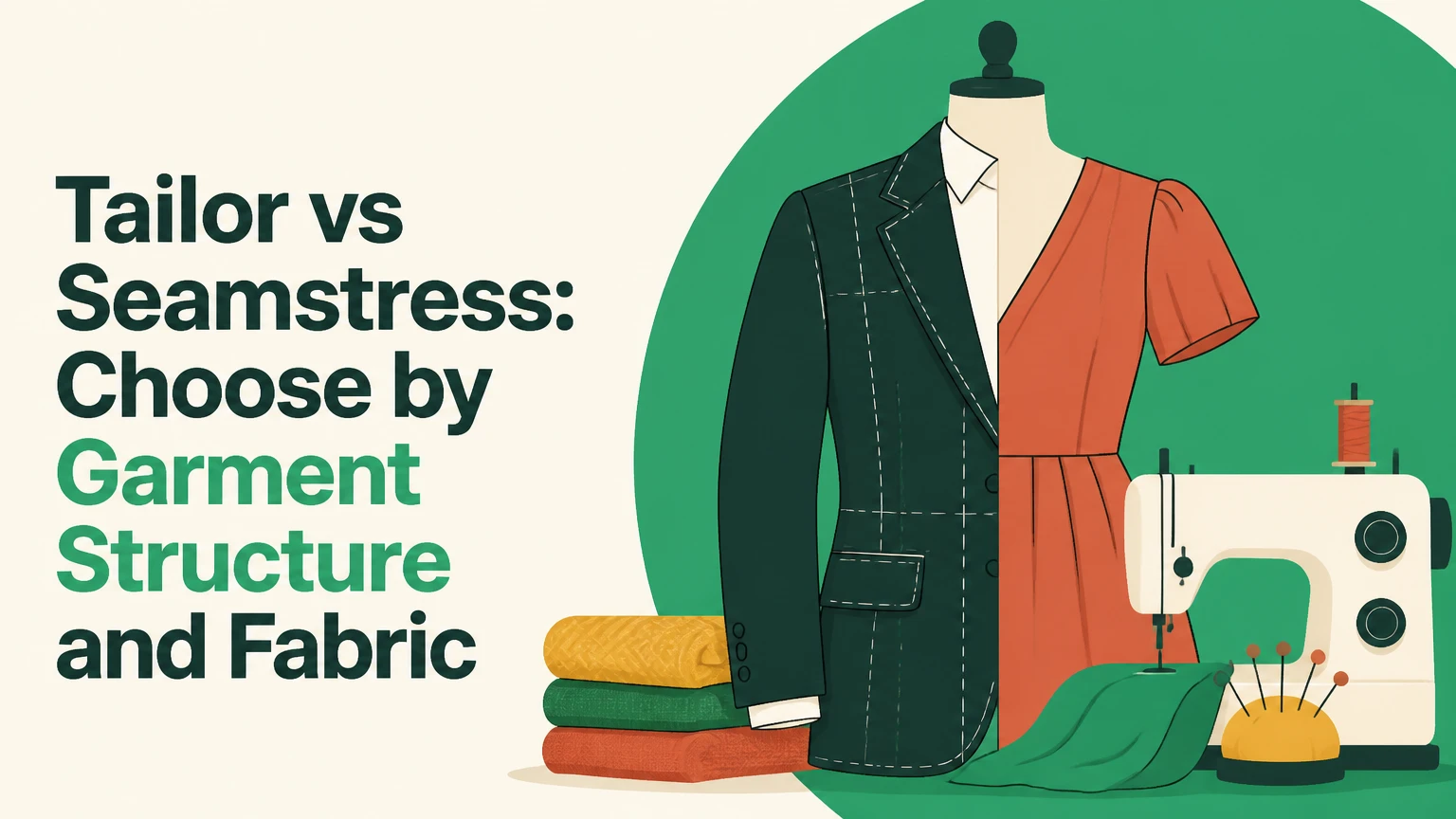
A tailor specializes in fitting and constructing structured garments such as suits, jackets, coats, and trousers, while a seamstress specializes in sewing, repairing, and altering dresses, gowns, skirts, and everyday clothing. The distinction is useful, but portfolios overlap, so the garment’s structure, fabric, and alteration difficulty matter more than the job title alone.
Key Facts at a Glance
- Tailors work most often with jackets, trousers, coats, waistcoats, canvassing, padding, and structured fitting.
- Seamstresses work most often with dresses, gowns, hems, zippers, soft fabrics, decorative finishes, and general repairs.
- A tailor is usually the safer choice for suit shoulders, lapels, chest fit, jacket balance, and posture corrections.
- A bridal seamstress or dressmaker is usually the safer choice for lace, tulle, chiffon, beading, corsetry, and bustle construction.
- Typical basic alterations cost $15-$120, while bridal, custom, and bespoke work can cost $300-$6,000 or more.
- Job titles are inconsistent. A professional’s recent work on the same garment type is stronger evidence than the sign above the shop.
What Is the Difference Between a Tailor and a Seamstress?
A tailor engineers garment shape, fit, and internal structure; a seamstress specializes in stitching, fabric handling, garment construction, and repair. Tailoring traditionally centered on menswear, but contemporary tailors also make and alter structured womenswear, including blazers, formal trousers, coats, and tailored dresses.
A seamstress is not an inferior version of a tailor. Seamstresses often have deeper practical knowledge of fluid fabrics, curved seams, hems, appliqué, lace placement, invisible zippers, and decorative handwork. A dressmaker may draft or adapt patterns for complete garments, whereas a general seamstress may focus on repairs and alterations.
The distinction is professional rather than legally fixed. In the United States, United Kingdom, Canada, and Australia, businesses may use “tailor,” “seamstress,” “dressmaker,” or “alterations specialist” differently. A shop called a tailor may outsource bridal work, while an experienced seamstress may successfully alter a soft-structured women’s suit.
Tailor, Seamstress, Dressmaker, and Alterations Specialist
These titles describe different emphases, not an absolute ranking. A tailor generally prioritizes three-dimensional structure, a dressmaker creates dresses from patterns or designs, and an alterations specialist modifies existing garments without necessarily offering custom construction.
| Professional | Primary work | Typical garments | Best evidence of skill |
|---|---|---|---|
| Tailor | Fit and structure | Suits, coats, trousers, blazers | Jacket interiors, shoulder and sleeve work |
| Seamstress | Sewing and fabric manipulation | Dresses, skirts, shirts, curtains | Clean hems, zippers, delicate fabric finishes |
| Dressmaker | Custom garment construction | Dresses, skirts, costumes | Pattern adaptation and completed custom pieces |
| Alterations specialist | Modification and repair | Jeans, uniforms, jackets, dresses | Before-and-after alteration examples |
The word “seamstress” is gendered, so some professionals use “seamster,” “sewist,” or “garment maker.” The service description still matters more than the label.
Which Garments Should Each Professional Handle?
Choose according to construction rather than the garment’s gender or retail category. A fully canvassed jacket needs different knowledge from a bias-cut silk dress, even when both are expensive formalwear.
| Garment or problem | First-choice professional | Main technical concern | Referral risk |
|---|---|---|---|
| Suit jacket sleeve length | Tailor | Working around vents, lining, and buttonholes | Incorrect sleeve balance |
| Trouser waist or hem | Tailor or alterations specialist | Rise, break, taper, and waistband | Uneven leg line |
| Wool coat reshaping | Tailor | Heavy pressing and internal interlinings | Flattened structure |
| Bridal gown bustle | Bridal seamstress | Layers, train weight, and hidden loops | Dragging or torn fabric |
| Chiffon dress hem | Seamstress | Differential stretch and rolled finish | Wavy hem |
| Beaded evening gown | Bridal or couture seamstress | Weight, bead removal, and lining | Broken embellishment |
| Zipper replacement | Seamstress or repair specialist | Matching zipper length and insertion | Distorted seam |
| Leather jacket alteration | Leather specialist or tailor | Needle holes and material thickness | Permanent visible damage |
A dry cleaner’s counter can handle straightforward hems or zipper repairs, but it may subcontract complex work. Ask who will perform the alteration and whether the business has handled the same fabric and construction before.
Can a Seamstress Alter a Suit?
A seamstress can alter a suit when the work involves simple hems, side seams, trouser waists, or removable buttons, but a tailor is safer for shoulders, chest balance, lapels, canvassing, and major jacket reshaping. The decisive issue is the jacket’s internal construction, not whether the wearer is male or female.
A jacket sleeve can often be shortened from the cuff, but shortening from the shoulder becomes more complex when the sleeve has working buttonholes or a pronounced pitch. Shoulder narrowing can affect the armhole, sleeve head, chest canvas, and lining. Those changes require pattern and structural judgment.
An experienced seamstress may perform this work well. Request photographs of comparable suit alterations before booking.
Can a Tailor Alter a Wedding Dress?
A tailor can alter a wedding dress if the tailor regularly handles gowns, but a bridal seamstress is generally better equipped for trains, bustle systems, lace appliqué, tulle layers, corsetry, and beading. Bridal alterations often require fabric-specific techniques that ordinary menswear tailoring does not include.
A bridal professional should inspect the dress inside and outside, count its layers, identify the hem construction, and test whether embellishments can be moved. Wedding shoes and the intended undergarments should be present at the fitting because both affect length and bodice fit.
How Do Tailoring and Seamstress Work Differ?
Tailoring reshapes a garment through pattern lines, controlled ease, pressing, and internal support; seamstress work more often depends on accurate stitching, seam finishes, fabric grain, drape, and surface detail. Both professions measure, pin, sew, press, and check movement, but they prioritize different variables.
For a structured jacket, the professional may evaluate shoulder slope, chest prominence, jacket balance, sleeve pitch, posture, and the relationship between collar and neck. For a fluid dress, the professional may evaluate bust placement, waist position, bias stretch, hem sweep, lining tension, and drape.
Pressing is an expert separator. Wool can be shaped with steam and pressure, while excessive heat can shine synthetic fibers or damage silk. A professional should know when to press, pad-stitch, ease, baste, or avoid disturbing the original construction.
What Happens During a Professional Fitting?
A standard alteration involves consultation, measurement, fitting, marking, sewing, pressing, and a final check; complex custom work adds pattern development and one or more basted fittings. The customer’s normal posture, shoes, and undergarments determine whether the final measurements remain useful.
- Consultation: Explain the intended use, desired silhouette, deadline, and comfort requirement.
- Assessment: The professional checks fabric, seams, lining, grain, construction, and available seam allowance.
- Measurement and fitting: You wear the garment naturally while the professional observes balance and movement.
- Pinning and marking: Chalk, pins, or temporary stitches indicate the proposed change.
- Construction: The garment is opened, altered, basted, pressed, and resewn.
- Final inspection: You move, sit, raise your arms, fasten closures, and inspect the finished line.
Bespoke tailoring usually includes a draft pattern and a basted fitting. Made-to-measure work modifies a base pattern. An ordinary alteration may require only one fitting.
What Types of Tailors and Seamstresses Exist?
Tailors divide by construction method and garment category, while seamstresses divide by fabric, occasion, and service complexity. Knowing the category helps you avoid paying bespoke prices for a hem or sending a couture gown to a general repair counter.
| Specialist type | Work method | Typical price | Typical timeline |
|---|---|---|---|
| Alterations tailor | Modifies ready-to-wear garments | $15-$250 | 3-21 days |
| Made-to-measure tailor | Adjusts a base pattern | $800-$2,000 for a suit | 4-8 weeks |
| Bespoke tailor | Drafts an individual pattern | $2,500-$6,000+ for a suit | 2-4 months |
| General seamstress | Repairs and alters apparel | $15-$150 | 3-14 days |
| Bridal seamstress | Alters layered formalwear | $300-$1,000+ | 1-3 months |
| Custom dressmaker | Creates dresses from patterns or designs | $500-$2,500+ | 1-2 months |
Prices are typical United States brick-and-mortar ranges, not universal rates. Urban labor costs, designer garments, rush fees, hand finishing, and local demand can change the total substantially.
What Is Bespoke Versus Made-to-Measure?
Bespoke clothing begins with an individual pattern drafted for one client, while made-to-measure clothing adjusts an existing block or factory pattern. Bespoke work normally requires more fittings, more pattern correction, and more labor than made-to-measure construction.
A bespoke tailor may schedule three to five fittings and spend more than 40 labor hours on a complex two-piece suit, although individual practices vary. Made-to-measure usually involves one or two fittings because the base pattern already establishes much of the garment’s geometry.
Neither method guarantees a perfect result. A skilled made-to-measure cutter can outperform a careless bespoke provider, especially when the base pattern and fitting process match the client’s posture.
How Much Do Tailor and Seamstress Services Cost?
Basic hems commonly cost $15-$35, jacket alterations often cost $40-$250, and complex bridal or custom work commonly starts around $300. The final price depends on garment construction, fabric, location, handwork, urgency, and whether the alteration requires disassembly.
| Service | Typical price | Typical turnaround | Fittings |
|---|---|---|---|
| Trouser or skirt hem | $15-$35 | 3-7 days | 1 |
| Zipper replacement | $20-$80 | 3-14 days | 1 |
| Jacket sleeve shortening | $40-$90 | 7-14 days | 1-2 |
| Jacket side adjustment | $50-$120 | 7-14 days | 1-2 |
| Trouser waist adjustment | $30-$90 | 7-14 days | 1 |
| Bridal gown alterations | $300-$1,000+ | 1-3 months | 3-4 |
| Custom dress construction | $500-$2,500+ | 1-2 months | 2-3 |
| Bespoke two-piece suit | $2,500-$6,000+ | 2-4 months | 3-5 |
A low quote may exclude pressing, lining work, bustle construction, bead removal, or a second fitting. Ask for a written estimate that identifies each operation rather than relying on the phrase “standard alterations.”
Which Option Is Faster?
A simple seamstress repair often takes 3-7 days, while structured jacket work commonly takes 7-14 days and bespoke or bridal work takes several weeks or months. Turnaround depends on the queue as much as sewing time, so an advertised rush service may carry a premium.
Bring wedding gowns at least eight weeks before the event when possible. Bring suits two to four weeks before use, especially if sleeves, shoulders, or trousers need coordinated changes. A final fitting should occur after the principal construction is complete, not immediately after the first pinning.
What Can and Cannot Be Altered?
Most garments can be improved when the alteration follows existing seams and enough material remains, but shoulders, armholes, rise, length, and pattern proportions impose hard limits. A professional should refuse or qualify a job when the proposed change would damage balance, grain, design details, or fabric integrity.
| Alteration | Usually feasible? | Main limitation | Warning sign |
|---|---|---|---|
| Hemming trousers or skirts | Yes | Existing hem and lining design | Decorative border would be cut |
| Taking in side seams | Often | Seam allowance and pocket position | Horizontal pulling remains |
| Letting out waist | Sometimes | 1-2 inches of internal allowance is typical | No matching fabric remains |
| Shortening jacket sleeves | Often | Buttonholes and sleeve pitch | Working cuffs near new hem |
| Narrowing shoulders | Difficult | Armhole, sleeve head, and canvas | Shoulder seam already too narrow |
| Increasing bust or hip room | Sometimes | Pattern shape and fabric supply | No side or center allowance |
| Lengthening a dress | Limited | Original hem and border | Lace or beading reaches hem |
| Altering a damaged silk garment | Case-specific | Weak fibers and visible needle marks | Tears spread under handling |
The common “one to two inches of seam allowance” rule is only a rough guide. Allowance may be uneven, interrupted by stitching, or unusable because pressing has permanently shaped the fabric.
Why Do Clothes Pull, Pucker, or Pool?
Pulling usually indicates insufficient ease or incorrect balance, puckering often indicates tension or poor handling, and trouser pooling usually indicates excessive length or an unsuitable break. The visible symptom must be diagnosed while the wearer stands and moves naturally.
| Symptom | Likely cause | Corrective action |
|---|---|---|
| Horizontal lines across chest | Jacket too tight or button position wrong | Reassess chest ease and button placement |
| Collar gap at neck | Shoulder or back balance issue | Adjust collar, shoulder, or upper back |
| Puckered zipper | Insertion tension or fabric mismatch | Reinstall with correct stabilizing method |
| Pants pooling at shoes | Excess length or break preference | Re-hem to slight break or no break |
| Drag lines behind knees | Trouser length, posture, or rise issue | Evaluate rise and leg balance |
| Wavy chiffon hem | Stretch during cutting or sewing | Rehang, stabilize, and recut if needed |
A final garment should permit ordinary movement. A jacket that looks immaculate while standing but strains when reaching for a steering wheel is not correctly fitted.
Which Should You Choose for Your Situation?
Choose a tailor for structured tailoring, a bridal seamstress for layered or embellished gowns, and a general seamstress for everyday repairs. When a garment combines categories, choose the specialist whose portfolio matches the hardest technical operation.
For Suits, Blazers, and Business Clothing
Use an alterations tailor for jacket shoulders, chest, lapels, sleeve pitch, canvassing, and trouser balance. A general seamstress remains suitable for trouser hems, simple side-seam adjustments, or replacing a loose button.
The right tailor should inspect the jacket inside. Half-canvassed, fully canvassed, fused, and unstructured jackets respond differently to reshaping.
For Bridal and Eveningwear
Use a bridal or couture seamstress for gowns with trains, boning, horsehair braid, beading, lace, chiffon, silk, tulle, or multiple underskirts. Ask specifically about bustle styles, hem layers, bead relocation, and whether the professional has worked on the designer’s construction.
A general seamstress may handle a simple bridesmaid dress, but a wedding gown’s weight and internal architecture can exceed ordinary alteration equipment.
For Jeans, Shirts, Zippers, and Casual Clothing
Use a general seamstress, alterations specialist, or reputable repair shop for hems, patching, zipper replacement, sleeve adjustments, and basic waist changes. A tailor may complete these jobs, but the specialist’s availability and price may be more practical.
Denim repairs require matching thread, seam recreation, and sometimes a walking-foot machine. Stretch knits require different needles and techniques from woven cotton.
For Athletic or Asymmetrical Body Proportions
Choose a professional who discusses posture, movement, and pattern balance rather than promising to “take everything in.” Broad shoulders, a narrow waist, forward posture, scoliosis, or unequal leg length may require multiple adjustment points.
Bespoke or made-to-measure construction can solve a recurring fit problem, but it cannot replace a competent consultation. Start with one garment and assess the result before ordering a wardrobe.
How Do You Find the Right Professional?
Review recent examples of the same garment, ask which operations will be performed, and confirm the deadline before leaving the clothing. A portfolio of beautiful dresses does not prove competence with jacket canvassing, and a row of suits does not prove safe handling of beaded silk.
Use this screening checklist:
- Show the exact garment: Bring the item, shoes, and intended undergarments.
- Ask about comparable work: Request examples involving the same fabric and construction.
- Clarify the limitation: Ask what the professional cannot alter safely.
- Request an itemized quote: Separate labor, materials, rush charges, and fittings.
- Confirm responsibility: Determine whether work is performed in-house.
- Set the inspection date: Leave time for correction before the event.
- Check preservation: Ask whether original hems, labels, buttons, or appliqués will be retained.
An honest professional may recommend returning a garment rather than altering it. That refusal can save the customer from an expensive result that remains visibly wrong.
Common Mistakes Before and After Fittings
The most common fitting errors come from inaccurate preparation, unrealistic alteration expectations, and delayed inspection. Customers should wear the intended shoes and undergarments, stand naturally, and inspect movement before accepting the finished garment.
- Wearing different shoes: Heel height changes trouser and dress hems. Bring the actual footwear.
- Changing undergarments later: Padding and compression alter bust, waist, and torso measurements.
- Holding an artificial posture: Sucking in or stiffening the body creates a fit that fails during normal movement.
- Waiting until the event week: Bridal and bespoke queues often require multiple appointments.
- Removing tags too soon: Confirm that the garment is large enough to alter before making it nonreturnable.
- Ignoring the final try-on: Check sitting, walking, reaching, fastening, and closure strain.
- Accepting unexplained pulling: Ask for the cause and remedy before paying the final balance.
What If the Finished Garment Feels Too Tight?
Return the garment promptly and compare the final fit with the fitting-day shoes and undergarments. The professional can inspect available allowance, but a garment cannot always be enlarged when the pattern, fabric, or original seams provide insufficient room.
Do not wash, dry-clean, or wear the garment repeatedly before discussing the issue. New stains, shrinkage, or additional stress can make diagnosis and correction harder.
FAQ
Is a tailor more expensive than a seamstress?
A tailor often costs more for structured jackets, custom suits, and posture-related fitting, while a seamstress may charge less for hems, zippers, and everyday repairs. Prices overlap because fabric, construction, location, labor time, and urgency matter more than the title. A complex bridal seamstress project can exceed a basic tailor alteration.
Is a dressmaker the same as a seamstress?
A dressmaker is a type of garment professional who usually designs or constructs dresses, skirts, and related clothing, while a seamstress may focus on sewing, repairs, and alterations. Many professionals perform both roles. Ask whether the provider drafts patterns and builds complete garments or only modifies existing clothing.
Should I use a tailor or seamstress for a bridesmaid dress?
Use a seamstress with bridal or formalwear experience for a bridesmaid dress, especially when it includes chiffon, satin, lace, lining, or an invisible zipper. A tailor can handle a simple structured dress, but the provider should show recent work with the fabric and construction before accepting the appointment.
Can a tailor make women’s clothing?
Yes, a tailor can make and alter women’s clothing when the tailor has experience with the relevant design and fabric. Tailoring is not limited to menswear. A women’s blazer, wool coat, trouser suit, or structured dress may suit a tailor, while a flowing gown may suit a dressmaker or bridal seamstress.
How early should I book alterations?
Book ordinary alterations one to three weeks before wearing the garment, suits two to four weeks ahead, and bridal or complex formalwear at least eight weeks ahead. Bespoke work commonly requires two to four months. The shop’s current queue can extend every timeframe, so confirm the completion date in writing.
What is the most important question to ask?
Ask, “Have you altered this garment type and fabric before, and what part is risky?” The answer reveals practical experience, equipment, and honesty about limitations. A professional who explains seam allowance, lining, embellishment, balance, and movement gives stronger evidence than a generic promise of a perfect fit.
The Bottom Line
The best answer to tailor vs seamstress depends on the garment’s construction and the operation required. Choose a tailor for suits, coats, trousers, jackets, and structured fit corrections; choose a seamstress for gowns, dresses, delicate fabrics, hems, zippers, and general sewing. For borderline jobs, compare portfolios, request an itemized quote, and select the professional who regularly performs the most technically demanding part of the work.