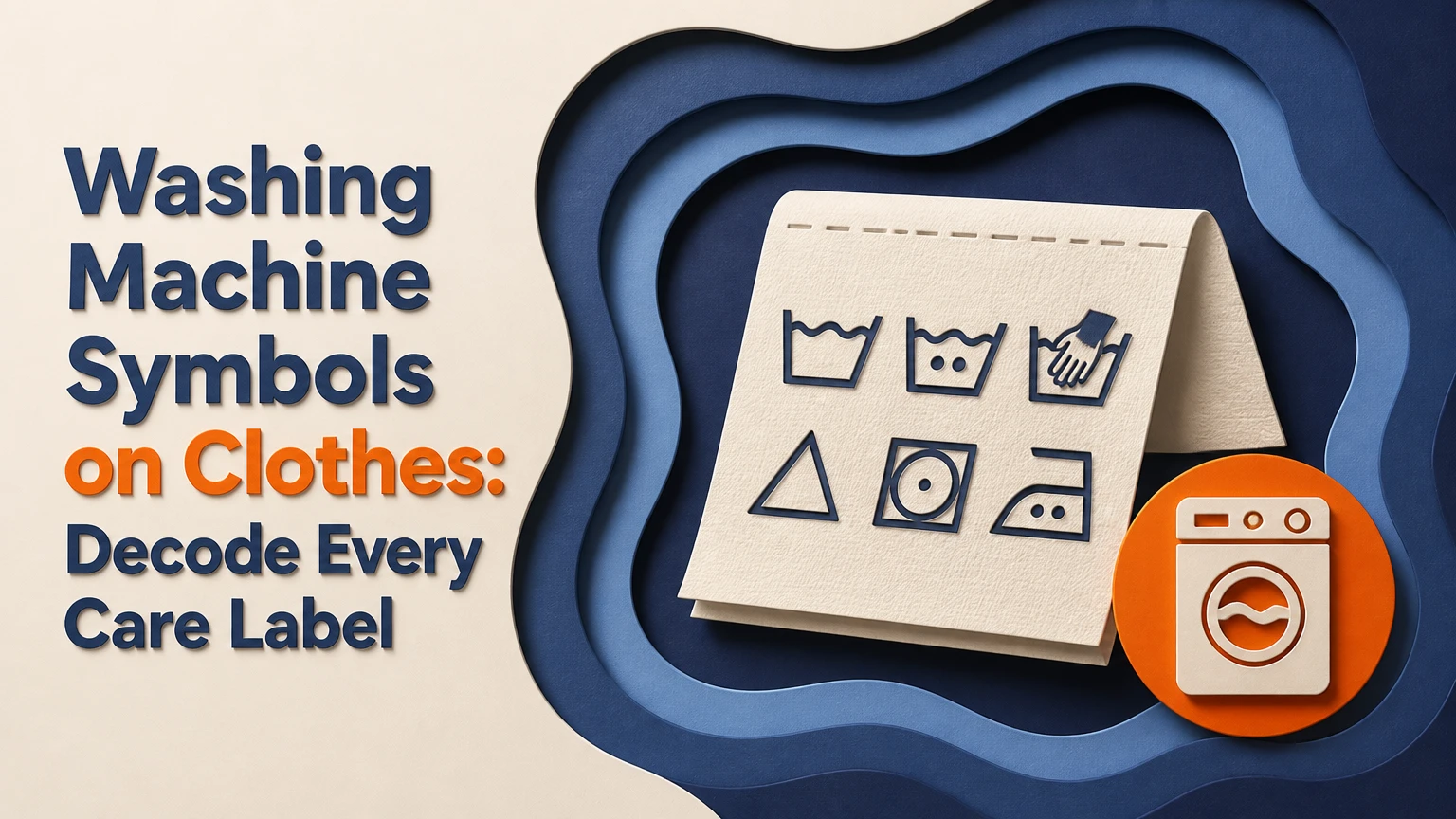
Washing machine symbols on clothes are standardized care-label pictograms that show whether a garment may be washed, bleached, dried, ironed, or professionally cleaned. The washtub symbol gives the washing method and maximum temperature, while bars, dots, numbers, and crosses modify the cycle, heat level, or permitted action.
Key Facts at a Glance
- A washtub means water washing; a hand inside the tub means hand washing only.
- The number or dots inside a washtub show the maximum washing temperature, not a required temperature.
- One or two bars under a washtub require gentler machine action and usually lower spin speeds.
- A triangle controls bleaching, a square controls drying, an iron controls pressing, and a circle controls professional cleaning.
- A cross over a symbol means do not perform that process.
- The safest setting for an uncertain everyday garment is usually 30°C, a gentle cycle, mild detergent, and air drying.
What Do the Symbols on Clothing Labels Mean?
Clothing care symbols translate textile limits into household instructions. The five main pictograms normally appear in this order: washing, bleaching, drying, ironing, and professional care. Each shape identifies a process, while internal marks specify temperature, mechanical force, solvent type, or prohibition.
The system is based internationally on ISO 3758, used with the GINETEX care-label framework in many markets. North American labels commonly follow ASTM D5489 conventions, although United States labels may also include written instructions and temperature numbers. The same basic visual grammar remains recognizable across regions.
A care label is not a recommendation to use the strongest available setting. The temperature is a ceiling, and the permitted process describes the harshest treatment the manufacturer expects the garment to tolerate under stated conditions. Washing below the maximum can reduce color loss, fiber stress, and energy use.
Where Is the Care Label?
Care labels are commonly sewn into a side seam, the back neckline, or an inner waistband. Bedding and towels may have labels in a corner seam, while sportswear often places a small printed label inside the lower side seam.
A missing label changes the decision from instruction-following to risk management. Fabric composition, colorfastness, structure, and decoration become more important because a material label alone cannot reveal whether adhesives, coatings, pleats, or prints can tolerate water and heat.
How Do You Read Washing Machine Symbols on Clothes?
Read the washtub from left to right: identify whether water washing is allowed, check the temperature, then check the bars or hand symbol. A crossed tub excludes machine washing, a hand symbol requires manual washing, and an unmarked tub permits the strongest cycle allowed by the listed temperature.
The bars indicate mechanical treatment rather than water temperature. A plain tub generally corresponds to a normal cycle; one bar indicates a permanent-press or reduced-action cycle; two bars indicate a very gentle or delicate cycle. Machine names differ, so select the program with the lowest comparable agitation and spin.
A manufacturer may label a polyester blouse with a 40°C tub and one bar. That does not mean the blouse belongs with towels. The correct practical choice is a 30°C or 40°C synthetics or easy-care program, moderate detergent, and reduced spinning if the appliance offers that control.
Washing Symbol Reference
| Washtub mark | Maximum temperature | Mechanical instruction | Typical examples |
|---|---|---|---|
| Plain tub, 30 | 30°C / 86°F | Normal machine cycle | Dark cotton shirts, colored casualwear |
| Plain tub, 40 | 40°C / 104°F | Normal machine cycle | Cotton blends, everyday underwear |
| One bar, 40 | 40°C / 104°F | Permanent press, reduced spin | Polyester shirts, nylon blends |
| Two bars, 30 | 30°C / 86°F | Delicate cycle, gentle agitation | Lace, silk blends, fine knitwear |
| Hand in tub, 30 | 30°C / 86°F | Hand wash, no machine cycle | Wool, fragile garments, embellished items |
| Crossed tub | Not permitted | Do not wash with water | Some tailored, leather, or solvent-only items |
A tub containing a number uses an explicit Celsius maximum. A tub containing dots uses a heat scale, particularly on North American labels. One dot generally indicates cold or 30°C treatment, two dots commonly indicate 40°C, and three dots commonly indicate 50°C, but the exact regional convention should be checked against the garment’s written label.
What Do the Bars Under a Washtub Mean?
Bars under a washtub reduce mechanical stress. One bar calls for a permanent-press or easy-care cycle, and two bars call for a delicate cycle with gentler agitation and slower spinning than a plain tub.
The bar is not a cleanliness rating. A two-bar item can be heavily soiled, but removing the soil may require pretreatment and extra soaking rather than more agitation. A practical rule is to treat bars as limits on force, not as instructions to use less detergent.
What Do Temperature Dots and Numbers Mean?
Temperature dots and numbers show the highest permitted wash temperature. They do not require hot water, and a 40°C label can normally be washed at 30°C when the lower temperature still removes the soil.
| Label indicator | Common maximum | Fahrenheit equivalent | Practical use |
|---|---|---|---|
| One dot or 30 | 30°C | 86°F | Wool, silk, dark colors, delicate synthetics |
| Two dots or 40 | 40°C | 104°F | Everyday clothing and mixed fibers |
| Three dots or 50 | 50°C | 122°F | Selected durable colored textiles |
| Four dots or 60 | 60°C | 140°F | White cotton, towels, sheets |
| Five or six dots, or 70-95 | 70-95°C | 158-203°F | Specialized durable cotton and hygiene cycles |
The actual water temperature may vary during a cycle, and household machines do not always deliver the exact drum temperature shown on the display. Hotter washing can improve removal of body oils and some pathogens, but it also increases dye migration, shrinkage, elastane damage, and energy consumption.
The American Cleaning Institute advises consumers to “always check the care label before washing.” That short instruction captures the correct order of operations: identify the textile’s permitted process before choosing detergent, temperature, or dryer heat.
What Does the Triangle Bleach Symbol Mean?
The triangle is the bleaching symbol. An empty triangle permits any bleach that is suitable for the fabric, a triangle with two diagonal lines permits non-chlorine oxygen bleach only, and a crossed triangle prohibits bleaching.
| Triangle symbol | Chemical permission | Suitable product category | Main risk |
|---|---|---|---|
| Empty triangle | Chlorine or oxygen bleach permitted | Sodium hypochlorite or oxygen bleach | Dye damage if the product is misused |
| Triangle with two diagonal lines | Oxygen or non-chlorine bleach only | Color-safe oxygen bleach | Chlorine whitening, yellowing, or fiber damage |
| Crossed triangle | No bleach | Detergent without bleaching agents | Permanent discoloration or weakness |
| No triangle visible | Read the complete label | Use the stated written instruction | Assuming bleach is safe |
Most colored clothing should not receive chlorine bleach even when the symbol technically permits it unless the care instructions and product label agree. Never mix chlorine bleach with ammonia, acidic cleaners, or some toilet products, because the resulting fumes can be dangerous.
Pretreat a stain with detergent or a fabric-compatible stain product before reaching for bleach. Bleach does not remove every stain, and heat can permanently set protein stains such as blood, milk, and egg before treatment.
How Do You Decode the Square Drying Symbols?
The square identifies natural or machine drying. A circle inside the square permits tumble drying, dots set dryer heat, vertical lines describe drip or line drying, a horizontal line means dry flat, and diagonal corner lines mean dry in the shade.
| Drying symbol | Instruction | Typical temperature or position | Garment example |
|---|---|---|---|
| Square with circle, one dot | Tumble dry low | Low heat, often about 50-60°C air setting | Nylon activewear |
| Square with circle, two dots | Tumble dry medium | Medium heat, often about 60-70°C | Cotton blends |
| Square with circle, three dots | Tumble dry high | High heat, appliance-dependent | Durable towels |
| Square with one vertical line | Line dry | Hang after washing | Shirts and light cotton |
| Square with one horizontal line | Dry flat | Support garment fully on a flat surface | Wool sweater |
| Crossed square with circle | Do not tumble dry | Air dry instead | Elastane, coated fabrics |
Dryer temperatures vary by appliance, load size, moisture level, and cycle design, so the dot is a relative heat limit rather than a universal measured drum temperature. A low-heat setting can still damage a garment if the load runs too long or the fabric is already weakened.
What Do Vertical and Horizontal Lines Mean?
Vertical lines inside a square indicate drying by hanging or dripping. One vertical line commonly means line dry, three vertical lines mean drip dry without wringing, and two diagonal lines in the upper corner mean dry away from direct sun.
A horizontal line means dry flat. Flat drying prevents gravity from lengthening wet wool, viscose, heavy knits, and garments with unstable shoulder or waist structures. Lay the item on a clean towel or mesh rack, reshape seams, and turn it once if the label and fabric permit.
Sunlight can fade dark dyes and some bright reactive colors. Shade drying takes longer, but it reduces ultraviolet exposure and limits uneven fading around seams, pockets, and folded areas.
What Do Ironing Symbols and Dots Mean?
The iron symbol gives the maximum pressing temperature. One dot indicates low heat, two dots medium heat, three dots high heat, and a crossed iron prohibits ironing.
| Iron symbol | Approximate maximum | Suitable examples | Safer technique |
|---|---|---|---|
| One dot | 110°C / 230°F | Acrylic, acetate, nylon | Press inside out through a cloth |
| Two dots | 150°C / 300°F | Polyester, wool blends | Use moderate heat and brief contact |
| Three dots | 200°C / 390°F | Cotton, linen | Press while slightly damp if allowed |
| Crossed iron | No ironing | Heat-sensitive coatings and prints | Steam cautiously only if separately permitted |
| Crossed steam lines | No steam | Water-sensitive finishes | Use a dry iron at the permitted setting |
A low iron setting does not guarantee safety for a printed graphic, bonded seam, reflective strip, or polyurethane coating. Place a pressing cloth between the iron and decoration, and test an inconspicuous area when the label allows ironing.
Steam is not automatically gentler than dry ironing. Moisture and heat can alter water-sensitive finishes, create marks on some acetate or rayon surfaces, and loosen certain adhesive constructions.
What Does the Circle Professional-Care Symbol Mean?
The circle identifies professional cleaning rather than a household washing-machine process. Letters inside the circle tell a qualified cleaner which solvent or wet-cleaning method is permitted, while a crossed circle means professional dry cleaning is prohibited.
| Circle mark | Professional process | Who should interpret it | Important limitation |
|---|---|---|---|
| P | Solvent cleaning, commonly perchloroethylene-compatible systems | Professional cleaner | Not a home washing instruction |
| F | Hydrocarbon or petroleum-based solvent system | Professional cleaner | Solvent choice must match the textile |
| W | Professional wet cleaning | Trained cleaner | Controlled water process differs from home washing |
| Crossed circle | Do not dry clean | Consumer and cleaner | Use the label’s alternate care method |
| Blank circle | Regional professional-care instruction | Cleaner | Written label may add restrictions |
A circle does not mean that every cleaner can process the garment identically. Tailoring, interlinings, sequins, leather trim, resin finishes, and glued components can react differently from the outer fabric. Point out stains, decoration, and previous spot treatments when handing over the garment.
How Should You Sort Clothes by Care Symbols?
Sort garments first by prohibited processes, then by washing temperature and mechanical action. A careful household load takes about 5-10 minutes to sort once labels are familiar, while a mixed basket containing delicates, towels, and dark colors may require several separate loads.
Before You Start
| Requirement | Typical value |
|---|---|
| Sorting time | 5-10 minutes |
| Required tools | 2-4 hampers, mesh bags, stain-treatment product |
| Default cool wash | 30°C / 86°F |
| Delicate load size | Half to two-thirds of drum capacity |
| Typical detergent amount | Follow the product dose for load size and water hardness |
| Main prerequisite | Read every visible care label |
Step 1: Remove Items That Cannot Use the Machine
Set aside crossed tubs, hand-wash garments, circle symbols, and items with leather, suede, rigid tailoring, or extensive glued decoration. A crossed tub is a prohibition, not a suggestion to use a shorter cycle.
You will know the first sort worked when every remaining item has a permitted water-washing method. The common mistake is treating a crossed circle as a washing symbol; the circle refers to professional care, not machine washing.
Step 2: Separate Colors and Soil Levels
Create dark, light, white, and strongly colored groups, then separate heavily soiled items from lightly worn clothing. New red, navy, black, and denim garments deserve their first few washes away from pale fabrics.
The success checkpoint is a load with compatible dye risk and soil level. The common mistake is sorting only by color while combining towels with delicate garments, which exposes fragile fabrics to lint and abrasion.
Step 3: Match the Washtub and Temperature
Group plain tubs separately from one-bar and two-bar tubs. Select the lowest temperature that can clean the load, such as 30°C for lightly worn dark clothing and 40-60°C for more durable, heavily soiled cotton when the labels permit it.
The success checkpoint is one cycle with a common maximum temperature and similar mechanical tolerance. The common mistake is using 60°C because the machine offers that program when the label permits only 30°C or 40°C.
Step 4: Adjust Spin and Detergent
Choose reduced spin for one-bar and two-bar garments, and use a detergent dose matched to the load, soil, water hardness, and product instructions. Excess detergent can leave residue, while excessive spinning can crease or stretch wet textiles.
The success checkpoint is a clean load with limited tangling and no visible suds or powder residue. The common mistake is adding more detergent to compensate for a low-temperature cycle instead of pretreating the stain.
Step 5: Read the Drying Symbols Before Loading the Dryer
Separate tumble-dry items from garments requiring line, drip, flat, or shade drying. Remove the load promptly when the cycle ends, because prolonged heat and compression increase creasing even when the dryer symbol permits tumble drying.
The success checkpoint is a drying method that matches every item in the load. The common mistake is putting a washable wool item into the dryer because its washing symbol allowed a machine cycle.
ISO and North American Symbols: Are They Different?
ISO 3758 and ASTM D5489 use the same five basic shapes, but temperature presentation and regulatory context can differ. ISO-based labels frequently place Celsius numbers in the washtub, while North American systems commonly use dots and may pair symbols with written English instructions.
| Feature | ISO 3758 and GINETEX practice | ASTM D5489 and North American practice |
|---|---|---|
| Washing temperature | Commonly 30, 40, 60, or 95 | Commonly one to six dots |
| Washing action | Plain tub, one bar, two bars | Plain tub, one bar, two bars |
| Bleach notation | Empty, striped, or crossed triangle | Empty, striped, or crossed triangle |
| Drying notation | Square with lines or circle | Square with lines or circle |
| Written instructions | May be replaced by symbols in some markets | Frequently accompanies symbols on US labels |
| Temperature units | Celsius on many labels | Dots avoid printed temperature units |
The systems are not perfectly interchangeable in every legal detail. A label sold internationally may combine symbols, numbers, and text, so the written instruction takes precedence when the presentation appears ambiguous or contradictory.
What Should You Do When a Label Is Faded or Conflicting?
Use the most restrictive instruction when care symbols and text conflict, and choose 30°C, gentle washing, low spin, and air drying when the label is unreadable. For valuable, structured, lined, or decorated garments, a professional cleaner is safer than a fabric guess.
Common failure modes require different responses:
- A garment shrank in hot water. Protein fibers such as wool may felt and become permanently smaller when heat, moisture, and agitation combine. A lukewarm conditioner soak may relax some knits, but it cannot reliably reverse severe felting or fiber deformation.
- A dark item bled onto another garment. Keep the load damp, rinse in cold water, and use a color-run treatment only if its label permits use on both fabrics. Do not tumble dry until the transfer is addressed.
- A shirt stretched after washing. Reshape it while damp and dry it flat if the symbol permits. Hanging a heavy wet knit often lengthens shoulders and distorts the neckline.
- An item smells after a cold wash. Check detergent dosage, drum cleanliness, load size, and drying time. A lower temperature does not cause every odor, but trapped moisture and overloading commonly prevent effective rinsing.
- A printed logo cracks or peels. Turn the garment inside out, use a cool or moderate cycle, avoid chlorine bleach, and keep the print away from direct iron contact.
- A care label contradicts the fabric composition. Follow the stricter process and contact the retailer or manufacturer with a photograph of the label. The fiber percentage cannot establish the safety of dyes, finishes, adhesives, or internal construction.
Care labels also have limitations. Symbols cannot tell you whether a stain will release, whether a garment will fade after repeated washing, or whether a machine’s particular program is genuinely gentle. They specify permitted treatment, not guaranteed appearance after unlimited cycles.
Which Settings Are Safest for Common Garments?
The safest setting depends on both the care symbol and the garment’s construction. A cotton T-shirt and a cotton-lined jacket may share a fiber category but require different treatment because lining, interfacing, prints, and shape retention change the risk.
| Garment | Typical label | Recommended cycle | Drying decision |
|---|---|---|---|
| Cotton T-shirt | Tub 30-40, plain | Cotton or mixed fabrics | Air dry or low tumble |
| Denim jeans | Tub 30-40, plain | Cool, moderate spin, inside out | Line dry to reduce fading |
| Polyester blouse | Tub 30-40, one bar | Synthetics or easy-care | Low tumble or hang dry |
| Wool sweater | Hand tub or two bars, 30 | Wool or hand wash | Dry flat |
| Silk blouse | Two bars, 30 or hand tub | Silk or delicate cycle | Dry flat or shade dry |
| Cotton towels | Tub 40-60, plain | Cotton, full rinse | Tumble if permitted |
| Sports leggings | Tub 30, one bar | Synthetics, low heat | Hang dry, avoid fabric softener |
| Bra with molded cups | Hand tub or two bars | Mesh bag, delicate cycle if allowed | Air dry, never high heat |
Sportswear deserves special care because elastane tolerates repeated high heat poorly. Fabric softener can also reduce moisture-wicking performance on some technical fabrics, so follow the garment and detergent manufacturer’s instructions rather than adding it automatically.
How Can You Reduce Damage and Laundry Energy?
Wash at the lowest permitted temperature, run full but not overloaded loads, and air dry garments whenever the square symbol allows it. The UK government’s Energy Saving Trust identifies lower-temperature washing and avoiding unnecessary tumble drying as practical ways to reduce household laundry energy use, although exact savings depend on the machine, cycle, and electricity source.
Practitioner rules improve results:
- Turn dark garments inside out to reduce surface abrasion and visible fading.
- Close zippers, fasten hooks, and empty pockets before washing.
- Use a mesh bag for bras, lace, small straps, and garments with loose hardware.
- Do not pack the drum tightly; a hand’s width of space at the top is a useful washer-loading check for many front-load machines.
- Remove wet laundry within about 30 minutes when possible, especially in warm rooms.
- Clean the detergent drawer and door seal monthly if the appliance develops residue or odor.
A cold or 30°C wash is not automatically the greenest choice if the garment must be rewashed because the load was overloaded or stains were untreated. Efficient care combines an appropriate temperature with adequate mechanical action, correct dosing, and prompt drying.
The Bottom Line
Washing machine symbols on clothes tell you the maximum safe washing temperature, mechanical force, bleaching permission, drying method, ironing heat, and professional-care process. Read the washtub first, use bars to reduce agitation, treat dots and numbers as upper limits, and follow crossed symbols as absolute prohibitions.
For most uncertain everyday garments, begin with 30°C, a gentle or easy-care program, moderate detergent, and air drying. Separate delicates, towels, dark colors, and professional-care items before the machine starts. The label protects the garment only when the complete symbol sequence controls the wash, dry, and finishing decisions.
Frequently Asked Questions
Can I Wash a 40°C Garment at 30°C?
Yes. A 40°C marking identifies the maximum permitted washing temperature, so 30°C is normally acceptable when the selected detergent and cycle can remove the soil. Lower temperatures usually reduce color loss and shrinkage risk, but heavily soiled towels, bedding, or medical textiles may need a higher permitted setting.
Does a Crossed Washtub Mean Hand Wash?
No. A crossed washtub means do not wash with water, either by machine or by hand. A hand inside the washtub is the symbol for hand washing. Garments marked with a crossed tub may require professional cleaning, spot treatment, or disposal if no safe cleaning method is provided.
Can I Tumble Dry Something With a Square Symbol?
Not necessarily. A plain square describes natural drying instructions and does not itself permit tumble drying. Tumble drying requires a circle inside the square. Dots inside that circle set the dryer heat, while a crossed circle inside the square prohibits tumble drying.
Is a Two-Bar Wash Symbol the Same as a Delicate Cycle?
A two-bar washtub generally requires a very gentle or delicate cycle, but machine programs vary by manufacturer. Select the program with the lowest agitation and spin that matches the label, and use a mesh bag when the garment has lace, straps, or small detachable parts.
What Does a Circle With a P Mean on a Shirt?
A circle with a P means the garment can receive a professional solvent-cleaning process compatible with the P designation. The symbol is for a qualified cleaner, not a home washing machine. Tell the cleaner about stains, glued decoration, leather trim, and previous home spot treatments.
Should I Follow the Fabric Composition or the Care Label?
Follow the care label when it is present and legible. Fiber composition identifies the material but cannot reveal the behavior of dyes, coatings, linings, prints, adhesives, or structured construction. When the two appear inconsistent, use the more restrictive method and ask the manufacturer or a professional cleaner for clarification.