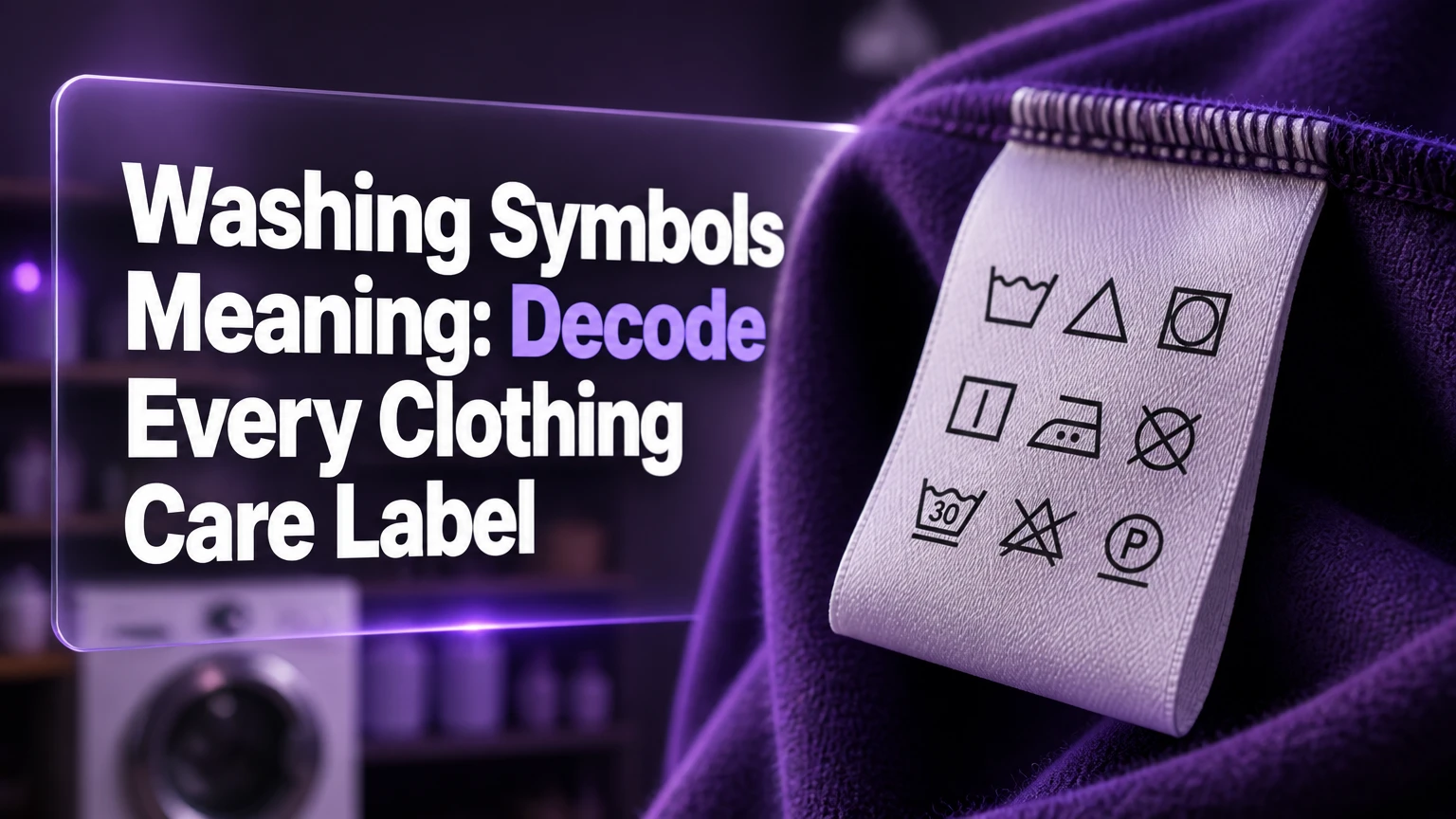
Washing symbols are standardized care-label pictograms that specify how a garment may be washed, bleached, dried, ironed, or professionally cleaned. The tub, triangle, square, iron, and circle form a sequence, while dots, bars, letters, and crosses add temperature, gentleness, solvent, or prohibition instructions.
Key facts at a glance
- The five principal care symbols appear in this order: washing, bleaching, drying, ironing, and professional textile care.
- A number inside a wash tub gives the maximum wash temperature in degrees Celsius.
- Dots indicate heat, while bars beneath an icon reduce mechanical action or cleaning intensity.
- A cross over a care symbol means the specified process is prohibited.
- A square with a circle describes tumble drying; a plain square describes natural drying.
- Care labels state the harshest safe treatment, so a lower temperature and gentler process are usually acceptable.
Washing Symbols Meaning, Decoded by Icon
The meaning of a washing symbol comes from its base shape first, then from its modifiers. A washtub concerns water washing, a triangle concerns bleach, a square concerns drying, an iron concerns pressing, and a circle concerns professional textile care.
ISO 3758:2012, the international standard for care-labelling code using symbols, establishes the familiar visual language used across many clothing markets. National labeling rules still affect what manufacturers must disclose. In the United States, the Federal Trade Commission states that “The Rule requires manufacturers and importers to attach care instructions to clothing,” which explains why a garment label is a legal care instruction rather than decorative packaging.
The symbols communicate maximum treatment limits, not guaranteed results under every laundry condition. A cotton shirt marked 40°C may tolerate a 30°C wash easily, but a heavily stained shirt may not become clean at that lower temperature without suitable detergent or pretreatment.
Why are washing symbols important?
Washing symbols prevent avoidable damage because heat, water, friction, chemicals, and solvent exposure affect fibers differently. Excess heat can shrink wool, weaken elastane, set some stains, or distort synthetic fabrics, while excessive agitation can cause pilling, stretching, seam failure, or print damage.
The label cannot identify every risk. A symbol does not tell you whether a red garment will bleed, whether a loose knit will snag on a zipper, or whether an old adhesive print has deteriorated. Use the label as the maximum-treatment rule, then add sensible sorting, fastening, detergent, and drying decisions.
How Does the Five-Symbol Care System Work?
Read clothing-care icons from left to right: washtub, triangle, square, iron, and circle. The sequence moves from water-based cleaning to chemical whitening, moisture removal, heat pressing, and professional cleaning.
| Base icon | Care category | Main question answered | Typical mistake |
|---|---|---|---|
| Washtub | Washing | Can water and machine agitation be used? | Exceeding the listed temperature |
| Triangle | Bleaching | Can whitening chemicals be applied? | Assuming oxygen bleach is always safe |
| Square | Drying | How can moisture be removed? | Confusing air drying with tumble drying |
| Iron | Ironing | How much soleplate heat is permitted? | Pressing synthetics at cotton temperature |
| Circle | Professional care | Which professional process is permitted? | Treating “do not dry clean” as “hand wash” |
Dots, bars, letters, and crosses modify the base icon. The same modifier does not always describe the same physical variable: dots usually describe heat, while bars describe reduced mechanical or professional-cleaning intensity.
What do dots, bars, and crosses mean?
Dots indicate a heat level, bars indicate a gentler process, and a cross prohibits the action shown by the symbol. The exact heat value depends on the base icon, so one dot in a dryer is not interchangeable with one dot on an iron.
- One dot: low heat for the relevant process.
- Two dots: medium heat.
- Three dots: high heat.
- One bar: reduced or permanent-press intensity.
- Two bars: very gentle or delicate intensity.
- Cross: do not perform the labeled action.
A blank icon is not automatically a recommendation for the most aggressive setting. For example, a tumble-dry symbol without dots permits a normal heat setting under common systems, but a cautious operator may still choose low heat to reduce wear.
What Do Washing Tub Symbols Mean?
A washtub gives the washing method and maximum water temperature. A plain tub usually permits a normal machine cycle, a tub with one or two bars requires progressively gentler action, a hand in the tub means hand washing, and a crossed tub prohibits water washing.
| Tub marking | Maximum temperature | Mechanical action | Suitable practical setting |
|---|---|---|---|
| Tub, no bar, 30 | 30°C / 86°F | Normal agitation | Cotton or linen, lightly soiled |
| Tub, one bar, 40 | 40°C / 104°F | Reduced agitation | Polyester or permanent-press clothing |
| Tub, two bars, 30 | 30°C / 86°F | Very gentle agitation and spin | Silk-like fabric or decorated knit |
| Hand in tub, 40 | 40°C / 104°F | Hand wash only | Wool, lace, fragile trims |
| Crossed tub | No water wash | No machine or hand washing | Professional or specialized cleaning |
Numbers inside the tub are direct Celsius limits. In some labeling systems, dots replace numbers. One dot commonly corresponds to 30°C, two dots to 40°C, and higher dot counts permit progressively hotter washes, although the numeric convention is clearer and more widely used for garments.
Does one bar or two bars change the washing machine cycle?
Yes. One bar calls for a reduced-action or permanent-press cycle, while two bars call for a delicate or wool cycle with less agitation and a slower spin. Selecting the correct temperature but the wrong mechanical program can still damage a garment.
A normal cycle repeatedly flexes and rubs fabric. That action is acceptable for durable woven cotton but can distort lace, loosen sequins, felt wool, and create abrasion pills on soft synthetics. Use a mesh bag when the label permits machine washing, but do not use a bag to justify a harsher cycle.
What does hand wash mean?
A hand inside the tub means wash by hand, commonly at a maximum of 40°C, using limited squeezing and no aggressive twisting. The symbol does not mean “wash on the machine’s hand-wash setting” unless the manufacturer separately confirms that machine program is suitable.
Fill a basin with cool or lukewarm water, dissolve a small amount of mild detergent, immerse the garment, and press it gently through the water. Rinse without wringing. Remove water by rolling the item in a towel, then reshape it before drying according to the square symbol.
What does a crossed washing tub mean?
A crossed tub means the garment must not be washed in water. It does not automatically mean dry clean only, because some items require professional wet cleaning, solvent cleaning, or specialist spot treatment instead.
Check the circle symbol beside the tub. If the circle is also crossed, ask a professional cleaner for an alternative process. If the label is missing or illegible, avoid soaking until the fiber content, dyes, trims, and backing materials have been assessed.
What Do Bleaching Triangle Symbols Mean?
A triangle specifies whether bleach may be used and which chemical class is acceptable. An empty triangle permits any bleach allowed by the care system, a triangle with two diagonal lines permits non-chlorine oxygen bleach, and a crossed triangle prohibits all bleaching.
| Triangle marking | Permitted chemical | Common use | Safer interpretation |
|---|---|---|---|
| Empty triangle | Chlorine or oxygen bleach | White cotton towels | Follow product dilution instructions |
| Two diagonal lines | Non-chlorine oxygen bleach | Colorfast cotton or polyester | Test hidden area first |
| Crossed triangle | No bleach | Wool, silk, dyed garments | Use detergent and targeted pretreatment |
| Unclear or damaged triangle | Unknown | Any garment | Do not bleach until verified |
“Non-chlorine” does not mean harmless. Oxygen bleach can still fade unstable dyes and damage some protein fibers, especially wool and silk. Never mix chlorine bleach with acids, ammonia, or other cleaning chemicals.
For a grease or protein stain on a no-bleach garment, use a compatible detergent pretreatment instead. A short, cool wash is often safer than a stronger chemical treatment that permanently changes the color.
How Should Drying Symbols Be Read?
A square describes natural drying, while a square containing a circle describes tumble drying. Lines inside the square identify line, drip, flat, or shade drying; dots inside the circle identify dryer heat.
| Drying symbol | Heat or position | Typical duration | Correct action |
|---|---|---|---|
| Square with circle, no dot | Normal tumble heat | 45-75 minutes | Use ordinary dryer program |
| Square with circle, one dot | Low tumble heat | 50-90 minutes | Choose low heat |
| Square with circle, two dots | Medium tumble heat | 40-70 minutes | Use medium heat |
| Crossed square with circle | No tumble drying | 0 minutes | Air-dry by the label |
| Square with vertical line | Line dry | 4-24 hours | Hang while wet |
| Square with horizontal line | Flat dry | 12-48 hours | Lay flat and reshape |
| Square with corner diagonals | Dry in shade | 6-36 hours | Keep out of direct sun |
The times in the table are typical household ranges for light to medium garments at normal room humidity. Dense towels, wool sweaters, and humid conditions take longer. A dryer cycle’s end time also depends on load size, moisture extraction, venting, and sensor accuracy.
What do tumble-dry dots and bars mean?
A circle inside a square means tumble drying, and one, two, or three dots permit low, medium, or high heat. A bar beneath the square and circle calls for a permanent-press setting, while two bars call for a delicate setting; a cross prohibits tumble drying.
A solid circle without dots is a no-heat or air-fluff instruction in systems that use that marking. Do not confuse it with an empty circle, which belongs to professional cleaning and has a different meaning.
What do line-dry, drip-dry, and flat-dry symbols mean?
A vertical line inside a square means line dry, one horizontal line means flat dry, and multiple vertical lines mean drip dry in systems using that distinction. Diagonal lines in the upper corner mean shade drying, which limits direct sunlight rather than changing the garment’s physical orientation.
Flat drying matters for wool, viscose, and heavy knits because water increases garment weight. Hanging a wet sweater can lengthen the shoulders and produce an uneven hem even when the washing process was correct.
What Do Ironing Symbols and Dots Mean?
An iron symbol gives the maximum soleplate temperature: one dot is low heat, two dots are medium heat, and three dots are high heat. A crossed iron prohibits ironing, while a crossed steam marking means iron without steam.
| Iron marking | Maximum temperature | Common fibers | Practical protection |
|---|---|---|---|
| One dot | 110°C / 230°F | Acetate, acrylic, nylon | Press inside out through a cloth |
| Two dots | 150°C / 302°F | Polyester, wool, silk blends | Use moderate heat and brief contact |
| Three dots | 200°C / 392°F | Cotton, linen | Use steam if permitted |
| Crossed iron | No ironing | Heat-sensitive coatings | Reshape while damp |
| Crossed steam | No steam | Water-marked or heat-sensitive fabric | Dry iron only |
Iron temperature refers to the soleplate, not the garment’s internal temperature. A hot iron held motionless can damage a fabric faster than a brief glide at the same setting, particularly around synthetic prints, elastane, and laminated membranes.
Place a pressing cloth over dark synthetics, transfers, velvet, and coated fabrics. Test an inside seam first. Never iron directly over a plastic graphic unless the label specifically permits it.
What Do Circle Symbols for Dry Cleaning Mean?
A circle identifies professional textile care, not necessarily a mandatory dry-cleaning service. Letters inside the circle guide the cleaner toward a solvent or process, while bars beneath the circle reduce cleaning intensity and a cross prohibits professional solvent cleaning.
| Circle marking | Process guidance | Typical garment | Consumer instruction |
|---|---|---|---|
| Empty circle | Professional solvent cleaning permitted | Tailored wool jacket | Take to a qualified cleaner |
| P inside circle | Professional process using permitted P-class solvents | Suit or structured coat | Show the full label |
| F inside circle | Hydrocarbon-solvent process | Delicate tailored garment | Use a cleaner with that capability |
| W inside circle | Professional wet cleaning | Some washable structured garments | Do not substitute home washing |
| One bar under circle | Mild professional process | Trimmed or shaped garment | Request reduced mechanical action |
| Two bars under circle | Very mild professional process | Fragile luxury textile | Confirm specialist handling |
| Crossed circle | No professional solvent cleaning | Solvent-sensitive coating | Ask about wet cleaning or spot care |
An empty circle means professional dry cleaning is permitted under the applicable care-label system; it does not always mean “dry clean only.” The complete label determines whether home washing is also allowed. A cleaner may reject a process when dyes, adhesives, coatings, or mixed materials create risks not visible from the icon alone.
Which Care Method Is Best for Each Garment?
The best care method is the least aggressive labeled process that removes the soil and preserves the garment’s shape. Cold machine washing is efficient for durable items, hand washing protects fragile structures, and professional care handles tailored construction, solvent-soluble oils, and complex materials.
| Care route | Typical household or service time | Typical direct cost | Main risk |
|---|---|---|---|
| Normal machine wash and tumble dry | 1-2 hours | $0.25-$1.50 utilities | Heat, friction, shrinkage |
| Gentle machine wash and air dry | 12-48 hours | $0.20-$1.00 utilities | Stretching during drying |
| Hand wash and flat dry | 12-48 hours | $0.25-$2.00 detergent and water | Wringing or reshaping errors |
| Professional dry cleaning | 24-72 hours | $6-$30 per garment | Solvent, pressing, and service cost |
| Professional wet cleaning | 24-72 hours | $8-$35 per garment | Shape change if incorrectly handled |
These are typical consumer ranges, not universal prices. Location, garment size, lining, stain treatment, and service level change professional fees substantially.
Choose a normal cycle for durable cottons and linens when the tub permits it. Choose a gentle cycle for polyester, lace, loose knits, and decoration. Choose professional care for structured jackets, garments with fused components, or labels that prohibit home washing.
Is cold washing always safer?
Cold washing is usually safer for dyes, elastane, and shrink-prone fibers, but cold water does not automatically remove heavy grease, body oils, or some pathogens as effectively as a hotter validated cycle. Detergent chemistry, contact time, soil level, and drying method also control results.
A practical rule is to use the lowest labeled temperature that cleans the garment. Reserve the maximum temperature for situations that need it and that the fiber, dye, and construction can tolerate.
What Are the Most Common Care-Label Mistakes?
Most laundry damage comes from misreading a modifier or treating a maximum limit as a recommended setting. The most expensive errors usually involve dryer heat, wrong agitation, chemical bleaching, and unsupported assumptions about professional cleaning.
- Confusing tumble drying with dry cleaning: A crossed square with a circle bans the household dryer, not necessarily professional cleaning. A crossed circle bans solvent cleaning and requires a different route.
- Ignoring bars beneath the tub: A 30°C delicate garment can still be damaged by a normal high-agitation cycle.
- Using bleach because a garment is white: White fabric may contain elastane, wool, a finish, or a coating that bleach weakens.
- Hanging a heavy wet knit: Flat-dry instructions prevent shoulder distortion and lengthening.
- Ironing a printed surface: Heat can fuse, gloss, crack, or transfer the design.
- Overloading the machine: A full drum reduces rinsing and increases rubbing, even when the selected program is correct.
An expert laundry rule is to treat the most fragile component as the garment’s limiting component. A cotton dress with a silk lining, elastic waistband, or glued embellishment cannot be managed like plain cotton.
How Can You Recover From Shrinkage or Color Bleeding?
Shrinkage may be partly reversible in some knits, but heat-set dye transfer and fiber damage often cannot be fully repaired. Stop the damaging process immediately, keep the garment wet if appropriate, and avoid applying additional heat until the problem is assessed.
For a slightly shrunken cotton or wool knit, soak it in cool or lukewarm water with a compatible mild cleanser, gently ease it toward its original measurements, and dry it flat. Hair conditioner is sometimes used as a fiber-softening home treatment, but it is not a guaranteed restoration method and may leave residue.
For fresh color bleeding, separate the item, rinse or rewash it according to its label, and use a color-transfer product only after checking fiber and color compatibility. Do not tumble-dry the garment first, because heat can make transferred dye more difficult to remove.
What if the label contradicts the fabric or machine program?
Follow the most restrictive credible instruction and contact the manufacturer when the label, product page, or machine manual conflicts. Machine program names are not standardized: one brand’s “delicate” cycle may use more heat or agitation than another brand’s cycle.
Photograph the label and retain the purchase information. For expensive garments, a professional cleaner can perform a fiber, dye, and trim assessment before processing.
How Should Different Fabrics Be Treated?
Fiber content predicts behavior, but the care label remains authoritative because finishes, blends, coatings, linings, and construction alter the safe method. A fabric blend should be treated according to its most vulnerable component when the label gives no clearer instruction.
| Material or construction | Frequent damage mechanism | Safer default | Drying preference |
|---|---|---|---|
| Cotton jersey | Shrinkage and twisting | 30-40°C, gentle detergent | Flat or low tumble |
| Linen | Creasing and dimensional change | Cool to moderate wash | Line dry, reshape damp |
| Wool knit | Felting and stretching | Hand wash or wool cycle | Flat dry |
| Silk | Water marks, dye loss, abrasion | Hand wash only if labeled | Flat in shade |
| Polyester | Heat glazing and odor retention | 30-40°C, reduced action | Low tumble or line dry |
| Elastane blend | Loss of recovery from heat | Cool wash, no high heat | Air dry |
| Viscose or rayon | Wet weakness and distortion | Gentle cycle or hand wash | Flat dry |
| Sequins or glued trim | Detachment and melting | Inside out, mesh bag, gentle cycle | Air dry away from heat |
Professional insight: rayon can appear robust when dry but become weak when wet, so its safe care decision depends more on wet handling and drying than on surface appearance. Another practical rule is to close zippers and fasten hooks before washing, while leaving delicate decoration protected inside out.
How Do Standards and Countries Affect Symbol Meaning?
The icon meanings are broadly international, but labeling requirements, language, enforcement, and permitted solvent references vary by market. ISO 3758 provides a global symbol framework, while GINETEX manages the care-symbol trademark system used widely in Europe.
A European label may show a Celsius number in the tub, while a North American label may use words alongside symbols. The underlying instruction remains comparable, but a US garment may include additional warnings required by the FTC, and a European circle may communicate professional-cleaning chemistry more specifically.
Older garments, imported clothing, and homemade labels may use obsolete or nonstandard marks. When a symbol looks unfamiliar, compare the entire icon rather than one isolated line, and seek the manufacturer’s instructions before choosing a high-risk process.
A Reliable Five-Step Way to Read Any Label
Use the label in sequence, then select the lowest effective treatment. The process takes about one minute and requires only the garment, its label, and the washing-machine or dryer controls.
- Read the tub. Record the maximum temperature and count the bars. Select normal, permanent-press, delicate, wool, or hand washing accordingly.
- Read the triangle. Confirm whether all bleach, oxygen bleach only, or no bleach is permitted.
- Read the square. Decide between tumble drying, low heat, line drying, drip drying, flat drying, and shade drying.
- Read the iron. Set the iron to one, two, or three dots, or remove ironing and steam entirely.
- Read the circle. Give the garment to a cleaner when professional care is required, and show the letters and bars.
You will know the interpretation is complete when every symbol has produced a specific action, temperature, or prohibition. The common mistake at this stage is reading only the tub and ignoring drying, because the dryer often causes more irreversible damage than the wash.
FAQ About Clothing Care Symbols
Can I wash a dry-clean-only garment at home?
No, not safely by default. A circle indicates professional textile care, and “dry clean only” means the manufacturer has not approved home washing. Water can shrink interlinings, release dyes, distort tailoring, or damage adhesives even when the outer fabric appears washable.
What does 30°C mean on a washing label?
A 30°C number means 30°C is the maximum wash temperature, approximately 86°F. It does not require water to reach exactly 30°C, and a colder wash is generally acceptable if the detergent and soil level allow effective cleaning.
Does a triangle with lines allow stain remover?
Only if the stain remover is a non-chlorine oxygen product and the garment’s fiber and dye tolerate it. Test an inconspicuous area first. A crossed triangle prohibits bleach, but it does not prohibit every detergent or specialized non-bleaching pretreatment.
Can I use a dryer if the label shows one dot?
Yes. One dot inside the tumble-dry symbol permits low dryer heat. Select a low-temperature or delicate setting, remove the garment while slightly damp when possible, and avoid adding heat through a prolonged finishing cycle.
What does a circle with a P mean?
A circle with P gives the professional cleaner process information about permitted solvent categories under the applicable care-label system. Consumers should not attempt to reproduce that process at home, because solvent selection, ventilation, machine design, and fire controls require professional equipment.
What should I do when a care label is missing?
Identify the fiber content, inspect construction and trims, and use the least aggressive plausible method. Cool water, mild detergent, low agitation, and air drying reduce risk, but unknown vintage, tailored, coated, or heavily decorated garments should be assessed by a textile-care professional.
The Bottom Line
Washing symbols meaning becomes straightforward when the five base icons are read in order: tub for washing, triangle for bleach, square for drying, iron for pressing, and circle for professional care. Temperature dots or numbers set heat limits, bars reduce process intensity, and crosses prohibit the named action.
Choose the lowest temperature and gentlest cycle that can clean the garment, then follow the square symbol carefully because dryer heat and incorrect hanging frequently cause permanent damage. When the label is unclear, contradictory, or unusually restrictive, preserve the garment by stopping before washing and obtaining manufacturer or professional textile-care guidance.