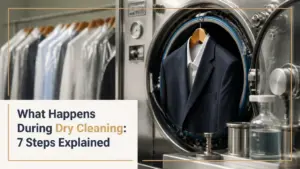
Dry cleaning uses liquid solvents instead of water, most commonly petroleum-based hydrocarbon blends, perchloroethylene (PERC), silicone solvent D5, or modified alcohol solvents. Professional cleaners also use water, detergents, surfactants, stain-removal agents, sizing products, and steam during treatment, finishing, and quality control.
Key Facts at a Glance
- Perchloroethylene, also called PERC or tetrachloroethylene, has CAS number 127-18-4 and is being phased out of United States dry cleaning under an EPA rule.
- Hydrocarbon solvents are petroleum-derived, combustible liquids that generally require longer drying than PERC.
- GreenEarth cleaning uses decamethylcyclopentasiloxane, commonly called D5, rather than a water-based process.
- Pre-spotting chemicals are selected by stain chemistry, so one formula cannot safely remove every stain.
- Professional wet cleaning uses water, controlled mechanical action, detergents, and drying programs designed for garments traditionally labeled dry clean.
- Solvent residue should be recovered, filtered, and distilled or otherwise managed inside a properly ventilated commercial facility.
What Does Dry Cleaning Mean?
Dry cleaning is textile cleaning performed with a liquid solvent that contains little or no water during the primary cleaning bath. The word “dry” distinguishes the process from immersion washing in water; garments are still wetted by liquid, extracted, dried, pressed, and sometimes treated with controlled moisture.
The process protects some fabrics because solvent exposure produces less swelling than water exposure. Wool fibers can felt under moisture, heat, alkalinity, and agitation, while silk can lose shape or develop water rings. Dry cleaning reduces some of those risks, but it cannot guarantee that every trim, dye, coating, interlining, or finish will remain unchanged.
“Dry clean” does not mean chemical-free, odor-free, or risk-free. It identifies a cleaning method, not one universal chemical.
Which chemicals are in a typical cleaning order?
A typical commercial order can involve several chemical groups, although the exact products vary by machine, solvent, stain, and local regulations.
| Chemical group | Typical examples | Function |
|---|---|---|
| Primary solvent | PERC, hydrocarbon blend, D5, modified alcohol | Dissolves oils, grease, and compatible soils |
| Detergent or charge agent | Anionic, nonionic, or proprietary solvent detergent | Suspends soil and improves cleaning |
| Water-control additive | Controlled moisture, sizing, or detergent additive | Helps remove selected water-soluble soil |
| Pre-spotter | Enzyme, tannin, protein, or petroleum formula | Treats localized stains before immersion |
| Finishing product | Sizing, starch substitute, odor treatment | Restores body, hand, or appearance |
| Pressing medium | Steam and sometimes water mist | Reshapes fibers during finishing |
The primary solvent is the largest chemical component of the cleaning bath. Pre-spotters and detergents often determine whether a specific stain is removed successfully.
How Do Dry-Cleaning Solvents Remove Soil?
Dry-cleaning solvents remove soil by dissolving, dispersing, or suspending substances that water alone handles poorly, especially sebum, cooking fat, lubricants, waxes, and oily cosmetics. Solvent molecules interact more readily with many non-polar soils, while detergents help carry loosened particles away from fabric surfaces.
The common explanation that “oil dissolves in oil” is useful but incomplete. A solvent’s performance depends on solvency, polarity, density, viscosity, evaporation rate, detergent formulation, mechanical action, temperature, filtration, and the time available for contact.
Water-based stains create the main limitation. Coffee, wine, perspiration salts, sugar, and some food residues contain polar or ionic components that hydrocarbon solvents may not dissolve efficiently. Technicians often use controlled moisture, a water-compatible detergent, or a separate pre-treatment for those soils.
What determines stain removal?
Stain removal depends on four interacting variables:
- Stain composition: Sebum and grease respond differently from tannins, proteins, dyes, or adhesives.
- Fabric construction: A tightly woven wool suit tolerates different treatment from silk satin or bonded jersey.
- Age and heat exposure: An old stain oxidizes or bonds more firmly after ironing or tumble drying.
- Previous treatments: Home sprays, bleach, detergent, and rubbing can spread or set the mark.
A solvent can remove the oily carrier while leaving the dye or pigment behind. That is why a garment may look cleaner but retain a colored shadow.
Which Dry-Cleaning Solvents Are Used Most Often?
The main commercial solvent families are PERC, hydrocarbon blends, silicone D5, and modified alcohol solvents. Liquid carbon dioxide is a technically distinct alternative, while professional wet cleaning replaces the solvent bath with water and controlled textile processing.
The table gives typical United States commercial ranges, not retail prices. Solvent prices vary with drum size, supplier contracts, freight, regional rules, distillation equipment, and whether the figure includes detergent or waste handling.
| Solvent family | Chemical identity and example | Typical solvent price | Typical cycle characteristic |
|---|---|---|---|
| PERC | Tetrachloroethylene, CAS 127-18-4 | $20-$35 per gallon | About 30-45 minutes in many systems |
| Hydrocarbon | Isoparaffinic hydrocarbons, CAS 64742-48-9 | $12-$22 per gallon | About 50-75 minutes, often slower drying |
| Silicone D5 | Decamethylcyclopentasiloxane, CAS 541-02-6 | $20-$30 per gallon equivalent | About 60-90 minutes in many systems |
| Modified alcohol | Formaldehyde dibutyl acetal, used in products such as SolvonK4 | $25-$40 per gallon equivalent | About 45-70 minutes |
| Liquid carbon dioxide | Carbon dioxide, CAS 124-38-9 | Facility-specific | About 30-60 minutes, with high equipment cost |
| Professional wet cleaning | Water plus textile detergents | Facility-specific | About 45-120 minutes, including drying and finishing |
Is PERC still used in dry cleaning?
PERC remains present in some commercial operations, but its regulatory status is changing rapidly. The United States Environmental Protection Agency’s 2024 final rule under the Toxic Substances Control Act established a 10-year phaseout of PERC use, with restrictions that affect new and existing dry-cleaning equipment on different schedules.
PERC is nonflammable and has strong solvency, which explains its historical popularity. The same properties that clean heavy oily soil effectively also create occupational and environmental concerns when vapor control, leak prevention, waste management, or machine maintenance is inadequate.
The EPA described the rule as a “10-year phaseout” of PERC use in dry cleaning. Requirements differ by equipment type, business size, and date of installation, so a facility in the United States should follow current EPA and state guidance rather than rely on an old machine label.
Is hydrocarbon cleaning safer than PERC?
Hydrocarbon cleaning avoids PERC exposure, but hydrocarbon solvent is not harmless. Hydrocarbon blends are combustible and can irritate skin, eyes, or airways when workers encounter concentrated vapor or liquid. Proper equipment, electrical classification, ventilation, storage, grounding, and spill response remain necessary.
Hydrocarbon solvents usually evaporate more slowly than PERC. Machines therefore need carefully managed drying and vapor recovery, and a poorly tuned cycle can leave odor or residue. Hydrocarbon cleaning is often gentler toward plastics, sequins, and some adhesive components, but a technician must still test vulnerable trims.
Is GreenEarth cleaning chemical-free?
GreenEarth cleaning is not chemical-free. GreenEarth is a branded process that uses D5 silicone solvent, decamethylcyclopentasiloxane, with proprietary detergents and operating procedures.
D5 has a mild feel and low odor compared with some traditional operations, and it can be suitable for delicate textiles. Its environmental profile is debated by jurisdiction and assessment method, particularly because silicone compounds can persist in some environmental pathways even though they break down through atmospheric and environmental reactions.
A cleaner using the GreenEarth name still handles a solvent, manages contaminated waste, controls vapor, and follows machine-safety procedures.
How Does a Dry-Cleaning Machine Process a Garment?
A modern dry-cleaning cycle normally includes inspection, stain treatment, solvent washing, extraction, drying with vapor recovery, and finishing. The complete customer turnaround commonly takes one to three days because queueing, spotting, drying, pressing, inspection, and packaging take longer than the machine wash alone.
| Stage | Typical action | Typical duration or control |
|---|---|---|
| Inspection | Check care label, pockets, stains, trims, and existing damage | 2-8 minutes per order |
| Pre-spotting | Apply a targeted stain formula and allow controlled dwell time | 1-10 minutes |
| Solvent wash | Rotate garments in a solvent bath with detergent | 15-35 minutes |
| Extraction | Spin garments to remove liquid solvent | 2-8 minutes |
| Drying and recovery | Warm, filtered air evaporates solvent; vapor is condensed | 15-45 minutes |
| Finishing | Steam, press, reshape, inspect, and package | 5-20 minutes |
Step 1: Inspect and classify the garment
Technicians inspect pockets, buttons, sequins, leather panels, stains, colorfastness, and prior damage before cleaning. Sorting by color, fabric weight, soil level, and solvent compatibility reduces dye transfer and mechanical damage.
The care label is evidence, not a complete guarantee. A “dry clean only” label does not reveal whether a glued trim, polyurethane coating, heat-sensitive print, or unstable dye will tolerate the process.
Step 2: Pre-spot the stain
A technician chooses a pre-spotter according to the stain’s chemistry. Protein formulas may target blood, milk, egg, or perspiration; tannin formulas may target coffee, tea, wine, and fruit; petroleum formulas may target grease, lipstick, and oil.
Pre-spotters are not interchangeable. Enzyme products can damage protein fibers if misused, alkaline products can alter dyes, and aggressive brushing can create a visible texture change even after the stain disappears.
Step 3: Wash in the solvent bath
The machine circulates solvent through the garments while the drum provides controlled mechanical action. Typical drum speeds and temperatures differ by machine, load, fabric, and solvent, so published figures such as 40-45 revolutions per minute should be treated as equipment-specific rather than universal.
Detergent concentration matters. Too little detergent can leave suspended soil behind; too much can increase residue, odor, or static.
Step 4: Extract the solvent
The drum accelerates to remove liquid solvent through centrifugal force. Commercial extraction speeds commonly fall around 800-1,200 revolutions per minute, but the exact setting depends on machine design and garment sensitivity.
A strong extraction reduces drying energy and solvent carryover. Over-aggressive extraction can crease loosely constructed garments or distort fragile decorations.
Step 5: Dry and recover solvent vapor
Filtered warm air moves through the load, evaporating solvent from the textile. Closed-loop equipment sends vapor to a condenser, returns liquefied solvent for reuse, and uses filters or distillation to control dissolved soil and degradation products.
Drying temperature is not governed by one universal 140°F or 60°C fabric threshold. Actual safe settings depend on the solvent, airflow, sensor location, fabric moisture, trim, adhesive, and machine program. The operator should follow the equipment manufacturer’s validated program.
Step 6: Finish and inspect
Steam, pressing, tension, and reshaping restore the garment’s intended silhouette. Final inspection checks remaining stains, odor, loose buttons, shine, color change, and pressing marks before packaging.
Finishing cannot reverse every chemical or heat injury. A fused interlining, permanently set crease, or dye migration may remain after cleaning.
Which Chemicals Treat Different Stains?
Stain chemicals are selected by soil type, but technicians also consider fabric pH tolerance, dye stability, and whether the stain has been heat-set. The safest professional treatment is usually the least aggressive formula that dissolves the contaminant without altering the textile.
| Stain or soil | Common treatment category | Why it works | Main risk |
|---|---|---|---|
| Body oil or sebum | Petroleum-solvent pre-spotter or solvent detergent | Dissolves non-polar lipids | Rings or spreading on absorbent fabric |
| Coffee or tea | Tannin formula with controlled moisture | Targets polar plant compounds | Dye change on unstable colors |
| Blood or milk | Protein formula, often enzyme-assisted | Breaks down protein residue | Heat can set protein stains |
| Lipstick | Combination of oily-solvent and pigment treatment | Separates wax, oil, and colorant | Residual pigment or fabric abrasion |
| Candle wax | Solvent treatment after physical removal | Dissolves remaining hydrocarbon wax | Heat can spread the wax |
| Ink or paint | Ink-specific solvent or specialist treatment | Targets resin, dye, or binder | Permanent dye bleed or fiber damage |
Can Dry Cleaning Damage Clothes?
Dry cleaning can damage garments when solvent compatibility, moisture, heat, mechanical action, or trim construction is unsuitable. Common failures include color bleeding, shine from pressing, adhesive separation, plastic distortion, coating loss, shrinkage, and odor from incomplete drying or contaminated solvent.
Dry cleaning is especially risky for garments containing polyurethane coatings, vinyl prints, foam-backed materials, rubberized elastic, glued embellishments, imitation leather, and unstable dyes. A care label may permit dry cleaning while the garment’s construction still creates a failure risk.
A professional cleaner should identify foreseeable risks before accepting the order. Consumers should disclose home stain treatments, fragrance products, perspiration damage, and previous cleaning failures.
What happens to solvent left in clothing?
Correctly operated equipment removes most recoverable solvent during extraction and drying. A faint process odor can occur immediately after cleaning, but a strong persistent odor can indicate inadequate drying, overloaded equipment, poor filtration, contaminated solvent, or storage before complete aeration.
Consumers should not seal a strongly solvent-smelling garment in plastic for extended storage. Ask the cleaner to re-aerate or reprocess the item, especially if the odor causes headache, throat irritation, dizziness, or nausea.
How Safe Are Dry-Cleaning Chemicals at Home?
Commercial dry-cleaning solvents should not be used at home because they are industrial chemicals requiring explosion control, vapor recovery, ventilation, waste handling, compatible storage, and trained operation. Home dry-cleaning kits generally use a damp cloth, heat, and a pre-treated bag rather than exposing the consumer to a drum of solvent.
Consumers can reduce exposure by collecting garments promptly, removing plastic bags after transport, ventilating a room if odor persists, and following the product label. Do not pour solvent, spotting fluid, or contaminated liquid into a drain or outdoor soil.
The National Institute for Occupational Safety and Health has historically identified inhalation and skin contact as important workplace exposure routes for dry-cleaning personnel. Modern closed-loop equipment reduces release, but it does not eliminate the need for maintenance and monitoring.
Which Dry-Cleaning Method Should You Choose?
The best method depends on the garment’s fiber, construction, stain type, local facility controls, and the cleaner’s experience with that material. For a routine wool suit, a well-maintained hydrocarbon or PERC alternative facility may perform well; for a washable but structured garment, professional wet cleaning can be the better choice.
| Priority | Often suitable method | Specific advantage | Limitation |
|---|---|---|---|
| Heavy oily soil | PERC where legally permitted | Strong solvency and rapid evaporation | Regulatory and exposure concerns |
| Delicate fashion trim | Hydrocarbon or D5 | Lower water swelling and gentle handling | Combustibility or longer drying |
| Water-soluble soil | Professional wet cleaning | Water dissolves salts, sugars, and many tannins | Shrinkage control requires skill |
| Environmental solvent reduction | Liquid carbon dioxide | Closed-loop carbon dioxide process | High-pressure equipment cost |
| Mixed oil and water soil | Modified alcohol or expert wet cleaning | Broader soil compatibility | Product and long-term exposure data vary |
| Wool and cashmere | Experienced solvent or wet-cleaning specialist | Fiber-specific mechanical control | Felting remains possible with poor processing |
Professional wet cleaning
Professional wet cleaning uses computer-controlled water levels, mild detergents, reduced agitation, and carefully programmed drying. It can clean many wool, silk, rayon, and structured garments successfully when the facility understands fiber relaxation and dimensional control.
Wet cleaning is not automatically safer for every item. Water can cause shrinkage, puckering, dye migration, shape loss, and adhesive failure, particularly when the garment has weak construction or a water-sensitive finish.
Liquid carbon dioxide
Liquid carbon dioxide cleaning uses pressurized carbon dioxide as the cleaning medium, often with detergents in a closed system. The process can reduce conventional solvent waste, but the machinery operates at high pressure and has a higher capital and maintenance burden than common solvent systems.
Availability is limited. A consumer should not assume that a cleaner advertising “carbon dioxide cleaning” uses the same process as carbonated water, dry ice, or a household steam treatment.
How Much Does Solvent Choice Affect Cost and Time?
Solvent choice affects operating cost, drying energy, machine investment, waste handling, and cycle duration, but customers usually pay for labor, pressing, risk, overhead, and local market conditions rather than a simple per-gallon solvent charge. A shirt may cost $5-$12 and a suit $15-$35 in many United States markets, with substantial regional variation.
| Service variable | Typical range | Main cost driver |
|---|---|---|
| Shirt cleaning | $5-$12 per item | Pressing labor and local overhead |
| Two-piece suit | $15-$35 per set | Fabric, structure, finishing time |
| Dress cleaning | $20-$60 per item | Beading, lining, shape, stain work |
| Solvent cycle | 30-90 minutes | Machine program and solvent evaporation |
| Standard turnaround | 1-3 days | Queue, inspection, finishing, packaging |
| Rush service | Same day to 24 hours | Scheduling and added labor |
PERC may support shorter drying cycles, while hydrocarbon and D5 systems often require more drying time. A longer cycle does not prove better cleaning, and a low price does not prove poor solvent control.
What Are the Most Common Chemical-Handling Mistakes?
The most consequential mistakes are excessive moisture, overloaded or contaminated solvent, poor drying control, and inappropriate spotter selection. Each mistake can create garment damage even when the machine itself operates normally.
- Adding uncontrolled water: Water boosters help with selected polar soil, but excess moisture can cause rings, shrinkage, buckling, or dye movement. Facilities should follow their detergent supplier’s measured procedure rather than apply a universal “below 70%” rule.
- Skipping filtration or distillation: Soil, dye, fatty acids, and detergent residues accumulate when solvent purification is neglected. Gray appearance, sour odor, and redeposition are warning signs.
- Overloading the drum: A crowded load reduces solvent circulation and airflow. Garments may leave with uneven cleaning, wrinkles, or residual odor.
- Using the wrong pre-spotter: An alkaline or oxidizing product can alter a delicate dye faster than the original stain did.
- Ending drying early: Residual solvent may remain when sensors are dirty, airflow is restricted, or the load exceeds the machine’s capacity.
- Ignoring trims and coatings: Sequins, adhesives, foam, vinyl, and polyurethane coatings may fail even when the base fabric looks unaffected.
A useful practitioner rule is to treat every stain as two problems: remove the soil, then preserve the garment’s color, hand, dimensions, and construction.
What Should You Ask a Dry Cleaner?
Ask which primary solvent the facility uses, how the business manages ventilation and solvent recovery, and whether staff inspect trims and coatings before processing. The solvent name matters, but machine maintenance and technician judgment often matter more for the finished garment.
Use these questions before handing over an expensive or irreplaceable item:
- Which solvent does this location use: PERC, hydrocarbon, D5, modified alcohol, or wet cleaning?
- Has the facility cleaned this fiber and construction before?
- Can the cleaner identify the likely source of the stain?
- Will the cleaner document existing damage, loose trim, or coating failure?
- What happens if the item retains odor or the stain remains?
- Does the facility offer wet cleaning for garments that can tolerate controlled water?
- How does the business manage solvent recovery, filtration, and waste?
A precise answer is more useful than a generic “eco-friendly” label. Ask for the method and the process controls.
FAQ
Are dry-cleaning chemicals left on clothes?
Small residual amounts may remain immediately after processing, but properly operated machines extract and dry garments before release. Strong or persistent odor is not an expected substitute for complete drying. Return the garment for re-aeration or inspection if the smell remains intense or causes irritation.
Is dry cleaning better than washing?
Dry cleaning is better for some water-sensitive, structured, oily, or tailored garments, while laundering is better for many cotton, linen, and water-soluble-soil items. The care label, garment construction, stain chemistry, and cleaner’s skill determine the appropriate method.
Can dry cleaning remove sweat stains?
Dry cleaning can remove oily components of perspiration, but salt, protein, and deodorant residues may require controlled moisture or specialized pre-spotting. Old yellowing may involve fiber oxidation or dye change, so cleaning may improve but not completely restore the original appearance.
Why do clothes sometimes smell after dry cleaning?
Post-cleaning odor can result from incomplete drying, contaminated solvent, overloaded equipment, restricted airflow, or storage before aeration. A mild temporary odor can dissipate, but a strong persistent smell warrants a return to the cleaner for reprocessing and equipment review.
Are hydrocarbon solvents flammable?
Yes. Hydrocarbon dry-cleaning solvents are combustible and require equipment designed for flammable liquids, ventilation, ignition-source control, grounding, and compliant storage. Hydrocarbon cleaning avoids PERC but does not remove the need for commercial chemical-safety controls.
The Bottom Line
The chemicals used in dry cleaning include a primary liquid solvent, solvent detergents, pre-spotting formulas, controlled moisture additives, and finishing products. PERC, hydrocarbon blends, D5 silicone, modified alcohols, and liquid carbon dioxide each have different solvency, flammability, regulatory, energy, and garment-compatibility profiles.
For consumers, the safest decision is to choose a cleaner that names its solvent, inspects garment construction, explains stain limitations, and maintains its recovery and filtration equipment. The chemical name matters, but competent process control determines whether dry cleaning protects or damages the garment.