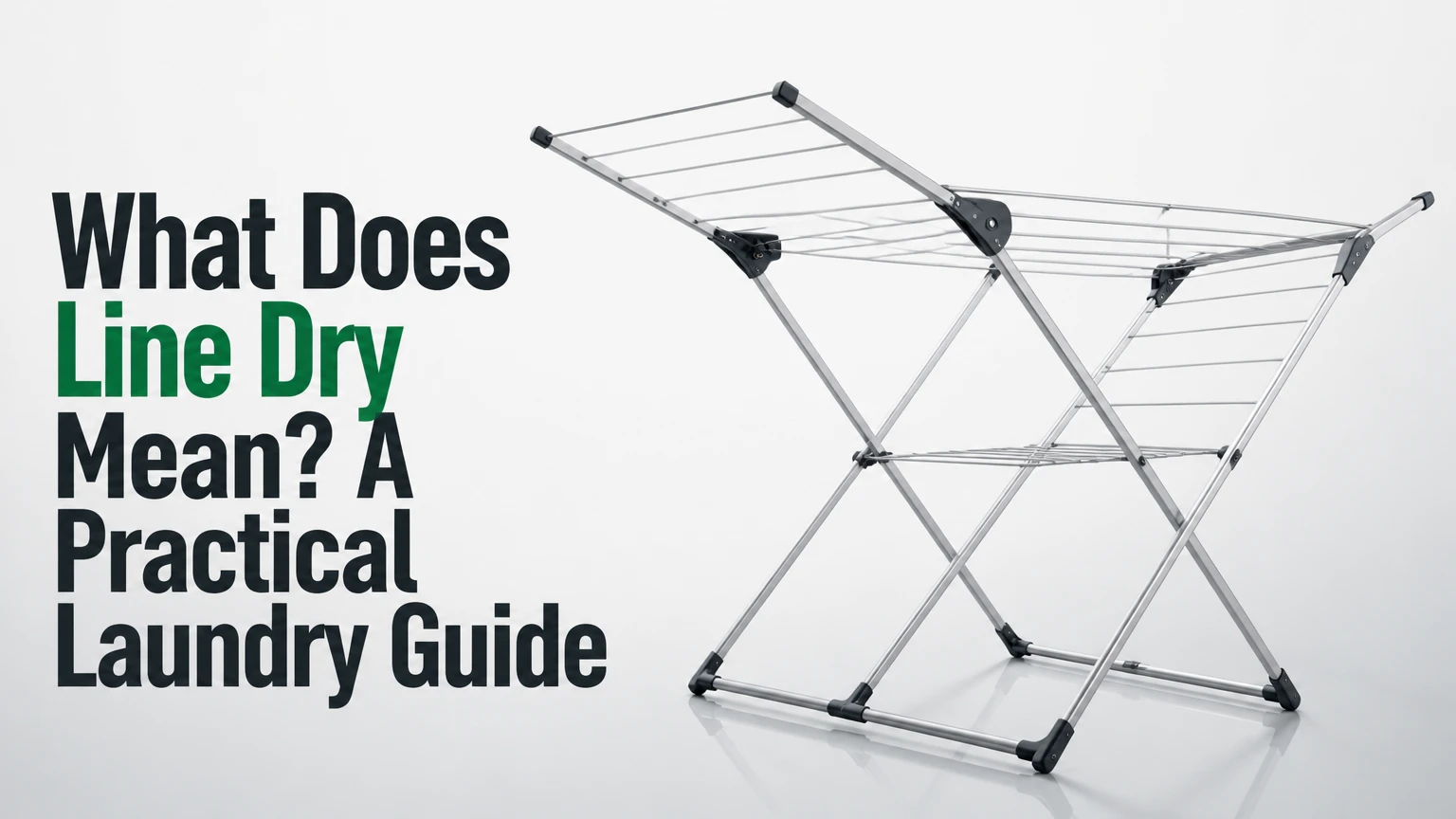
Line drying means drying washed clothes by hanging them on a clothesline, cord, hanger, or drying rack so surrounding air removes moisture. The process uses evaporation rather than a rotating, heated dryer, and it can happen outdoors or indoors. Drying speed depends mainly on airflow, humidity, temperature, fabric thickness, and how much water remains after washing.
Key Facts at a Glance
Line drying uses ambient air movement and heat instead of mechanical tumbling.
A warm, breezy outdoor load often dries in 1-3 hours, while an indoor rack commonly takes 12-24 hours.
Line drying reduces heat and tumbling, which can limit shrinking, abrasion, and elastic damage.
Direct sun can fade dyes, so dark and brightly colored garments often dry better inside out or in shade.
Sweaters, heavy wool, and loose knits usually need flat drying because hanging can stretch their shape.
Indoor line drying requires ventilation or a fan because wet laundry raises room humidity.
What Does Line Dry Mean in Laundry Care?
In laundry care, “line dry” means hang a garment until it is dry instead of placing it in a tumble dryer. A line can be a permanent outdoor clothesline, a retractable cord, a rotary dryer, or an indoor folding rack; the equipment changes, but the drying method remains air exposure without drum tumbling.
A garment label may use the words “line dry,” “hang dry,” or a square symbol containing a curved horizontal line. Those instructions generally tell you to suspend the item after washing. The exact position still matters because a lightweight shirt, a wet towel, and a wool sweater respond differently to gravity.
Line drying is not identical to every form of air drying. Air drying is the broader category, including laying an item flat, placing it on a mesh surface, or hanging it. Line drying specifically implies suspension from a line or a comparable hanging support.
Is line drying the same as tumble drying?
Line drying and tumble drying are different methods. Line drying uses still or moving ambient air, while tumble drying uses a rotating drum and usually heated, forced air. Tumble drying is faster and more predictable, but heat and repeated mechanical movement can increase shrinkage, surface abrasion, and elastic wear.
The care label decides whether a garment can tolerate a dryer. A label that says “do not tumble dry” does not automatically mean “hang vertically”; delicate fabrics may require flat drying instead. The distinction prevents a common error: treating every non-dryer garment as suitable for a clothesline.
How Does Line Drying Work?
Line drying works through evaporation: liquid water in fabric becomes water vapor and moves into the surrounding air. Wind or a fan removes the damp air next to the garment, while warmer conditions supply more energy for evaporation. Low humidity and open spacing usually matter more than direct sunlight alone.
A thick towel dries slowly because water must travel from inner fibers to the surface. A tightly folded shirt dries slowly for the same reason. A garment spread open in moving air exposes more wet surface, so it often dries sooner than the same garment bunched together.
Weather changes the result substantially. A cool, dry, breezy day may dry laundry faster than a hot, humid, windless day because saturated air cannot accept much additional water vapor. Sunlight adds radiant warmth, but strong ultraviolet exposure can break down dyes and fibers over time.
A fan helps indoor drying by moving air across fabric, not by heating the room. Keep the fan several feet away, avoid blocking its intake, and maintain ventilation. Indoor drying becomes risky when condensation collects on windows, walls, or ceilings, because persistent moisture can encourage mildew.
Does sunlight disinfect line-dried clothes?
Sunlight can reduce some microbes and bleach some stains, but ordinary outdoor sun exposure is not a dependable sterilization method. Ultraviolet intensity varies with latitude, season, clouds, shade, glass, and exposure time, while thick fabric layers may shield microorganisms.
Use washing temperature, detergent, and appropriate laundering procedures for hygiene. Use sunlight mainly as a drying aid and occasional deodorizing exposure, while protecting dark, bright, elastic, and printed garments from prolonged direct UV.
How Do You Line Dry Clothes Correctly?
To line dry clothes correctly, remove excess water, shake garments open, position each item according to its fabric and shape, and leave enough space for air circulation. A typical household load takes 1-3 hours outdoors in warm, moving air and 12-24 hours on an indoor rack.
Before hanging laundry
Check the care label first. Select a clean, stable line or rack, inspect clothespins for rust or dirt, and choose a shaded area for dark colors, elastane, wool, and screen-printed items. If laundry remains very wet after washing, use an additional spin cycle when the garment label permits it.
Shake each item once or twice immediately after removing it from the washer. The movement separates twisted layers and reduces wrinkles. Do not snap fragile lace, loosely woven fabric, or garments with weak seams.
Garment placement guide
| Garment | Recommended placement | Typical support | Main reason |
|---|---|---|---|
| T-shirt | Hem over line or plastic hanger | 2 clothespins or 1 hanger | Reduces shoulder marks |
| Button shirt | Hanger with buttons open | Smooth plastic hanger | Preserves shoulder shape |
| Jeans | Waistband spread across line | 3-4 clothespins | Supports heavy wet denim |
| Socks | Cuff over line | 1-2 clothespins | Prevents toe stretching |
| Towel | Folded over line at equal halves | 2-3 clothespins | Balances wet weight |
| Bedsheet | Folded lengthwise over line | 4-6 clothespins | Keeps corners from dragging |
| Wool sweater | Flat on mesh rack | Full surface support | Prevents vertical stretching |
| Bra or elastic item | In shade, supported at band | 2 clothespins at band | Protects elastane and shape |
Leave approximately 5-10 centimeters between ordinary garments. Increase the gap for towels, jeans, and bedding, which block airflow more effectively than thin shirts. Keep wet items from touching walls, floors, shrubs, or dirty outdoor surfaces.
Step-by-step line drying
- Run an appropriate final spin. Use the highest garment-safe spin setting that does not damage delicate fabric. Less retained water usually means shorter drying time, but excessive spinning can crease some textiles.
- Shake and straighten each item. Open collars, cuffs, pockets, and folded hems. Smooth seams with your hands before placing the garment on the line.
- Choose the correct support point. Place shirts at the hem or on hangers, trousers at the waistband, and heavy items across multiple points. Lay sweaters flat rather than suspending them.
- Create airflow gaps. Keep 5-10 centimeters between light pieces and more space around bulky laundry. Do not stack two damp towels on one narrow rack section.
- Position for the climate. Use direct morning sun for white cotton when fading is acceptable, but use shade with airflow for dark colors, printed garments, swimwear, and elastic clothing.
- Turn or reposition bulky items. Rotate towels and denim after roughly 60-90 minutes outdoors or every 4-6 hours indoors. This exposes damp inner areas without compressing the fabric.
- Check the thickest area. Feel waistbands, pockets, cuffs, seams, and towel centers. A dry surface does not prove that the inside is dry.
- Remove laundry promptly. Fold or hang dry items as soon as they finish. Extended sun and wind exposure can fade fibers, stiffen some finishes, and deposit outdoor dust.
You will know the process worked when the garment feels uniformly dry at seams and thicker sections, has no cool damp patches, and smells clean rather than sour. A cool sensation alone is not a reliable test because evaporative cooling can make dry fabric feel cold.
Which Line-Drying Equipment Fits Your Home?
The best line-drying equipment depends on available space, load size, weather exposure, and whether the rack must be stored after use. A retractable line suits occasional use, an outdoor rotary dryer suits frequent large loads, and a folding rack suits apartments or indoor winter drying.
| Equipment | Typical US price | Usable capacity | Best setting | Main limitation |
|---|---|---|---|---|
| Basic cord or rope line | $10-$25 | 10-25 meters | Small yard or balcony | Needs secure anchors |
| Retractable line | $20-$80 | 3-8 meters | Bathroom or compact patio | Limited heavy-load support |
| Folding indoor rack | $20-$60 | 10-20 meters | Apartment or rainy weather | Occupies floor space |
| Outdoor rotary dryer | $60-$150 | 30-60 meters | Large family loads | Requires outdoor installation |
| Heated airer | $80-$180 | 8-20 meters | Cold indoor conditions | Uses electricity and needs ventilation |
| Mesh sweater rack | $15-$45 | 2-6 garments | Wool and knitwear | Not suitable for full loads |
A rack’s advertised line length is not the same as practical capacity. A 20-meter rack may hold less laundry when garments need 5-10 centimeters of spacing, and bulky towels can consume several times the space of underwear.
For indoor use, select a rack with stable feet, rust-resistant bars, and enough height to prevent fabric touching the floor. Keep it away from a gas stove, portable heater, radiator surface, and electrical cable. Never drape wet laundry over a heater because blocked airflow and heat can create fire and equipment hazards.
How Long Does Line Drying Take?
Line drying typically takes 1-3 hours outdoors on a warm, breezy day, 4-8 hours outdoors in cool or overcast weather, and 12-24 hours indoors on a standard rack. A heated airer commonly reduces indoor time to 4-8 hours, but fabric thickness and room humidity can change every estimate.
| Conditions | Thin shirts | Jeans or towels | Sheets | Typical completion |
|---|---|---|---|---|
| Warm, dry, breezy outdoor air | 45-90 minutes | 2-4 hours | 1-3 hours | Same day |
| Warm, humid outdoor air | 1-3 hours | 4-8 hours | 3-6 hours | Same day or overnight |
| Cool, dry outdoor air | 2-4 hours | 5-10 hours | 4-8 hours | Same day |
| Indoor rack with open window | 4-8 hours | 12-24 hours | 12-24 hours | Same day or next day |
| Indoor rack in humid room | 8-12 hours | 24-48 hours | 24-48 hours | Often overnight |
| Heated airer with ventilation | 2-4 hours | 4-8 hours | 4-8 hours | Same day |
Use the thickest part of the load as the schedule guide. If pockets, waistbands, or towel centers remain damp, continue drying rather than storing the laundry and risking a musty smell.
Is Line Drying Better Than Tumble Drying?
Line drying is usually gentler and cheaper per load, while tumble drying is faster, more consistent, and independent of weather. The better choice depends on fabric, urgency, energy price, indoor humidity, and whether the garment label permits mechanical drying.
| Decision factor | Line drying | Tumble drying |
|---|---|---|
| Typical time | 1-24 hours | 30-90 minutes |
| Energy use | Near zero outdoors; rack-only indoors | Commonly 1.5-5 kWh per load, model-dependent |
| Heat exposure | Ambient temperature | Warm or hot drum air |
| Mechanical friction | Low | Moderate to high |
| Weather dependence | High outdoors | None |
| Shrinkage risk | Low from heat, but stretching is possible | Higher for heat-sensitive fibers |
| Texture | Cotton may feel firmer | Towels often feel softer |
| Space requirement | Line, rack, or room | Dryer and vent or condenser system |
Line drying does not have a literally zero environmental footprint in every situation. Outdoor drying uses no dryer electricity, but manufacturing a rack, driving to a laundromat, or running an indoor heated airer still has resource and energy costs.
A typical electricity saving of roughly $0.30-$0.80 per avoided dryer load is plausible in many homes, but the actual amount depends on dryer efficiency, local utility rates, load size, and whether the dryer is electric or gas. At five avoided loads weekly, that range equals approximately $78-$208 annually before equipment costs.
Which fabrics benefit most from line drying?
Cotton shirts, linen, activewear, elastic garments, printed clothing, and many synthetics benefit from reduced dryer heat, provided they are supported correctly. Wool, cashmere, rayon, and loose knits need more careful handling because vertical hanging can distort their shape.
Line drying is not ideal for every garment. Waterproof or water-resistant items may need manufacturer-specific treatment, leather and suede should not be placed on a wet line, and padded items may require controlled drying to prevent clumping. The garment label overrides general laundry advice.
How Can You Line Dry Clothes Indoors?
You can line dry clothes indoors on a folding rack, retractable line, shower rod designed for wet loads, or mesh drying surface, provided the room has ventilation and the fabric does not touch contaminated surfaces. Open a window when practical, run an exhaust fan, or use a small fan to move air across the laundry.
Indoor laundry releases substantial water vapor into the room. A hygrometer helps monitor conditions; sustained relative humidity above about 60% increases condensation and mold risk in cool rooms. Spread loads across two racks instead of packing one rack tightly, because spacing often shortens drying time more effectively than adding heat.
For an apartment, place a compact rack near a window or bathroom exhaust fan, but avoid blocking the bathroom door if it traps moisture elsewhere. A retractable line saves floor space, while a vertical accordion rack increases capacity where width is limited.
Do not dry laundry indoors when visible condensation already covers windows or when the room has recurring mildew. In that situation, use a laundromat dryer, a properly ventilated heated airer, or a dehumidifier sized for the room.
What Causes Stiff, Faded, or Smelly Line-Dried Clothes?
Stiff line-dried clothes usually result from mineral residue, detergent residue, low airflow, or prolonged drying, while fading comes mainly from UV exposure. Sour odors usually indicate that fabric stayed damp too long, was packed too closely, or entered the line with an already overloaded or dirty washer.
Stiffness
Cotton can feel crisp because fibers dry in fixed positions rather than being repeatedly tumbled. Hard-water minerals may add a rougher feel, but adding large quantities of vinegar is not a universal solution. Repeated acid exposure can affect elastane, seals, and some washer components, and vinegar must never be mixed with chlorine bleach.
Use the detergent amount recommended for water hardness, avoid overloading the washer, and add an extra rinse when residue is evident. A brief 5-minute tumble on a low, garment-safe setting can soften fabric before final air drying, but the care label still controls.
Fading
Direct UV exposure fades dyes and can weaken some fibers. Turn colored garments inside out, choose shade with strong airflow, and remove dry items promptly. White cotton and linen tolerate more sun than black denim, neon athletic wear, or garments with screen prints.
Odor and mildew
Musty odors develop when moisture remains trapped for too long. Rewash affected items according to the care label, improve spacing, clean the washer gasket and detergent drawer, and dry the load completely before storage.
Stretching and marks
Heavy knits can stretch when suspended from one point, while clothespins can leave impressions on delicate fabric. Use flat mesh support for sweaters and pin at reinforced hems, waistbands, or hidden seams rather than across visible chest or shoulder areas.
What Outdoor Conditions Make Line Drying Difficult?
Rain, high humidity, pollen, pollution, and overnight dew can make outdoor line drying impractical even when temperatures look favorable. Bring laundry inside before rain begins, avoid placing clean items beside smoky roads or active construction, and use a covered area only when air can still circulate.
A covered porch protects laundry from rain but may dry slowly if its sides are enclosed. Pollen is most problematic during local peak seasons, especially on still mornings. If allergies matter, dry indoors with filtration or use an extra rinse after outdoor exposure.
Wind improves evaporation until garments flap against dirty surfaces or clothespins fail. Use multiple pins on heavy pieces and inspect line tension before hanging a full load. A rotary dryer can increase exposure to moving air, but rotation does not compensate for saturated, stagnant weather.
Which Laundry Should Not Be Hung Vertically?
Garments should not be hung vertically when their wet weight can distort the fabric or when the manufacturer specifies flat drying. Wool sweaters, cashmere, heavy knits, loosely woven rayon, and some bias-cut garments belong on a clean, absorbent towel or mesh rack.
Shape the garment while damp, align seams, and support the entire body. Replace a wet towel beneath a flat-dried item if it becomes saturated, because a damp surface slows evaporation and can create odor.
Avoid direct sun for elastic swimwear, dark denim, silk, and printed items. Avoid ordinary clothespins on lace, silk, delicate mesh, and thin jersey unless the pin grips a reinforced hidden area.
The Bottom Line on What Does Line Dry Mean
What does line dry mean? It means allowing washed clothing to dry while suspended on a line, hanger, or rack through natural or room-air evaporation instead of tumble drying. Line drying can reduce heat, friction, and electricity use, but correct spacing, fabric support, ventilation, and sun management determine whether the result is fresh and well-shaped.
Use a clothesline for durable garments when weather and space cooperate. Use shade for colors, flat support for knits, and indoor airflow for rainy conditions. Choose tumble drying when rapid, predictable drying is more important and the care label permits it.
Frequently Asked Questions
Does line dry mean no dryer at all?
“Line dry” means the garment should be dried while hanging from a line or similar support, not dried by tumbling in a machine. Some households use a short, low-temperature tumble to remove stiffness before hanging, but that is only appropriate when the care label permits tumble drying.
Can I line dry clothes at night?
You can line dry clothes at night in a dry, warm, well-ventilated environment, but outdoor laundry may absorb dew and remain damp until morning. Indoor racks are safer overnight when humidity is controlled with ventilation, a fan, or a dehumidifier.
Why do my line-dried towels feel hard?
Line-dried towels can feel hard because cotton fibers dry without tumbling, while mineral or detergent residue can increase roughness. Improve washer rinsing, reduce detergent overuse, shake towels before hanging, and avoid packing several thick towels tightly together.
Should clothes be inside out when line drying?
Turn dark, bright, printed, and elastic garments inside out before line drying because the exposed outer surface receives less direct ultraviolet light. White cotton and pale linen can often face outward when fading is not a concern.
Is line drying sanitary?
Line drying is sanitary when garments are properly washed and dried completely. Outdoor sunlight may help reduce some microbes, but it is not a substitute for correct washing temperatures, detergent, or specialized hygiene procedures when contamination is a concern.