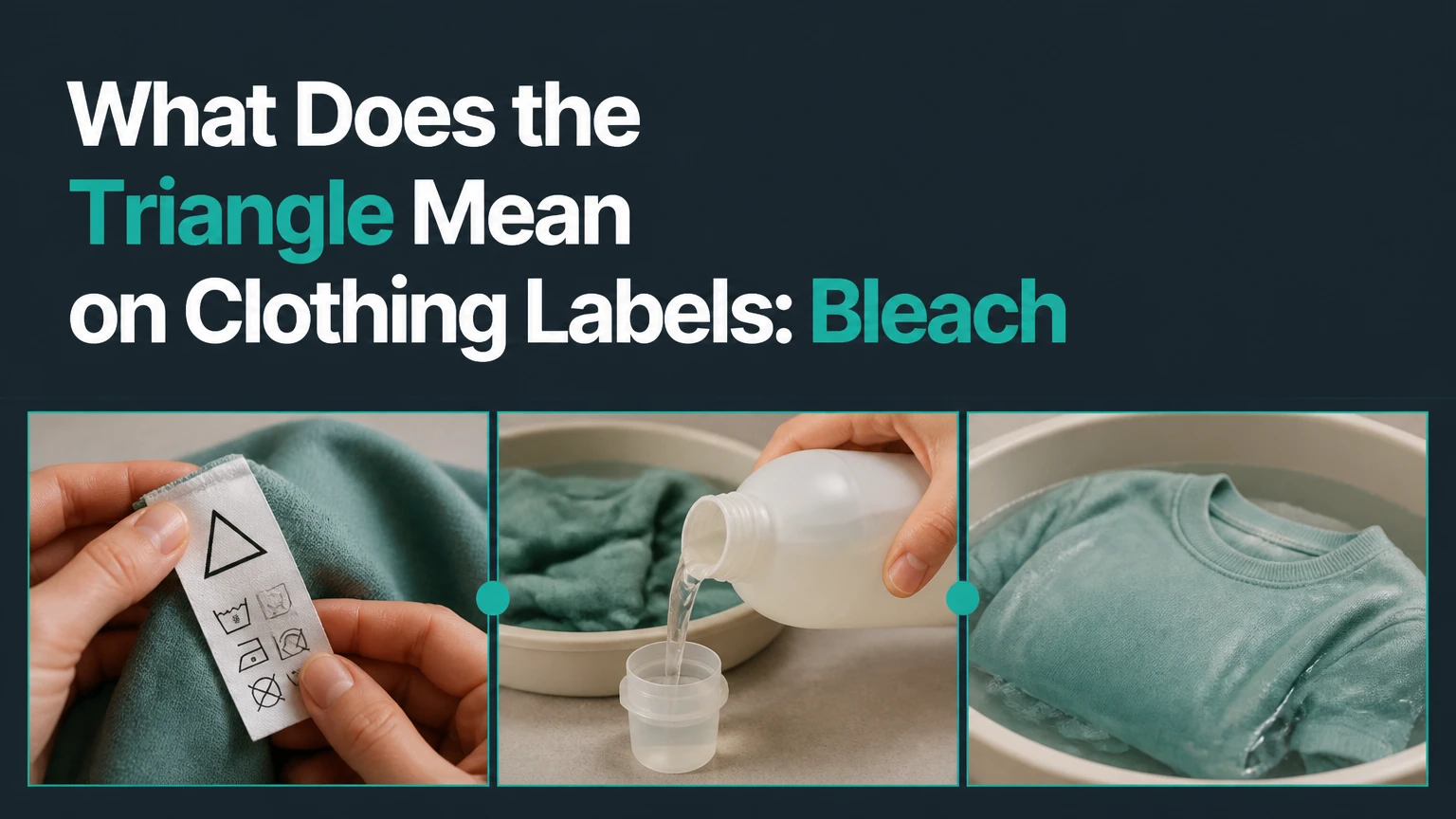
The triangle on a clothing care label represents bleaching instructions. An empty triangle generally permits bleach, a triangle with two diagonal lines permits non-chlorine bleach only, and a crossed-out triangle means do not use any bleach. The symbol concerns chemical bleaching, not ordinary detergent or washing temperature.
Key Facts at a Glance
- The triangle is the care-label symbol for bleaching.
- An empty triangle means bleaching is permitted, subject to the bleach product and garment materials.
- Two diagonal lines inside the triangle mean use non-chlorine, oxygen-based bleach only.
- A crossed-out triangle means avoid chlorine bleach and non-chlorine bleach.
- The triangle does not tell you the wash temperature, drying method, or bleach quantity.
- Wool, silk, elastane, leather trim, prints, and metallic details need additional caution even when a label permits bleaching.
What Does the Triangle Mean on Clothing Labels?
The triangle tells you whether a garment can be treated with a bleaching agent during laundering. A blank triangle permits bleaching, a lined triangle limits bleaching to non-chlorine products, and a crossed triangle prohibits bleaching altogether.
The symbol belongs to the textile-care system associated with GINETEX and represented internationally through ISO 3758. Countries and manufacturers can apply equivalent systems with small graphic or wording differences, so the written care instructions and manufacturer directions remain relevant.
Bleach is an oxidizing chemical. It changes or breaks down colored compounds, including stain molecules and textile dyes. That reaction can remove discoloration, but it can also weaken fibers, fade prints, yellow elastane, or damage finishes.
The triangle is therefore a permission limit, not a guarantee that every bleach product is suitable. A garment with an empty triangle may still react badly to concentrated bleach, excessive heat, prolonged soaking, or a decorative component made from a different material.
How Do the Three Triangle Symbols Differ?
The three current symbol forms communicate different levels of chemical permission. The lines and cross matter more than the triangle’s size, color, or position on the label.
| Label symbol | Care instruction | Suitable product category | Main restriction |
|---|---|---|---|
| Empty triangle | Bleaching permitted | Chlorine or non-chlorine bleach | Follow product directions and garment composition |
| Triangle with two diagonal lines | Non-chlorine bleaching permitted | Oxygen-based or other color-safe bleach | Do not use sodium hypochlorite |
| Crossed-out triangle | Do not bleach | No chemical bleach | Use detergent or a non-bleach stain method |
| Triangle marked “CL” | Historical chlorine permission | Chlorine bleach | Older notation; verify current manufacturer guidance |
The lined triangle is often misunderstood. It does not mean “use bleach carefully”; it specifically narrows the permitted chemistry. A chlorine product can damage a colored polyester shirt even when an oxygen product is acceptable.
The crossed triangle is also broader than many shoppers expect. It rules out oxygen bleach as well as chlorine bleach. If a stain remains, choose a method that does not oxidize the textile, such as detergent pre-treatment, an appropriate enzyme product, or professional cleaning.
Does a Solid Triangle Mean Do Not Bleach?
A solid black triangle is not the standard modern no-bleach symbol by itself. The decisive mark is usually a cross over the triangle, although low-resolution tags and brand-specific graphics can make the symbol difficult to read.
If the icon is unclear, compare it with the garment’s written instructions, search the manufacturer’s care guide, or avoid bleach. A mistaken decision can cause permanent dye loss, while postponing bleaching usually leaves more recovery options.
What Is the Difference Between Chlorine and Oxygen Bleach?
Chlorine bleach uses sodium hypochlorite and acts quickly, while oxygen bleach uses peroxide-based chemistry and generally works more slowly with lower color-stripping risk. Neither product is automatically safe for every fabric, because fiber type, dye stability, finish, and exposure time all affect the result.
| Characteristic | Chlorine bleach | Oxygen or non-chlorine bleach | Practical consequence |
|---|---|---|---|
| Common active chemistry | Sodium hypochlorite | Hydrogen peroxide or sodium percarbonate | Read the active ingredient, not only the front label |
| Typical action time | About 5-15 minutes when soaking | About 30 minutes to several hours | Oxygen products often need more contact time |
| Color effect | Frequently removes or alters dyes | Usually lower dye-stripping risk | Test colored garments first |
| Elastane risk | High; can yellow and weaken fibers | Lower, but product directions still apply | Avoid chlorine on stretch garments |
| Wool and silk | Generally unsuitable | Often unsuitable unless expressly approved | Delicate fibers require separate care |
| Disinfection strength | Strong oxidizing sanitizer under proper conditions | Primarily stain and odor treatment | Oxygen bleach is not a direct substitute for every sanitizer |
These time ranges are typical household practice, not universal instructions. Concentration, water temperature, formulation, and local product labeling change the safe exposure period. Product directions override a generic timetable.
Is Oxygen Bleach the Same as Non-Chlorine Bleach?
Oxygen bleach is the most common form of non-chlorine bleach, but “non-chlorine” is a product category rather than one single chemical. Labels may identify hydrogen peroxide, sodium percarbonate, or another oxidizing formulation.
A color-safe claim also has limits. Some unstable dyes, coatings, heat-transfer graphics, rubber trims, and recycled fibers can still fade or change. Test a hidden area when the garment’s appearance matters.
Can You Use Chlorine Bleach on a White Shirt?
You can use chlorine bleach on a white shirt only when the care label permits bleaching and the shirt contains no bleach-sensitive fibers or components. White color alone is not permission, because white elastane, printed logos, resin finishes, and blended fibers can still suffer irreversible damage.
Check the fiber content before treating a shirt. Cotton and linen tolerate some properly diluted chlorine products better than elastane, wool, silk, acetate, and many specialty finishes, but repeated exposure can weaken even compatible cellulose fibers.
How Should You Bleach a Garment Safely?
Safe bleaching requires five checks: the triangle symbol, fiber composition, product chemistry, dilution instructions, and exposure time. The label symbol authorizes a category of treatment, but the bleach manufacturer specifies the concentration, water temperature, and delivery method.
Step 1: Read the Complete Care Label
Locate the triangle beside the washtub, drying, ironing, and circle symbols. Record the garment fiber, maximum wash temperature, and any written instruction such as “wash separately” or “do not soak.”
A triangle does not cancel a dry-clean-only instruction or a warning about color transfer. If the label says professional cleaning only, do not improvise a home bleach treatment.
Step 2: Identify the Active Ingredient
Read the product’s ingredients or front-panel chemistry. Sodium hypochlorite is chlorine bleach; hydrogen peroxide and sodium percarbonate are common non-chlorine or oxygen systems.
Do not mix bleach with vinegar, ammonia, acids, toilet cleaner, or other household chemicals. Chemical reactions can release irritating or toxic gases.
Step 3: Test a Hidden Area
Apply the diluted product to an inside seam or hem, then rinse and inspect after the product’s stated contact time. A one-minute test is not universal and may miss delayed color change or fiber damage.
A test checks color and surface reaction, not every long-term effect. Garments with a valuable finish, strong contrast print, or uncertain fiber blend should be treated without bleach or handled by a professional cleaner.
Step 4: Dilute and Apply Correctly
Follow the bottle or packet directions, measure the water and product, and never pour concentrated chlorine bleach directly onto fabric. Add bleach to the washer’s designated dispenser or dilute it fully before the garment enters the solution.
Use gloves and ventilation when the product label requires them. Avoid metal containers, because some bleach formulations can corrode or react with metal hardware.
Step 5: Limit Exposure and Rinse
Use the shortest stated contact time that can address the stain, then rinse thoroughly and wash according to the garment label. Do not leave clothing in an improvised bleach bath for hours.
You know the treatment worked when the stain lightens without a pale halo, slippery texture, yellowing, or weakened seam. A new hole or color patch indicates chemical damage, not a stain-removal problem.
Which Fabrics Need Special Caution?
Fiber content often determines the real risk more accurately than garment color. Chlorine bleach is especially unsuitable for elastane, wool, silk, acetate, and many garments with bonded, coated, or printed parts.
| Material or component | Chlorine bleach | Oxygen bleach | Safer default |
|---|---|---|---|
| 100% cotton | Sometimes permitted by label | Often compatible if label permits | Use the mildest approved option |
| Linen | Sometimes permitted by label | Often compatible if label permits | Short exposure and thorough rinsing |
| Polyester | Can alter dyes and finishes | Often lower risk | Test hidden area first |
| Elastane or spandex | Can yellow and become brittle | Check product and label | Avoid chlorine |
| Wool or silk | Can damage protein fibers | Often unsuitable | Use fiber-specific detergent or cleaner |
| Acetate or triacetate | High damage risk | Check manufacturer directions | Avoid home bleaching |
| Screen print or heat-transfer graphic | Can fade or lift | May still affect print | Treat the reverse or avoid bleach |
| Leather, metal, or rubber trim | Can discolor or corrode | May still damage trim | Keep treatment away from trim |
Care labels describe the garment as sold, not every future repair or alteration. A replacement elastic panel, glued decoration, or added embroidery can introduce a material with lower bleach tolerance.
Why Does Chlorine Bleach Damage Spandex?
Chlorine bleach oxidizes elastane and can reduce its elasticity, turning the material yellow, brittle, or weak. The damage may appear after one treatment or accumulate through repeated low-level exposure.
This failure is common in swimwear, leggings, socks, underwear, and athletic clothing. A white garment is not exempt. If stretch recovery decreases after bleaching, laundering cannot restore the original polymer structure.
What Should You Use When the Triangle Is Crossed?
A crossed-out triangle requires a non-bleach stain-removal method. Start with the least aggressive option that matches the stain, because mechanical rubbing and heat can set damage even without chemical bleach.
| Stain type | First non-bleach approach | Typical contact time | Avoid |
|---|---|---|---|
| Grease or body oil | Liquid laundry detergent pre-treatment | 10-20 minutes | Hot drying before inspection |
| Protein stain, such as blood | Cold water and enzyme detergent | 15-30 minutes | Hot water at the beginning |
| Coffee or tea | Detergent and cool-to-warm laundering | 10-15 minutes | Chlorine on an unknown dye |
| Mud or soil | Dry brushing, then detergent | 5-15 minutes | Rubbing wet grit into fibers |
| Ink | Product-specific solvent test | Varies by product | Spreading solvent across the garment |
| Mildew odor | Label-approved wash and thorough drying | One full wash cycle | Mixing bleach with acids |
Enzyme detergents can help with protein, starch, and fat-based soils, but enzymes are not universal stain removers. They may be ineffective on dye transfer, rust, mineral deposits, and some inks.
Oxygen-based stain removers are still bleach. Do not use them on a garment carrying the crossed triangle simply because the packaging says “color safe.”
What Do the Other Laundry Symbols Tell You?
The triangle answers only the bleaching question. The washtub controls washing, the square controls drying, the iron controls ironing, and the circle controls professional solvent or wet cleaning.
| Symbol family | Information supplied | Example limit | What it does not authorize |
|---|---|---|---|
| Washtub | Washing method and temperature | 30°C machine wash | Bleaching |
| Square | Tumble or natural drying | Low-heat tumble dry | High heat |
| Iron | Ironing temperature | Two dots, medium heat | Chemical treatment |
| Circle | Professional cleaning method | P, F, or wet-cleaning mark | Home solvent use |
| Triangle | Bleaching chemistry | Two lines, non-chlorine only | A specific dosage or soak time |
Read the symbols as a set. A lined triangle beside a low-temperature wash symbol may permit oxygen bleach but still discourage hot soaking, which can cause shrinkage or dye migration.
The most restrictive applicable instruction controls the decision. Written warnings, fiber content, and manufacturer-specific guidance can narrow what the graphic symbol appears to permit.
Common Bleaching Mistakes and Their Fixes
Using Chlorine Bleach on a Crossed Triangle
Chlorine can cause rapid color loss, yellow patches, holes, or weakened seams. Rinse the garment immediately in cool water, wash it separately with detergent, and air-dry it while you assess the damage.
Color loss is usually permanent. Fabric dye may disguise an even color change, but it cannot reliably repair weakened fibers.
Treating a Lined Triangle with Chlorine
The diagonal lines exclude chlorine bleach. Switch to a permitted non-chlorine product only if the fabric label and product directions allow it.
If chlorine has already caused a pale area, further washing will not restore the original dye. Do not apply more chemistry in an attempt to even out the color.
Pouring Concentrate Directly on Fabric
Undiluted bleach can create a localized burst of oxidation that appears as a white spot or brittle patch. Rinse the area immediately and avoid rubbing, which can enlarge the damaged zone.
Use the dispenser or a correctly diluted solution for future treatments. Exact dilution belongs to the product label because formulas differ substantially.
Leaving a Garment to Soak Overnight
Long exposure increases fiber and dye damage without guaranteeing better stain removal. Remove the garment at the earliest effective time stated by the product instructions.
If the fabric feels rough, thin, or stretchy after soaking, stop using bleach. Continued treatments can convert surface damage into holes.
Mixing Bleach With Another Cleaner
Bleach mixed with acids or ammonia can produce hazardous vapors. Move away from the area, ventilate it if safe, and follow local poison-control or emergency guidance if breathing irritation occurs.
Never combine stain removers in the same container or wash cycle unless the manufacturers explicitly state compatibility.
What Are the Limits of the Triangle Symbol?
The triangle cannot identify a safe dosage, guarantee colorfastness, or replace the product’s hazard instructions. ISO-style care symbols communicate treatment severity and compatibility, while manufacturers must account for their specific formulation and garment construction.
A permitted symbol also does not promise successful stain removal. Old stains may have chemically bonded to the fiber, and yellowing can result from storage, oxidation, detergent residue, or fabric aging rather than removable soil.
The symbol system has regional and historical variation. An older “CL” triangle may indicate chlorine permission, but a modern garment with unclear or conflicting instructions should be treated conservatively. Manufacturer websites, customer-care departments, and professional cleaners can clarify unusual labels.
One practitioner rule is reliable: if the symbol is unreadable, the fiber blend is unknown, or the garment is expensive, do not experiment with chlorine. The cost of a professional opinion is usually lower than replacing a damaged garment, although no cleaner can reverse chemical fiber degradation.
Frequently Asked Questions
Does a Triangle on a Tag Mean Bleach Is Safe?
A triangle means the care system permits a category of bleaching, not that every bleach product is safe. An empty triangle permits bleaching in general, two diagonal lines restrict treatment to non-chlorine bleach, and a crossed triangle prohibits all bleach. Product directions and fiber-specific warnings still apply.
Can I Use OxiClean on a Triangle With Two Lines?
A product such as OxiClean may be suitable for a two-line triangle when its formulation is non-chlorine and the garment label permits that treatment. Check the package ingredients and directions, test an unseen area, and follow the garment’s temperature and washing limits.
Is a Crossed Triangle the Same as Colorfast?
No. A crossed triangle means do not use bleach, while colorfastness describes whether dye resists color change during a particular treatment. A garment can be colorfast in normal washing yet still be unsuitable for oxygen or chlorine bleach.
Why Did My White Clothes Turn Yellow After Bleaching?
White clothing can turn yellow when chlorine oxidizes elastane, damages a finish, reacts with residue, or weakens an incompatible fiber. Yellowing can also result from excessive concentration or long exposure. Stop chlorine use, rinse thoroughly, and identify the fiber before trying another product.
Can I Bleach Polyester With an Empty Triangle?
An empty triangle permits bleaching, but polyester dyes and finishes may still react differently from cotton. Use the product’s lowest effective concentration, test a hidden seam, avoid direct contact with concentrate, and stop if the test changes color or texture.
Can I Ignore the Triangle if I Only Use a Small Amount?
No. A small amount of an unsuitable bleach can still create a concentrated spot, especially when poured directly onto fabric. The triangle identifies chemical compatibility, and the product label determines dilution, application method, ventilation, and contact time.
The Bottom Line
The triangle on a clothing label means bleaching instructions. An empty triangle permits bleach, two diagonal lines mean non-chlorine bleach only, and a crossed triangle means use no bleach. Check the fiber content, identify the active ingredient, dilute products according to their labels, and choose a non-bleach stain method whenever the symbol or fabric is uncertain. That is the practical answer to what does the triangle mean on clothing labels, and it prevents the most common irreversible laundry damage.