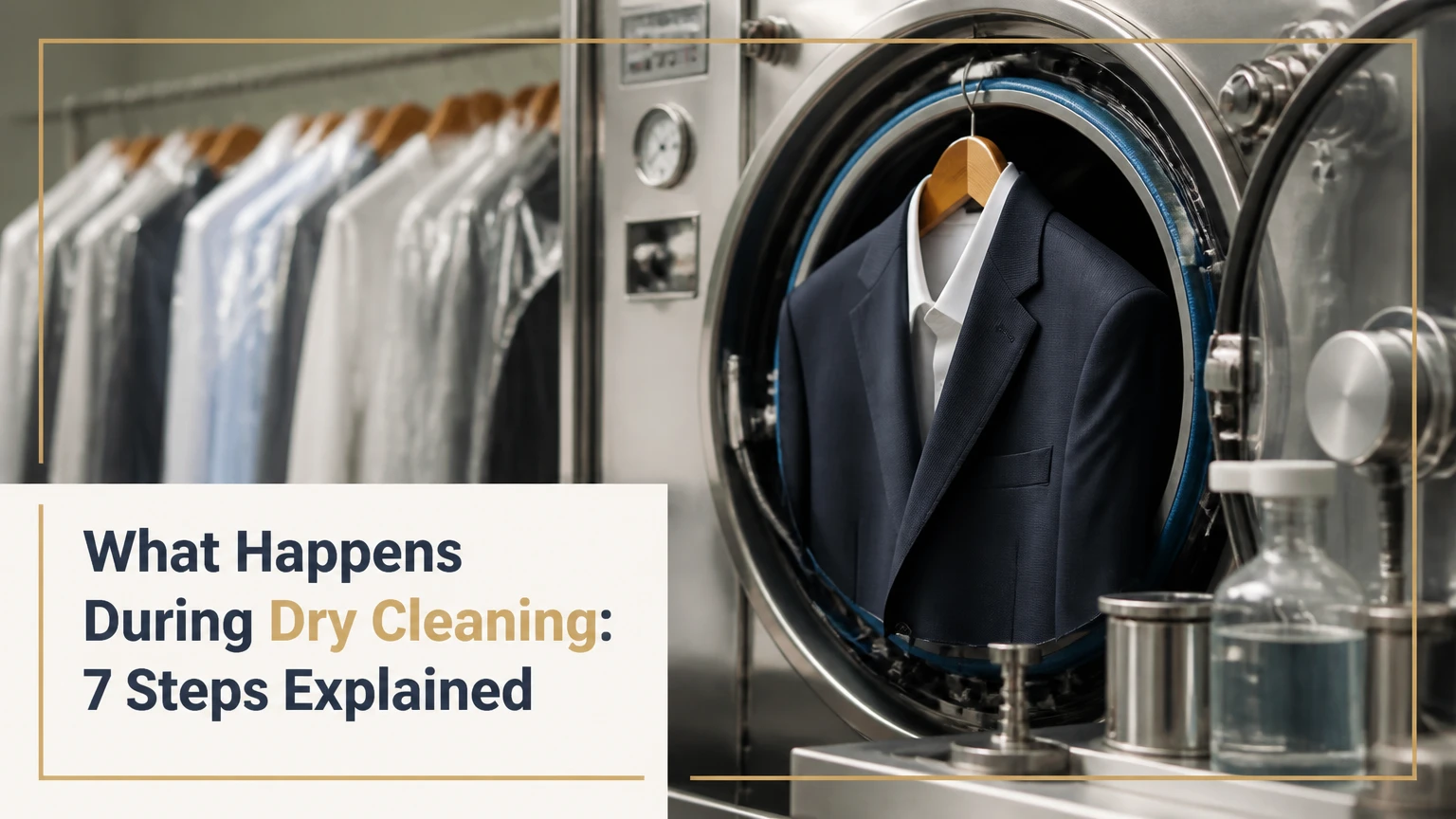
Dry cleaning cleans garments in a liquid solvent instead of an aqueous wash. A professional cleaner first inspects and tags the item, treats visible stains, cleans it in a controlled machine, recovers and filters the solvent, dries the garment, presses it into shape, and performs a final inspection before packaging.
Key Facts at a Glance
- Dry cleaning is a liquid cleaning process, not a water-free process.
- Non-polar solvents are especially effective against oils, fats, waxes, and greasy soils.
- Professional cleaners normally combine machine cleaning with separate stain treatment and pressing.
- A typical order takes 48-72 hours, although fabric, stains, workload, and alterations can extend the time.
- Dry cleaning cannot restore fabric damaged by bleaching, scorching, dye loss, abrasion, or oxidation.
- Professional wet cleaning uses water, detergent, and tightly controlled equipment; it is not the same process as dry cleaning.
What Does Dry Cleaning Actually Mean?
Dry cleaning means cleaning textiles with a liquid organic solvent rather than water as the primary cleaning liquid. The “dry” name distinguishes the process from laundering, because the garment is not immersed in an ordinary water-and-detergent wash, even though the garment becomes wet with solvent.
Water is polar, so it interacts strongly with charged or water-attracting substances and can swell some fibers. That swelling can shrink wool, felt animal-hair fibers, disturb silk finishes, move unstable dyes, or deform garments with fused interfacings. Dry-cleaning solvents are generally less polar and dissolve oily soils more readily without producing the same fiber swelling.
Cleaning still requires more than solvent. A machine uses controlled agitation, solvent circulation, detergent, filtration, extraction, and heat. Spotting technicians separately address stains that the main solvent may not dissolve, including some sugars, salts, tannins, and proteins.
The care label provides the starting constraint, not a guarantee of a perfect result. The Federal Trade Commission’s care-label system identifies an appropriate care method, but manufacturers do not have to predict every stain, dye defect, age-related weakness, or previous home-treatment error.
What Happens During Dry Cleaning, Step by Step?
A conventional professional order follows seven connected stages: inspection, tagging, pre-treatment, machine cleaning, solvent recovery, drying, finishing, and final inspection. The exact sequence varies by facility, because some cleaners spot garments before cleaning while others inspect and re-treat them between the cleaning and finishing stages.
Step 1: The Cleaner Inspects and Tags the Garment
The cleaner records the garment, customer order, stated service, and visible condition before processing begins. Staff may note missing buttons, open seams, frayed edges, broken zippers, worn cuffs, loose sequins, color variation, or stains that were already present.
A tracking number connects the garment to the order throughout the facility. Some operations use barcodes, while others use paper tags, color-coded bundles, or computer-controlled conveyors. Staff also check pockets because pens, cosmetics, coins, tissues, and batteries can damage clothing or machinery.
A competent intake inspection also identifies construction. A tailored jacket contains canvassing or fusing, shoulder padding, lining, and shaped lapels; a beaded dress may contain adhesives that react poorly to solvents; leather and suede require specialized processing rather than routine garment cleaning.
Success checkpoint: The order identifies the garment, requested service, visible damage, and special concerns.
Customer mistake: Failing to point out an old stain or previous home treatment can make later damage appear unexplained.
Step 2: A Spotter Pre-Treats Visible Stains
Spotting is targeted stain treatment performed before or after the main machine cycle. The technician identifies the likely stain family, selects a compatible reagent, applies controlled moisture or steam when appropriate, and uses air, vacuum, or gentle mechanical action to release the soil.
| Stain or soil type | Typical examples | Likely treatment approach | Important limitation |
|---|---|---|---|
| Oily soil | Salad dressing, body oil, lipstick | Solvent-compatible agent and absorbent action | Heat can spread oil through fibers |
| Protein soil | Blood, milk, egg | Enzyme or protein-targeted treatment at controlled temperature | Hot water can set protein stains |
| Tannin soil | Coffee, tea, wine, fruit | Tannin remover, moisture, and controlled flushing | Older stains may have oxidized |
| Sugar-based soil | Soft drinks, syrup | Water-based spotting chemistry | Residue can become brown after heat |
| Dye transfer | Ink, fabric dye, marker | Specialized dye reducer or controlled solvent | Color removal may damage the garment’s dye |
| Particulate soil | Mud, dust, makeup powder | Vacuuming, brushing, or suspension in solvent | Rubbing can drive particles deeper |
Stain chemistry determines the result more than the machine cycle alone. A dry cleaner may remove the original food or oil but still leave a permanent color change caused by bleach, sunlight, heat, or oxidation.
Success checkpoint: The stain lightens without a ring, color shift, surface fuzzing, or texture change.
Customer mistake: Rubbing silk or wool with water can create a visible tide mark or abraded patch that cleaning cannot reverse.
Step 3: The Garment Enters a Controlled Cleaning Machine
The garment goes into a sealed drum that resembles a commercial front-loading washer. The machine adds a measured volume of solvent and specialized detergent, then rotates the load at a programmed speed to suspend and remove soil.
Mechanical action matters. Solvent dissolves or loosens compatible soil, while the movement of garments through the liquid helps detach particles. Too little action can leave soil behind; excessive action can abrade delicate surfaces, distort embellishments, or create wrinkles.
The machine’s operator selects a cycle based on fabric, color, garment construction, and contamination. A lightly soiled wool jacket may need a gentler program than a heavily soiled work uniform, while a sequined item may require a low-action cycle and protective netting.
Modern equipment often keeps solvent in a closed system. The machine continuously monitors or controls solvent flow, temperature, filtration, and drying conditions, but solvent type and machine design differ between cleaners.
Step 4: Used Solvent Is Extracted, Filtered, and Recovered
After cleaning, the machine removes solvent from the garment by draining and spinning. The drum’s centrifugal force extracts much of the liquid, reducing the amount that must be evaporated during drying.
Filtration and distillation perform different jobs. Filters capture suspended lint, soil, and particulate matter, while distillation separates solvent from dissolved contaminants by using differences in volatility. The recovered solvent returns to a storage tank or working circuit.
Recovery is not identical to zero environmental impact. Closed-loop equipment greatly limits releases, but facilities still manage waste filters, sludge, separator water, spent spotting chemicals, and maintenance residues. The United States Environmental Protection Agency regulates perchloroethylene handling under hazardous-air-pollutant and waste-management rules, while state requirements can be stricter.
Expert insight: “Filtered” does not mean “chemically purified.” A filter removes suspended particles; distillation and solvent management address dissolved contamination and solvent quality.
Step 5: Warm Air Removes Residual Solvent
The machine circulates temperature-controlled air through the extracted garment. That air carries solvent vapor away from the fabric, then passes over cooling equipment that condenses much of the vapor back into liquid for reuse.
Drying temperature is a risk-control setting. Excessive heat can shrink animal fibers, soften adhesives, distort synthetic materials, or set certain stains. Insufficient drying can leave a chemical odor, especially in dense wool, quilted garments, thick seams, or heavily lined coats.
A finished garment should not feel wet with solvent or produce a strong, persistent chemical odor. A faint process odor may dissipate during ventilation, but an intense odor indicates that the cleaner should inspect the item and, if necessary, run additional extraction or drying.
Step 6: Pressing Restores Shape and Surface Appearance
Pressing removes wrinkles and restores the garment’s intended geometry after cleaning. Operators use steam, pressure, vacuum, heated bucks, sleeve forms, trouser toppers, and form finishers according to the garment’s construction.
A tailored jacket may be shaped over a form rather than flattened under a heavy iron. Velvet and corduroy require nap-sensitive handling, often with a needleboard or indirect steam, because direct pressure can crush the raised surface. Beaded and sequined garments may need hand finishing around fragile decoration.
Finishing can improve shape, but it cannot repair structural damage. A cleaner can reset a lapel roll or smooth a lining; pressing cannot restore a melted synthetic fiber, replace missing fabric, or reverse permanent shine from excessive ironing.
Step 7: Final Inspection and Packaging Complete the Order
Staff inspect the garment under strong light for remaining stains, missing accessories, loose threads, pressing marks, odor, and correct assembly. A second spotting treatment may occur if the original stain remains safely treatable.
Cleaners commonly place garments in plastic covers for transport. The cover protects against dust and handling during pickup, but long-term storage is better in a breathable garment bag, with adequate airflow and a shaped hanger.
Success checkpoint: The garment is clean, dry, correctly pressed, odor-controlled, and matched to the order.
Customer mistake: Leaving a garment in its delivery plastic for weeks can trap moisture and encourage odor or mildew in humid conditions.
Which Solvents and Cleaning Methods Are Used?
Professional cleaners use several solvent systems, and no method is ideal for every fiber or stain. Perchloroethylene, often called PERC, remains effective at dissolving oily soils, while hydrocarbon solvents, siloxane-based systems, liquid carbon dioxide, and professional wet cleaning offer different trade-offs.
| Method | Primary cleaning medium | Strengths | Main limitations |
|---|---|---|---|
| PERC dry cleaning | Perchloroethylene | Strong grease removal; established equipment base | Hazardous handling requirements; regulatory phaseouts |
| Hydrocarbon cleaning | Petroleum-based hydrocarbon solvent | Gentle action; useful for many embellished garments | Less aggressive on heavy oil; combustible-solvent controls |
| Silicone cleaning | D5 siloxane solvent | Mild feel; low water content; compatible with some delicate items | Environmental profile depends on handling and local rules |
| Liquid CO2 cleaning | Pressurized carbon dioxide | Low-temperature process; limited conventional solvent residue | High equipment cost; limited availability |
| Professional wet cleaning | Water, detergent, controlled mechanics | Strong on sweat, salts, and many water-soluble soils | Requires skilled drying and pressing; water-sensitive items remain unsuitable |
“Green” is not a standardized guarantee across cleaning businesses. A facility’s environmental performance also depends on solvent recovery, waste handling, energy use, ventilation, machine maintenance, and staff training.
Professional wet cleaning is not chemical-free. Water and biodegradable detergents are chemicals, and wet-cleaning results depend on controlled moisture, agitation, drying, and finishing. The method can work very well for washable wool, silk, rayon, and structured garments when the cleaner has the right equipment and expertise.
How Long Does Dry Cleaning Take?
Typical dry-cleaning turnaround is 48-72 hours, while same-day service may require early drop-off and an additional charge. Heavy coats, wedding dresses, stain-heavy items, repairs, alterations, outsourced processing, and holiday demand can extend the timeframe to several days or weeks.
| Service or garment | Typical turnaround | Common reason for delay |
|---|---|---|
| Shirt or trousers | 2-3 days | Stain treatment or pressing queue |
| Suit or blazer | 2-4 days | Structured finishing and inspection |
| Dress or embellished garment | 3-7 days | Hand spotting and decoration protection |
| Overcoat or duvet-style coat | 3-7 days | Dense insulation and extended drying |
| Wedding gown | 1-4 weeks | Detailed cleaning, inspection, and packaging |
| Same-day order | 6-12 hours | Early intake and limited garment complexity |
Ask for a promised completion time before leaving the order. “Same day” often describes standard garments, not every item accepted at the counter.
How Much Does Dry Cleaning Cost?
Typical United States prices range from $3-$8 for a button-down shirt and $12-$25 for a two-piece suit, but local labor rates, garment size, stain severity, fabric, service level, and geographic market create substantial variation.
| Garment | Typical price range | Likely surcharge |
|---|---|---|
| Button-down shirt | $3-$8 | Hand finishing or heavy stain treatment |
| Trousers or slacks | $5-$12 | Crease restoration or repair |
| Blazer or sport coat | $7-$15 | Leather trim or difficult construction |
| Two-piece suit | $12-$25 | Rush service or severe soil |
| Dress | $10-$25+ | Beading, silk, lace, or special packaging |
| Overcoat | $15-$35+ | Long length, insulation, or fur trim |
Premium items can add $2-$10 or more for hand spotting, delicate fibers, extensive embellishment, or specialized packaging. A cleaner should disclose unusual charges before processing when the required work is apparent at intake.
Which Garments Benefit Most From Dry Cleaning?
Dry cleaning is most useful for garments whose shape, surface, or fibers could be damaged by household laundering. Suits, tailored jackets, wool coats, pleated formalwear, lined dresses, some silk items, and garments with unstable dyes often benefit from professional assessment.
A care label reading “dry clean” does not mean every wearing requires a machine cycle. Airing, brushing, steaming, spot treatment, and proper storage can manage light use between cleanings.
| Garment situation | Usually appropriate action | Typical interval or trigger |
|---|---|---|
| Wool business suit | Air, brush, steam, then clean | Every 4-6 wears or after visible soil |
| Silk blouse | Follow label and dye stability | After perspiration or visible staining |
| Tailored blazer | Air and spot-clean carefully | Every 4-8 wears, depending on contact |
| Winter overcoat | Professional cleaning | Once per season or after salt and spills |
| Beaded evening dress | Specialist inspection | After each event if perspiration or stains exist |
| Cotton everyday shirt | Launder if label permits | After each wear or visible soil |
Practitioner rule: Over-cleaning can shorten a garment’s life because repeated solvent exposure, pressing, abrasion, and stain chemistry gradually affect fibers, finishes, buttons, and adhesives.
Is Dry Cleaning Better Than Washing at Home?
Dry cleaning is better for solvent-compatible oily soils and structured garments; home washing is usually better for washable cotton, sweat salts, mud, and water-based food residue. The correct method depends on fiber, construction, dye stability, stain chemistry, and the care label.
| Decision factor | Professional dry cleaning | Home washing |
|---|---|---|
| Grease and body oil | Strong solvent action | Requires detergent and pretreatment |
| Sweat salts | May require water-based spotting | Usually effective with detergent and water |
| Wool shrinkage risk | Lower when correctly processed | Higher with heat, agitation, and felting |
| Tailored structure | Preserves shape better | Can disturb fusing, padding, and lining |
| Cost per garment | Typically $3-$35+ | Often under $1 in household supplies |
| Convenience | 48-72-hour wait is typical | Often completed within one day |
Neither method removes every stain. A red-wine mark may include tannin, sugar, and dye; a cleaner can remove the residue while leaving permanent discoloration from oxidation or fiber damage.
Home washing is especially risky for velvet, suede, structured jackets, heavily embellished garments, and fabrics with “dry clean only” instructions. A cold cycle does not eliminate all risk because agitation, water migration, detergent alkalinity, and drying can still alter the item.
What Happens to Difficult or Permanent Stains?
A cleaner first separates removable soil from permanent fabric damage. Oil, dust, and some food residues may come out, but bleach marks, dye loss, scorch marks, rust damage, ink migration, and age-darkened cellulose may remain after technically correct cleaning.
Never iron a stained garment before professional treatment. Heat can set protein and sugar residues, flatten oily marks into the yarn, and create a larger area of discoloration.
Before drop-off, provide four facts:
- Identify the stain source, such as wine, grease, ink, makeup, or perspiration.
- State when the stain occurred and whether it has already dried.
- Describe every home treatment, including water, detergent, stain remover, or ironing.
- Point out the exact location, especially on dark or patterned fabric.
A cleaner may decline treatment when the likely remedy threatens the garment more than the stain does. That decision reflects risk management, not necessarily poor cleaning.
What Should You Do After Pickup?
Remove the plastic cover when the garment reaches its storage location, then inspect the item under bright light before putting it away. Keep the garment on a padded or shaped hanger, allow airflow, and avoid compressing wool, silk, velvet, or embellished clothing.
Return promptly if the garment has a strong solvent odor, dampness, a new pressing mark, missing accessories, or a stain that the intake conversation indicated would be treated. Delayed complaints make it harder to establish whether damage occurred during processing, storage, or later wear.
Store cleaned garments in a cool, dry, dark closet. Sunlight can fade dyes, humidity can support mildew, and wire hangers can distort shoulders. Long-term archival storage for wedding dresses or vintage textiles requires breathable materials and acid-free packaging rather than ordinary plastic.
Common Dry-Cleaning Problems and Their Fixes
Strong chemical odor
A strong persistent odor can indicate incomplete drying, inadequate ventilation, solvent contamination, or dense construction that retained solvent. Air the garment in a shaded, ventilated area, then contact the cleaner if the odor remains after 24 hours.
Remaining stain
A remaining mark may be permanent dye alteration rather than removable soil. Ask what stain family was identified and whether further treatment risks color loss or fiber damage.
Flattened velvet or corduroy
A crushed nap usually results from direct pressure or unsuitable finishing technique. Request nap restoration using indirect steam and a suitable needleboard; repeated pressing may make the texture harder to recover.
Shrinkage or distortion
Shrinkage can result from fiber relaxation, heat, moisture, agitation, or pre-existing manufacturing tension. Compare the garment with its original measurements and report the issue quickly, especially before wearing or altering it.
Missing button or damaged trim
Buttons, sequins, beads, and zipper pulls can loosen during ordinary wear or cleaning. Intake documentation helps distinguish pre-existing weakness from processing damage, while specialist cleaners may remove fragile trim before treatment.
Plastic-covered storage odor
Plastic is useful for transport but poor for extended storage. Replace it with breathable protection after the garment has cooled and fully aired.
Before Handing Garments to a Cleaner
Use this short intake checklist:
- Read the care label and mention any contradiction between the label and the garment’s visible construction.
- Empty all pockets and remove detachable belts, pins, jewelry, and accessories.
- Photograph existing damage on expensive, vintage, or formal clothing.
- Identify every stain and disclose prior treatment.
- Ask which cleaning method and solvent the facility uses.
- Confirm the expected price, pickup date, and rush-service charge.
- Ask whether the cleaner handles leather, suede, beading, wedding gowns, or vintage textiles in-house.
- Request a written note for fragile trim, color bleeding, or known damage.
A cleaner’s equipment matters, but judgment matters more. Correct garment classification prevents many failures before the item reaches the machine.
FAQ About Dry Cleaning
Does dry cleaning remove sweat odor?
Dry cleaning can reduce body oil and odor trapped in a garment, but sweat salts and water-soluble residues may need moisture-based spotting or professional wet cleaning. Persistent odor can also come from bacteria, synthetic fiber buildup, lining contamination, or inadequate drying rather than soil that solvent alone can dissolve.
Can dry cleaning shrink wool?
Correct professional dry cleaning usually presents less shrinkage risk than hot washing, but wool can still change size or shape through heat, moisture, agitation, fiber relaxation, or pre-existing tension. Ask the cleaner about the garment’s construction, especially for loosely woven knits, older coats, and cashmere.
Can dry cleaning remove ink?
Ink removal depends on the ink chemistry, garment dye, fiber, and age of the mark. Some solvent-compatible inks respond well to professional spotting, while permanent marker, ballpoint dye migration, and heat-set ink may leave a shadow or cause color loss during treatment.
Can I dry clean leather or suede with ordinary clothes?
Ordinary garment dry cleaning is not a substitute for leather or suede cleaning. Leather contains finishes, oils, and skins that require specialized cleaning and reconditioning; conventional processing can harden, discolor, shrink, or strip the surface.
Why does a dry-cleaned garment still wrinkle?
Wrinkles may remain when the fabric has permanent creasing, the lining shrank differently from the shell, the item was packed before cooling, or the finishing method did not match the construction. A professional cleaner can often re-press the garment, but pressing cannot correct fiber distortion or heat damage.
Is professional wet cleaning safer than dry cleaning?
Professional wet cleaning avoids conventional organic solvent, but it is not automatically safer for every garment. Water, detergent, agitation, and drying can damage unstable dyes, wool, silk, structured garments, and water-sensitive finishes, while a skilled cleaner can select the lower-risk method for the specific item.
The Bottom Line
What happens during dry cleaning is a controlled textile-cleaning sequence, not a simple solvent wash. Inspection, stain chemistry, machine settings, solvent recovery, drying, pressing, and final quality control determine the result, so the best outcome begins with accurate information at drop-off and ends with breathable storage after pickup.