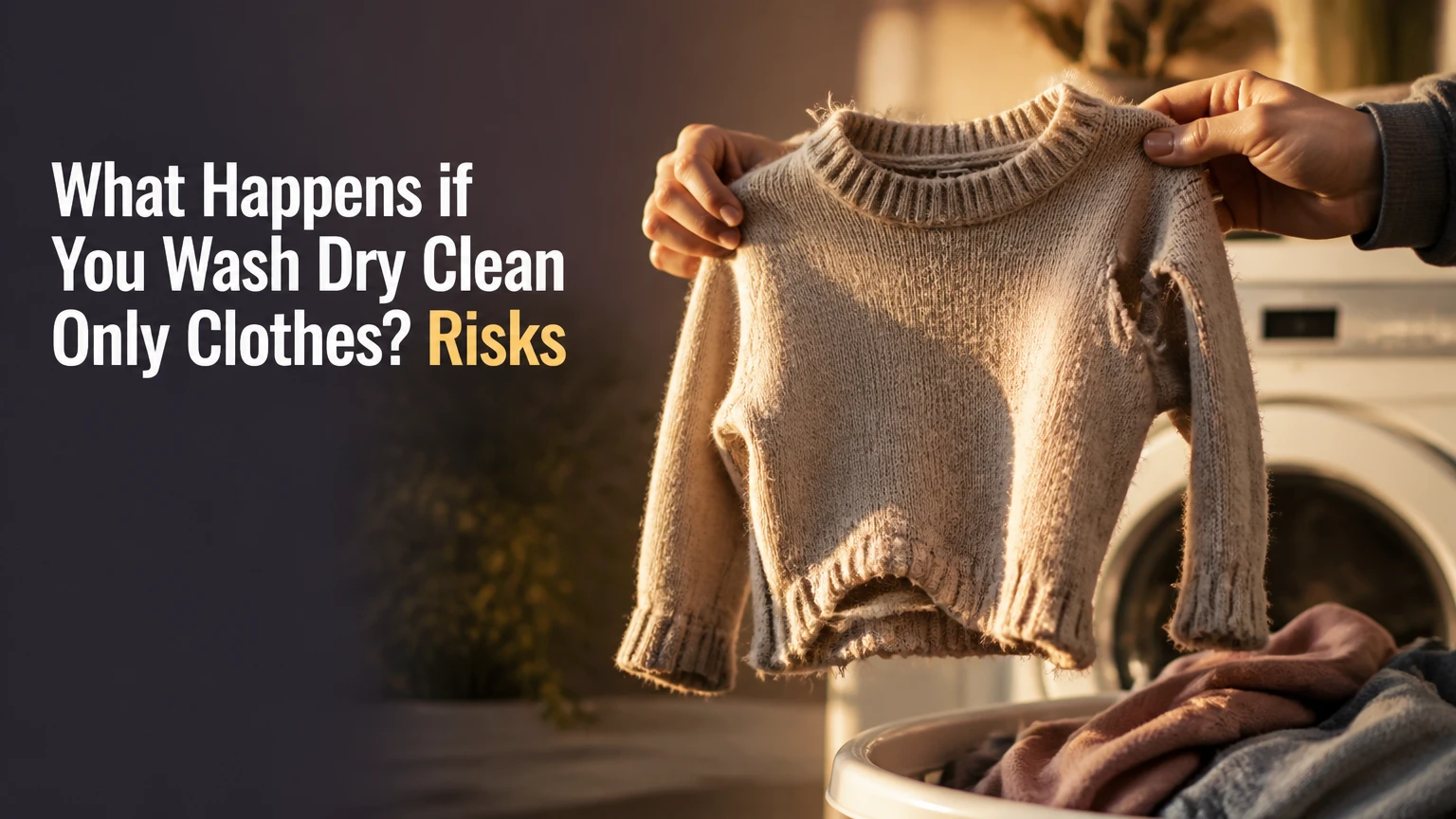
Washing dry clean only clothes can cause shrinkage, felting, dye bleeding, fabric distortion, or permanent damage to linings and internal structure. The result depends on the fiber, dyes, trims, construction, water temperature, detergent, agitation, and drying method. A cold wash is less aggressive than a hot cycle, but it does not remove every risk.
Key Facts at a Glance
“Dry Clean Only” means the manufacturer has identified professional dry cleaning as the safest tested care method.
Wool and cashmere can felt when moisture, heat, and friction lock their surface scales together.
Rayon and viscose may shrink or lose shape while wet, even without hot water.
A dryer adds heat, tumbling, and rapid moisture loss, which can make distortion irreversible.
Structured jackets can warp because water affects fusible interfacings, shoulder pads, linings, and adhesives.
Steam, airing, and spot treatment can refresh some garments, but they cannot replace cleaning for oil-based or embedded stains.
What Does “Dry Clean Only” Actually Mean?
“Dry Clean Only” is a care-label instruction that tells the consumer not to use ordinary water-based laundering unless a qualified professional has confirmed a safer alternative. The label does not mean the garment contains no washable fibers; it means the complete garment, including dyes, trims, lining, and construction, may not tolerate home washing.
In the United States, the Federal Trade Commission’s Care Labeling Rule requires manufacturers and importers to attach care instructions with a “reasonable basis.” That wording matters because a garment’s risk comes from its entire assembly, not from the fiber percentage alone. A polyester shell may be washable, while its glued interfacing or acetate lining is not.
“Dry clean” also does not mean the item must always be cleaned after every wear. Airing, brushing, steaming, and careful spot treatment can reduce cleaning frequency when the garment has no odor, perspiration buildup, or visible soil. A cleaner should handle garments with oil stains, unstable dyes, heavy lining, leather panels, or structural tailoring.
Is “Dry Clean” Different From “Dry Clean Only”?
Yes. “Dry Clean” generally identifies a recommended method, while “Dry Clean Only” gives a stronger restriction against other methods. The exact legal interpretation varies by country, and some brands use conservative labels to reduce complaints, but consumers should treat “Only” as a warning against machine washing.
A garment labeled “Dry Clean” may still be hand-washable if the manufacturer provides another approved symbol or written instruction. Without that additional instruction, testing a hidden area is safer than assuming the item can tolerate water.
Why Does Washing Cause Damage?
Water changes the dimensions and behavior of many fibers, while detergent, friction, and heat add mechanical and chemical stress. The most serious failures occur when wet fibers rub together, dyes dissolve into water, or internal garment layers respond differently from the outer fabric.
Professional dry cleaning uses a liquid solvent rather than water, although the garment is not literally cleaned without liquid. Solvents such as perchloroethylene, hydrocarbon formulations, or liquid silicone are selected and controlled to remove oils while limiting fiber swelling. Professional cleaners also inspect stains, select cycles, control extraction, and press the garment back into shape.
The common explanation that dry-cleaning solvent “never penetrates” fibers is too simple. Solvent can contact and move through the textile, but many solvents interact differently with fibers than water does. Dry cleaning also cannot guarantee zero shrinkage, because heat, finishing, previous wear, and fiber relaxation can still change dimensions.
What Happens in a Washing Machine?
A washing machine combines four risks:
- Water exposure: Fibers absorb moisture and may swell or relax.
- Mechanical action: Rubbing and agitation distort yarns, seams, pleats, and surface finishes.
- Detergent chemistry: Alkalinity, enzymes, optical brighteners, and solvents can affect dyes and protein fibers.
- Drying stress: Heat and tumbling accelerate shrinkage, creasing, stretching, and adhesive failure.
A cold, short, low-agitation cycle is less damaging than a hot heavy-duty wash, but “less damaging” is not the same as safe. The garment may emerge looking acceptable and later reveal shortened sleeves, rippled seams, a stiff handle, or a lining that no longer fits the shell.
What Happens to Different Fabrics?
The fabric, yarn structure, finish, and garment construction determine the failure mode. Two garments made from the same fiber can react differently because one is knitted and unlined while the other is woven, tailored, printed, or bonded.
| Material or construction | Likely washing result | Main risk level | Possible recovery |
|---|---|---|---|
| Wool, cashmere, alpaca | Shrinkage, felting, dense rough surface | High | Limited reshaping while damp |
| Silk, chiffon, satin | Water marks, dye migration, dullness, seam stress | Medium-high | Steam may remove wrinkles only |
| Rayon, viscose, modal | Shrinkage, limpness, stiffness, stretching | High | Reshaping may help slightly |
| Leather, suede | Stiffness, darkening, cracking, oil loss | Very high | Specialist treatment required |
| Tailored suit or blazer | Bubbling, warped lapels, lining mismatch | Very high | Pressing or relining may be needed |
| Polyester or nylon blend | Wrinkles, finish loss, color transfer | Medium | Often better than animal fibers, not guaranteed |
| Pleated or bonded garment | Pleat loss, delamination, rippling | High | Professional pressing may be partial |
Will Wool and Cashmere Shrink?
Wool and cashmere can shrink severely when water, heat, and friction cause felting. Microscopic scales on animal fibers can catch against neighboring fibers, creating a tighter, shorter, denser fabric; once substantial felting occurs, returning the garment to its original size is usually impossible.
A hand-washed wool sweater may shrink less than a machine-washed one because it avoids aggressive agitation and high spin speeds. The dryer is especially destructive. A wet sweater should never be wrung or hung, because its water weight can stretch the shoulders, neckline, or sleeve openings.
A conditioner or baby-shampoo soak may relax some mildly shrunken fibers, but it does not reverse true felting. Treat any “unshrinking” method as a low-probability rescue, not a reliable repair.
Can Silk Be Washed?
Some silk garments can be hand-washed, but a “Dry Clean Only” silk garment should not be assumed washable. Water can produce tide marks, change the sheen, mobilize unstable dyes, and expose weak seams or finishes; chiffon and lightweight silk are particularly vulnerable to snagging and distortion.
Silk is also sensitive to localized moisture. A single wet spot may dry with a visible ring because the surrounding fabric absorbs water at a different rate. Test hidden colorfastness only when the label permits experimentation, and never use a hot iron directly on silk.
What Happens to Rayon and Viscose?
Rayon and viscose often lose wet strength and dimensional stability, so washing can cause shrinkage, stretching, surface roughness, or permanent limpness. The exact strength loss varies by fiber type, manufacturing process, yarn, and finish; a universal figure such as “50% for every rayon garment” is not dependable.
Viscose dresses can become longer in some areas and shorter in others because the fabric absorbs water unevenly and the garment dries under its own weight. Lay the garment flat if a washable viscose item becomes wet, and avoid pulling the seams back into alignment while it is saturated.
Why Are Leather and Suede Different?
Leather and suede are skin-based materials that rely on oils, finish layers, and controlled moisture balance. Washing can darken the surface, remove oils, stiffen the hide, disturb nap, shrink panels, and create cracks as the material dries.
Do not place a washed leather jacket in a dryer, radiator, or direct sun. Blot surface water, keep the item supported in its natural shape, and contact a leather specialist before applying conditioner or dye. Household detergent can complicate later restoration.
What Happens to a Suit or Lined Jacket?
Water can make a tailored jacket bubble, pucker, sag, or lose its intended silhouette because the shell, lining, canvas, fusible interfacing, padding, and thread respond at different rates. Heat can soften adhesives, while tumbling folds lapels and stresses the shoulder line.
A jacket that looks merely wrinkled may have delamination beneath the cloth. Bubbling around lapels, chest panels, pockets, or hems indicates that pressing alone may not restore the garment. Professional cleaners and tailors can assess whether the jacket needs controlled pressing, re-fusing, panel replacement, or relining.
Which Care Method Should You Choose?
Professional cleaning is the safest default for a true “Dry Clean Only” garment, especially when it is structured, lined, expensive, embellished, leather-trimmed, or visibly stained. Hand washing is a possible alternative only for certain unstructured garments when the fiber, dye, trim, and manufacturer instructions support it.
| Care method | Suitable example | Typical time | Typical cost in the United States |
|---|---|---|---|
| Professional dry cleaning | Blazer, wool coat, silk dress | 1-3 days | $8-$35 per garment |
| Specialist leather cleaning | Suede jacket, leather coat | 1-3 weeks | $40-$150 |
| Careful hand washing | Unlined wool knit with approved instructions | 20-40 minutes plus drying | $0.50-$3 in detergent |
| Delicate machine cycle | Label-approved polyester blouse | 30-60 minutes | $0.25-$1 in utilities and detergent |
| Home dry-cleaning kit | Light odor or wrinkle refresh | 20-40 minutes | $2-$5 per garment |
Prices are typical consumer ranges, not universal rates. Urban cleaners, same-day service, stain treatment, rush work, wedding garments, and oversized coats can cost substantially more.
Is Hand Washing Safer Than Machine Washing?
Hand washing is mechanically gentler because the user can limit friction, temperature, soaking time, and extraction. It is still unsafe for many structured garments, unstable dyes, leather, heavily embellished pieces, garments with bonded components, and items whose label specifically prohibits water.
A garment labeled “Dry Clean Only” should not be hand-washed merely because it feels soft or lightweight. Construction is the deciding factor. An unlined cashmere knit and a cashmere-blend coat with shoulder pads require different care.
Do Home Dry-Cleaning Kits Really Clean Clothes?
Home dry-cleaning kits mainly refresh garments by reducing light odor and wrinkles in a household dryer. They do not reproduce professional stain identification, solvent filtration, controlled finishing, or specialized treatment for oil, protein, ink, or dye-transfer stains.
A kit may be reasonable between professional visits for a lightly worn, colorfast item. It is a poor choice for visible grease, perspiration rings, mildew, leather, structured tailoring, or a garment that has already suffered water damage.
How Should You Wash a Dry Clean Only Garment at Home?
Home washing should be limited to an unstructured, unlined garment whose fiber and trim tolerate water, preferably when the label says “Dry Clean” rather than “Dry Clean Only.” The process takes about 20-40 minutes, followed by 12-48 hours of flat drying; success depends most on avoiding heat, friction, and stretching.
Before You Start
| Requirement | Recommended specification |
|---|---|
| Water | Cold to lukewarm, 20-30°C |
| Cleaning product | 5-10 mL pH-neutral wool or silk detergent |
| Basin | Clean container holding at least 5 liters |
| Drying surface | Two clean towels or a mesh rack |
| Drying location | Shaded, ventilated room at 18-25°C |
| Color test | Hidden seam, white cotton cloth, 1 small detergent drop |
Do not proceed if dye transfers, the garment has leather or metal trim, the item is tailored or lined, or the care label prohibits water.
Step 1: Test the Dye
Dampen a white cloth with cool water and touch an inside seam for 5-10 seconds. Add a tiny amount of the intended detergent only if water alone causes no transfer.
You should see no color on the cloth. Any clear dye transfer means professional cleaning is the safer decision.
Step 2: Prepare the Washing Bath
Fill the basin with 5 liters of cold or lukewarm water and dissolve 5-10 mL of a wool or silk detergent. Avoid bleach, fabric softener, enzyme-heavy biological detergent, and stain removers containing oxygen or chlorine.
The bath should feel cool, not warm. Heat increases the risk of shrinkage and dye movement.
Step 3: Soak Without Scrubbing
Submerge the garment for 2-5 minutes and move it slowly through the water. Do not rub collars, scrub stains, twist fabric, or leave protein fibers soaking for 30 minutes.
A short, controlled wash reduces mechanical stress. You will know the step was gentle enough when the fabric remains smooth and the water shows no loose surface fibers.
Step 4: Rinse by Pressing
Drain the basin, refill it with cool water, and press the garment down repeatedly. Repeat once or twice until the water contains no visible detergent.
Do not hold the garment by the shoulders while it is saturated. Wet fabric can stretch under its own weight.
Step 5: Remove Water in a Towel
Place the garment flat on a clean towel, roll the towel around it, and press down with your hands. Unroll after 1-2 minutes and repeat with a dry towel if necessary.
Never wring or twist wool, cashmere, silk, rayon, or viscose. Excess force can permanently change seam alignment.
Step 6: Reshape and Dry Flat
Place the garment on a dry towel or mesh rack, align the seams, and restore the original dimensions without pulling. Dry it away from heaters, direct sunlight, and a tumble dryer.
Drying may take 12-48 hours depending on thickness and humidity. The garment is ready when the heaviest seams and waistband feel completely dry.
What Should You Do If You Already Washed It?
Stop the damage immediately by removing the garment from the washer or dryer, then assess its fiber, moisture level, shape, color, and surface. Do not add more heat or attempt aggressive stretching before deciding whether the problem is shrinkage, felting, dye bleeding, or structural failure.
| Observed problem | Immediate action | Avoid | Likely professional remedy |
|---|---|---|---|
| Wet wool or cashmere | Lay flat and towel-press | Wringing or hanging | Blocking or limited reshaping |
| Dye bleeding | Separate and keep damp | Heat-setting the color | Dye correction or cleaning |
| Stiff rayon or viscose | Support flat while drying | Pulling wet seams | Steam, pressing, or partial reshaping |
| Wrinkled silk | Air dry flat | Hot iron contact | Low-temperature steam |
| Bubbling blazer | Stop drying and preserve shape | Home ironing | Re-fusing or tailoring |
| Wet leather or suede | Blot and support naturally | Radiator or hair dryer | Leather restoration |
Can Shrunken Wool Be Repaired?
Mild dimensional change may improve with cool water, a brief soak, towel extraction, and careful blocking, but felted wool cannot reliably be restored. If the knit has become dense, stiff, and markedly smaller, home conditioner treatments are unlikely to recover the original fit.
Do not pull aggressively. Stretching can enlarge one section while leaving the body felted, producing a misshapen garment.
Can Color Bleeding Be Fixed?
Color bleeding sometimes responds to professional dye-transfer treatment, but household heat can make the transferred dye harder to remove. Keep the garment away from a dryer, iron, and direct sunlight, and tell the cleaner exactly what detergent, temperature, and cycle were used.
Do not apply chlorine bleach to silk, wool, leather, or rayon. Bleach can weaken fibers and create a second, irreversible defect.
Can a Damaged Suit Be Saved?
A suit can sometimes be saved if the problem is superficial wrinkling, but bubbling, separated fusible layers, warped canvas, and a distorted lining often require tailoring. Photograph the garment before further treatment, preserve the care label, and take it to a cleaner familiar with tailored clothing.
Pressing is not a universal fix. Heat can flatten wrinkles while making adhesive separation more visible or permanent.
What Mistakes Cause the Most Damage?
The most expensive mistakes combine moisture with heat or unsupported weight. Practitioners usually see the following avoidable failures:
- Using a hot dryer: Heat sets shrinkage and accelerates adhesive failure.
- Wringing wet knits: Twisting changes shoulder, cuff, and neckline dimensions.
- Hanging saturated garments: Water weight stretches rayon, silk, wool, and knit seams.
- Using regular detergent: Enzymes and alkalinity may be unsuitable for protein fibers and delicate dyes.
- Spot-cleaning without testing: Local moisture can create a ring or permanent color change.
- Ironing a bubbled jacket: Direct heat can worsen delamination beneath the outer cloth.
A useful practitioner rule is to distinguish surface refresh from soil removal. Steam can reduce wrinkles and some odors, but it does not remove body oils trapped in a lining or grease embedded in fibers.
How Can You Reduce Dry-Cleaning Frequency?
Air a garment for several hours after wearing it, brush loose particles from wool, treat small spots according to the label, and use a steamer at a safe distance rather than repeated full cleaning. Do not steam leather, suede, or garments with water-sensitive trims without specialist advice.
Clean a garment when it has visible soil, persistent odor, perspiration buildup, or a stain likely to oxidize. Storing a stained silk dress or wool jacket for months can make the mark more difficult to remove.
Is Professional Dry Cleaning Environmentally Better?
Environmental impact depends on the solvent, equipment, energy source, waste controls, and local regulations. Perchloroethylene, commonly called perc, is effective but requires careful handling and recovery; alternatives include hydrocarbon solvents, liquid silicone systems, professional wet cleaning, and carbon-dioxide processes.
“Green” on a storefront is not a sufficient technical specification. Ask which process the cleaner uses, whether solvent is recovered, and whether the item is suitable for professional wet cleaning. Wet cleaning is controlled water-based cleaning with specialized machinery, detergents, drying, and finishing, not ordinary home washing.
FAQ
Can I Wash a Polyester Dry Clean Only Dress?
A polyester dress may tolerate water better than wool or silk, but the label applies to the complete garment. Lining, interfacing, pleats, prints, beads, and finishes can still shrink, bleed, or distort. Use professional cleaning unless the brand provides a washable symbol or written water-care instruction.
Can I Put Dry Clean Only Clothes in the Dryer?
No. A dryer adds heat, tumbling, and rapid moisture removal, which increase shrinkage, felting, wrinkling, and adhesive failure. Remove a mistakenly washed garment immediately, towel-press it, reshape it while damp when appropriate, and air-dry it flat unless a specialist advises otherwise.
How Often Should Dry Clean Only Clothes Be Cleaned?
Clean them when they show soil, odor, perspiration buildup, or a stain that needs treatment, rather than after every wear. A jacket worn over a shirt may need professional cleaning after several wears, while a visibly stained silk or wool item should be treated promptly.
Can I Use a Steamer Instead of Dry Cleaning?
A steamer can relax wrinkles and refresh some odors, but it cannot remove embedded oils, grease, heavy perspiration, or set stains. Keep the steamer moving, avoid soaking the fabric, and follow the manufacturer’s temperature guidance. Leather, suede, bonded garments, and water-sensitive trims need specialist advice.
What Does a Black Circle on a Care Label Mean?
A circle generally indicates professional dry cleaning, while letters inside the circle provide solvent or process guidance for cleaners. A crossed-out circle means do not dry clean. Care-symbol meanings vary by labeling standard, so consult the garment’s country-specific textile-care guide when symbols conflict.
Should I Tell the Cleaner That I Washed the Garment?
Yes. Tell the cleaner the wash temperature, detergent, cycle, drying method, and visible changes. Previous water exposure can affect dye stability, fiber dimensions, and adhesive layers, so that information helps the cleaner choose a safer process and set realistic recovery expectations.
The Bottom Line
What happens if you wash dry clean only clothes depends on the garment’s fiber and construction, but the main risks are shrinkage, felting, dye bleeding, distortion, and structural damage. Professional cleaning is the safest choice for tailored, lined, embellished, leather-trimmed, or valuable pieces. For a washable unstructured garment, cool water, minimal agitation, towel extraction, and flat drying offer the lowest-risk home method, but no technique guarantees recovery after a damaged item has been washed.