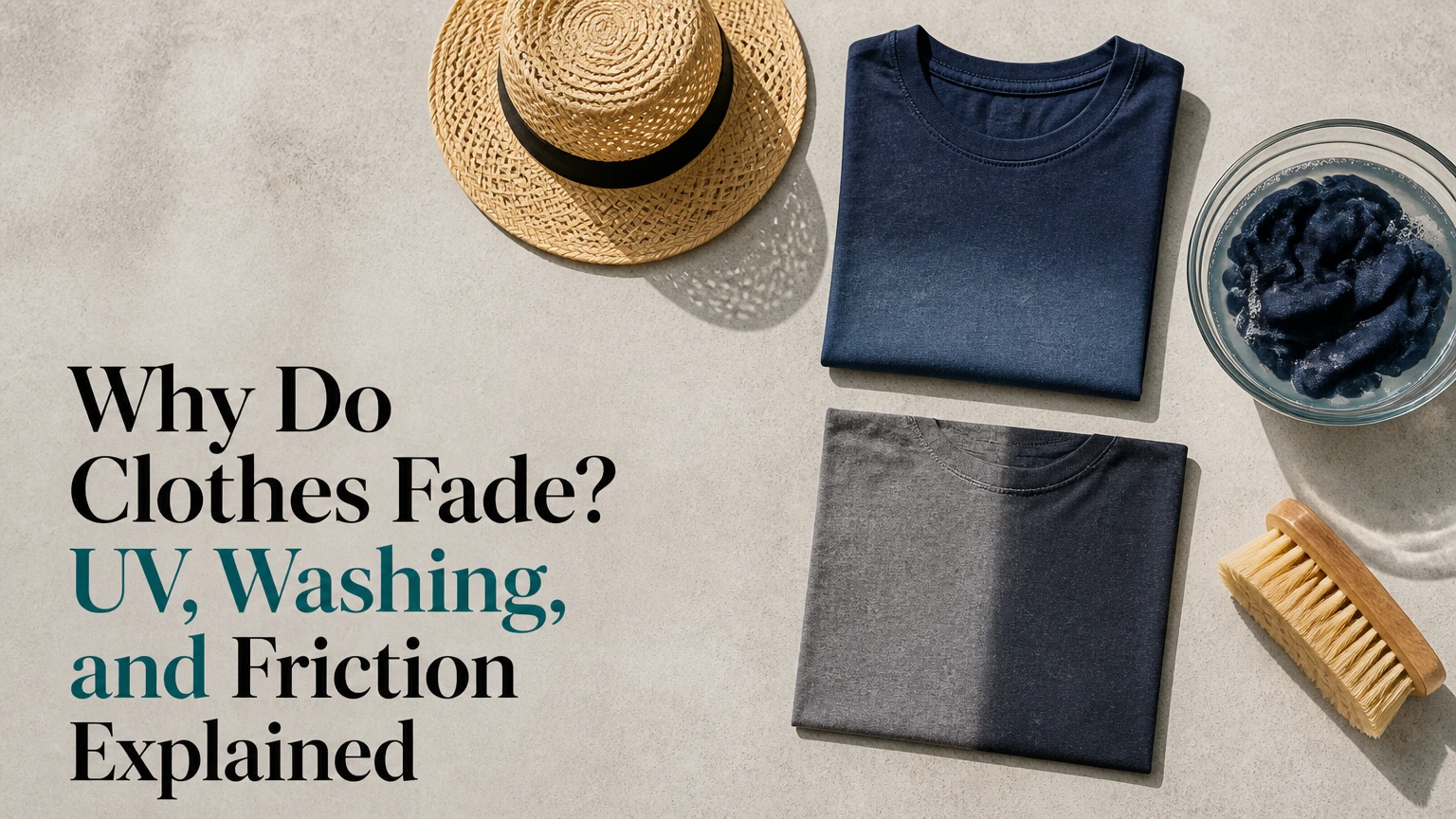
Clothes fade because light, washing chemistry, heat, and friction either chemically alter textile dyes or remove and roughen the colored surface. Ultraviolet radiation can permanently destroy dye molecules, while repeated laundering may extract unfixed dye, abrade fibers, and make intact color look dull through microscopic fuzz.
Key Facts at a Glance
- Sunlight fades clothing through photodegradation, an oxidation process that can permanently change dye molecules.
- Washing fades garments through a combination of dye bleeding, detergent chemistry, heat, abrasion, and tumbling.
- A gray cast does not always mean lost dye; surface fibrillation can scatter light and make intact color appear paler.
- There is no universal 30°C cutoff at which clothing suddenly begins to fade; dye type, fabric, detergent, time, and agitation all matter.
- Vinegar and salt are not reliable dye fixatives for most commercially manufactured clothing.
- The most effective low-cost routine is cold or cool water, a moderate load, a short gentle cycle, inside-out washing, and shade drying.
What Does Fading Mean in Clothing?
Clothing fading is a reduction in perceived color depth, saturation, or evenness. The color may genuinely decrease because dye leaves the fiber or breaks down, or the garment may only appear lighter because abrasion raises fibers on the surface.
Textile color comes from dyes or pigments interacting with light. A dye absorbs some wavelengths and reflects others toward the eye. When the dye molecule changes, the reflected color changes; when the fabric surface becomes fuzzy, incoming light scatters instead of reflecting from a smoother, darker plane.
The distinction matters because the remedies differ. A faded black T-shirt with chemically destroyed dye needs recoloring, whereas a cotton shirt with a pale, dusty surface may improve slightly after lint removal or gentler handling. Surface improvement cannot recreate dye that ultraviolet radiation has destroyed.
How Can You Tell Whether Color Is Actually Gone?
A simple comparison between an exposed outer area and a protected inner seam helps diagnose fading. If the hem allowance, inside waistband, or fabric beneath a pocket remains noticeably darker, light exposure probably caused the difference; if the garment looks gray everywhere, washing and abrasion are more likely contributors.
Use these checks:
- Inspect the reverse side. A much darker reverse often indicates surface abrasion or sunlight.
- Examine seams and hems. Protected folds provide a useful color reference.
- Look for fuzz. A matte, dusty texture suggests fibrillation.
- Look for sharp patches. White or orange spots usually indicate bleach, skincare chemicals, or localized photodamage.
- Check for loose dye in wash water. Continued bleeding indicates dye transfer or poor fixation, not necessarily uniform fading.
How Does Light Fade Fabric?
Light fades fabric when dye molecules absorb radiation, enter an energized state, and react with oxygen. Ultraviolet A and ultraviolet B can break chemical bonds in susceptible chromophores, while visible light can also damage some dyes during prolonged exposure.
Photofading does not require water or detergent. A shirt left on a sunny windowsill can fade even when clean and dry, because radiation reaches the exposed fibers directly. Outdoor drying, car-seat exposure, shop windows, and shoulders beneath strong indoor daylight can create sharply uneven color.
Red, orange, pink, and some dark blue dyes often show visible light damage quickly, but no color is universally safe. Black clothing may contain a mixture of dyes, so one component can degrade faster and leave a brown, reddish, or gray cast. Fiber content, dye class, finishing, exposure duration, and light intensity determine the result.
The U.S. Department of Energy identifies ultraviolet radiation as a major cause of fading in fabrics and furnishings, but ordinary household windows do not block all wavelengths or all visible light. Window glass usually reduces much UV-B while allowing substantial visible light and some UV-A through.
Why Do Black, Red, and Blue Clothes Fade So Noticeably?
Dark garments show small changes in reflectance more clearly than pale garments, while red dyes can be photochemically vulnerable. Black is usually a recipe of several colorants rather than one universal black molecule, so uneven degradation can shift its tone as well as reduce its depth.
A black hoodie on a sunny clothesline may fade first across the shoulders and hood. A red sports jersey may lighten across the front and sleeves. Blue denim usually develops high-contact whiskers and seat wear before its entire surface loses color.
Can Friction Make Clothes Look Faded?
Friction can make clothes look faded without removing all the dye. Washing, rubbing against a seatbelt, backpack strap, desk edge, or adjacent garments breaks and lifts surface fibers, producing fibrillation, pilling, and diffuse light scattering.
Cotton, rayon, and other staple-fiber fabrics are especially prone to this effect because their short fibers can protrude from yarns. Denim illustrates the process clearly: repeated contact creates pale thigh lines, whiskers, pocket edges, and seat marks even when deeper yarn areas retain indigo.
Abrasion can also remove surface pigment from printed designs and garment-dyed fabrics. A long, hot, high-spin wash increases contact time and force, but a short cold wash can still damage a delicate surface if the drum is overloaded or the garment rubs against rough zippers.
Cellulase enzymes may reduce some cotton fuzz by hydrolyzing exposed cellulose fibers. They are not universal restorers, can be unsuitable for wool, silk, and some finishes, and cannot replace dye lost from the yarn.
Does Hot Water Fade Clothes?
Hot water can accelerate fading, but 30°C is not a universal failure point. Higher temperatures may increase dye migration, fiber swelling, detergent activity, and chemical reaction rates, yet a poorly fixed dye can bleed in cool water and a well-finished garment may tolerate occasional warm washing.
The garment label is the first setting to follow because the manufacturer knows the fiber blend, finish, construction, and dye limitations. For unlabeled everyday colorfast clothing, 20-30°C is a conservative starting range; use warmer water only when hygiene, grease removal, or the care label requires it.
Water temperature is only one variable. A 40°C short, lightly loaded cycle may cause less wear than a 20°C overloaded cycle with aggressive agitation and a long tumble. Heat becomes particularly damaging when paired with overdrying, chlorine bleach, or repeated mechanical stress.
Which Wash Settings Reduce Color Loss?
| Garment situation | Water temperature | Cycle and spin | Drying recommendation |
|---|---|---|---|
| Black cotton T-shirt | 20-30°C | Short or normal, 600-900 rpm | Inside out, shade dry |
| Dark denim | 20-30°C | Delicate or denim cycle, 600-800 rpm | Hang by waistband, away from sun |
| Polyester activewear | 20-30°C | Sports cycle, moderate spin | Air dry, no fabric softener |
| Silk blouse | Cold, usually below 30°C | Hand wash or delicate, low spin | Flat dry in shade |
| Wool sweater | Cold, usually below 30°C | Wool cycle, minimal spin | Reshape and dry flat |
| Heavily soiled workwear | Label-directed, often 30-60°C | Full cycle, separated by color | Dry according to label |
Which Laundry Chemicals Cause Fading?
Chlorine bleach is the most obvious chemical cause of localized color loss, but oxygen bleach, strong alkaline products, oxidizing stain removers, hair treatments, benzoyl peroxide, and some solvents can also alter dyes. Chemical damage may appear as sharply defined pale, orange, yellow, or white marks.
Detergent alkalinity does not automatically destroy color. Alkaline formulas help remove soil, and many are safe when used at the recommended dose. Problems arise from excessive concentration, unsuitable bleach, prolonged soaking, high heat, or a dye whose chemistry cannot tolerate the treatment.
Perfume, deodorant, sunscreen, acne medication, and hair products can discolor fabric before the garment reaches the washer. Benzoyl peroxide is a well-known source of bleaching on dark towels, pillowcases, and clothing. Let topical products dry fully before dressing, and rinse contaminated areas promptly.
| Chemical or exposure | Typical visible result | Garments at risk | Safer response |
|---|---|---|---|
| Sodium hypochlorite chlorine bleach | White, orange, or yellow patches | Cotton, rayon, dyed blends | Use only when the label permits |
| Hydrogen peroxide or oxygen bleach | Gradual lightening or patchiness | Dark dyes, prints | Test an hidden area first |
| Benzoyl peroxide | Local pale marks after contact | Black cotton and towels | Use white linens near treatment |
| Hair dye or color remover | Strong localized staining or stripping | Light and dark fabrics | Rinse immediately, follow label |
| High detergent dose | Dull residue and uneven rinsing | Dark synthetic and cotton garments | Measure the dose for water hardness |
| Fabric softener buildup | Oily film and muted surface | Activewear, microfiber | Skip on technical fabrics |
Why Does Washing Fade Dark Clothes?
Washing fades dark clothes through five interacting events: water and detergent wet the fibers, dye may migrate, garments rub during agitation, loose color exits with rinse water, and drying adds heat or tumbling. Repetition matters more than one ordinary wash.
Dark cotton and denim often carry surface or near-surface color that gradually decreases through laundering. Garment-dyed pieces may release noticeable dye during early washes, while reactive-dyed cotton usually holds color more securely after proper fixation. “Color bleeding” describes dye moving into water or another garment; “fading” describes reduced color on the original garment. They can occur together but are not identical.
Overloading is a frequent hidden cause. When fabric cannot move freely through water, the load develops more garment-to-garment pressure, poorer rinsing, and longer drying. Metal hardware, hook-and-loop fasteners, and rough canvas can intensify abrasion.
Wash dark garments inside out, close zippers, empty pockets, separate rough items from delicate knits, and remove clothing promptly after the cycle. These steps reduce contact with the visible surface without pretending to stop chemical aging.
Is Sunlight or Washing Worse for Clothes?
Sunlight is usually worse for permanent, localized color destruction, while washing is usually worse for uniform wear across frequently laundered garments. The dominant source depends on exposure: an outdoor uniform may photofade quickly, whereas a black T-shirt worn indoors may lose surface quality mainly through laundering.
| Exposure pattern | Primary damage | Time to visible change, typical | Best control |
|---|---|---|---|
| Daily direct sun on cotton | Photodegradation | Weeks to months | Shade and rotate garments |
| Bright window exposure | Photodegradation | Months to years | Move garments from direct light |
| Weekly cold machine washing | Abrasion and dye loss | Dozens of washes | Short cycle, moderate load |
| Hot tumble drying | Heat and mechanical wear | 10-50 cycles, fabric-dependent | Low heat, remove promptly |
| Backpack or seatbelt contact | Local abrasion | Weeks to months | Reduce friction and rotate use |
Manufacturers assess light fastness with methods such as ISO 105-B02 and AATCC TM16. These laboratory ratings compare standardized exposure, not a guaranteed number of home washes. A fabric rated highly in one test may still suffer from detergent, abrasion, perspiration, or chemical contact.
Which Fabrics and Dyes Hold Color Best?
Solution-dyed polyester and acrylic generally resist wash-related color loss well because colorant is incorporated throughout the polymer before the filament is formed. Cotton, linen, rayon, silk, and wool can retain color successfully too, but performance depends strongly on dye class, fixation, finish, and care.
| Fiber or construction | Common dye or color method | Main fading vulnerability | Practical expectation |
|---|---|---|---|
| Cotton T-shirt | Reactive or pigment dye | Washing, abrasion, sunlight | Moderate, varies by finish |
| Raw or dark denim | Indigo, often ring-dyed yarn surface | Abrasion and repeated washing | Intentional high-contrast wear |
| Linen | Reactive, direct, or pigment dye | Light and laundering | Moderate, creases increase exposure |
| Rayon or viscose | Reactive or direct dye | Wet abrasion and shrinkage | Gentle washing needed |
| Wool | Acid or metal-complex dye | Alkalinity, heat, light | Cool, low-agitation care |
| Silk | Acid-reactive dye systems | Light, perspiration, alkalinity | Avoid prolonged exposure |
| Polyester | Disperse dye or solution dye | Heat setting, light in some colors | Usually high wash fastness |
| Nylon | Acid dye or solution dye | Light and chemicals | Moderate to high, construction-dependent |
Dye class is often more predictive than the fiber name alone. Vat dyes used in some denim and workwear can provide strong wash performance, while pigment printing sits near the surface and may crack or lose intensity with abrasion. A garment label rarely identifies the dye, so observed bleeding and the care instructions remain useful evidence.
What Does Colorfastness Testing Actually Tell You?
Colorfastness testing reports resistance to a specified exposure, such as light, washing, rubbing, perspiration, or water. ISO 105 and AATCC methods commonly use a grade scale in which higher values indicate better resistance under that test, but the grade does not predict an exact household lifespan.
AATCC TM61 accelerates laundering in a laboratory, and AATCC TM16 evaluates colorfastness to light. ISO 105-C06 addresses domestic and commercial laundering, while ISO 105-B02 addresses artificial light. Results should be compared only when the test method, fabric, color, and evaluation system are comparable.
How Should You Wash Clothes to Prevent Fading?
Use the coolest label-approved water, a correctly measured color-safe detergent, a moderate load, low or medium agitation, and shade drying. The most important factor is cumulative mechanical and light exposure, so a consistent routine protects color better than a single additive.
Step 1: Sort by Color and Surface
Separate darks, lights, reds, and heavily dyed new garments. Keep denim, towels, canvas, and garments with exposed zippers away from silk, fine knits, and printed surfaces.
Success checkpoint: Similar colors and similar textures share the load.
Common mistake: Sorting only by color while washing rough denim with delicate fabric.
Step 2: Turn Garments Inside Out
Turn dark T-shirts, printed tops, jeans, and dyed knitwear inside out before washing. Close zippers and hooks, but do not seal delicate garments in a tightly packed bag that prevents proper rinsing.
Success checkpoint: The visible face has less direct contact with the drum and neighboring surfaces.
Common mistake: Turning clothes inside out but leaving abrasive objects in pockets.
Step 3: Select Cool Water and a Suitable Cycle
Choose 20-30°C for routine darks when the care label allows it. Use a short or normal cycle for sturdy cotton, a delicate cycle for loose knits, and the lowest effective spin that leaves the garment manageable.
Success checkpoint: The machine is not tightly packed and the selected cycle matches construction.
Common mistake: Using a gentle setting while overloading the drum.
Step 4: Measure Detergent
Use the manufacturer’s dose for the load size and local water hardness. Liquid detergent can dissolve readily in cool water, but powder is not automatically harmful; residue and overdosing are the real concerns.
Success checkpoint: No chalky residue remains after rinsing.
Common mistake: Adding extra detergent to compensate for a small amount of visible fading.
Step 5: Dry Away From Direct Sun
Air-dry in shade or indoors with ventilation. Use low heat when a dryer is necessary, remove garments while slightly damp if the label permits, and avoid leaving dark clothing in a hot drum.
Success checkpoint: Clothing dries without prolonged ultraviolet exposure or baking heat.
Common mistake: Treating a shaded outdoor line as risk-free when the garment remains outside all day.
Do Vinegar and Salt Stop Clothes From Fading?
Vinegar and salt are not dependable universal dye fixatives for finished clothing. Salt can influence some dyeing processes during manufacture, and acid can affect particular dye-fiber systems, but adding either to a normal wash rarely bonds loose commercial dye back to cotton, polyester, silk, or a blended garment.
Vinegar may help reduce alkaline residue in some washing situations, but it does not reverse photodegradation and should not be mixed with chlorine bleach. Salt can sometimes reduce apparent bleeding during a first wash, yet the effect depends on dye chemistry and is not evidence of permanent fixation.
A commercial cationic fixative may help certain direct-dyed cotton, rayon, or other cellulose garments, particularly after home dyeing. It cannot restore a black shirt bleached by peroxide or ultraviolet light, and it may change handle, wash behavior, or future dyeing. Follow the product instructions and test an inconspicuous section.
Can Faded Clothing Be Restored?
Faded clothing can sometimes be recolored, but chemically destroyed dye cannot be reversed. Surface fuzz may be reduced, loose dye may be stabilized in limited cases, and a compatible fabric dye can create a darker, more even result when the garment is suitable.
| Restoration option | Typical cost | Best candidate | Main limitation |
|---|---|---|---|
| Lint comb or fabric shaver | $8-$25 | Fuzzy cotton knit | Removes surface fibers, not lost dye |
| Home garment dye | $5-$20 | Dyeable cotton, linen, rayon | Seams, polyester thread, and stains may remain lighter |
| Commercial dye fixative | $5-$15 | Some direct-dyed cellulose | Does not recreate destroyed color |
| Professional dyeing | $40-$150+ | Valuable natural-fiber garment | Construction and fiber blends limit uniformity |
| Replacement garment | $15-$200+ | Severe bleach or sun damage | Highest cost, predictable appearance |
Before dyeing, check fiber content, thread material, buttons, labels, stains, and care instructions. Polyester thread may resist a cotton dye, creating contrasting seams. Water-repellent finishes can prevent even absorption, while elastane may tolerate neither high heat nor aggressive chemical processing.
Why Are Jeans Developing White Streaks?
White jean streaks usually result from localized abrasion, creasing, indigo loss, or detergent residue rather than one single cause. A folded ridge receives more rubbing, and indigo concentrated near the yarn surface disappears there first.
Wash denim inside out in cool water, use a moderate load, reduce spin where practical, and avoid repeated hot drying. Do not expect a treatment to return removed indigo; professional or home overdyeing may even the tone but can produce a different finish.
Why Are Faded Areas Appearing Near the Shoulders?
Shoulder fading commonly comes from sunlight, backpack friction, seatbelt contact, or transfer from sunscreen and hair products. The pattern helps identify the cause: symmetrical top-surface fading suggests light, while narrow bands suggest straps or repeated rubbing.
Rotate frequently worn garments, dry them away from direct light, and allow skincare products to dry before dressing. A UV-protective spray may help some outdoor textiles, but coverage, compatibility, residue, and reapplication determine its value; it is not a substitute for shade.
What Are the Most Common Color-Care Mistakes?
The most damaging mistakes combine several stressors, such as hot water, a full drum, high spin, excess detergent, and direct sunlight. Correcting one variable helps, but removing the strongest repeated exposure produces the largest improvement.
- Washing every load warm or hot: Use cool water for routine color care unless soil or hygiene requirements justify heat.
- Overloading the drum: Leave enough room for garments to move and rinse.
- Using chlorine bleach on colored fabric: Choose a label-approved alternative or accept possible color change.
- Drying dark garments in direct sun: Use shade, indoor airflow, or a short low-heat cycle.
- Washing rough and delicate items together: Separate denim, towels, and canvas from fine knits.
- Assuming a detergent additive can reverse fading: Fixatives cannot repair photochemical destruction or bleach spots.
One practitioner rule is to treat the dryer as a wear multiplier, not merely a heat source. Tumbling adds repeated contact while heat accelerates some chemical and dimensional changes, so line drying in shade often protects color more effectively than switching detergent brands.
How Much Does Color Protection or Repair Cost?
Basic color protection costs approximately $0-$15 per load, while restoration ranges from $5 for home dye to more than $150 for professional work. The cheapest effective changes are usually cooler washing, smaller loads, inside-out handling, and shade drying.
A color-care detergent commonly costs about $8-$20 per bottle, depending on size and brand. A dye fixative is often $5-$15, home dye costs roughly $5-$20, and a fabric shaver costs about $8-$25. UV sprays may cost $12-$25, but product-specific performance and textile compatibility vary widely.
Replacement becomes financially sensible when a low-cost fast-fashion garment has extensive bleach damage, uneven synthetic-and-natural fibers, or a failed home dye attempt. Professional dyeing makes more sense for a valuable natural-fiber garment whose construction can accept an even color.
The Bottom Line: Why Do Clothes Fade?
Why do clothes fade? Clothing loses color when light chemically breaks down dye, laundering extracts or oxidizes susceptible colorants, and friction roughens the fiber surface so less light is absorbed evenly. The practical answer is to reduce the combined exposure: wash cool, avoid overloaded and abrasive loads, use measured detergent, turn garments inside out, and dry them in shade.
Fading cannot be prevented forever because dyes and fibers age with use. The goal is slower, more even wear, not a guarantee that a garment will remain factory-dark indefinitely.
Frequently Asked Questions
Does washing clothes inside out really prevent fading?
Washing clothes inside out can reduce visible-surface abrasion, especially on dark cotton, printed garments, and denim. The method does not prevent dye bleeding, ultraviolet damage, or chemical bleaching, but it protects the presentation side from direct contact with the drum, zippers, and neighboring garments.
Should new dark clothes be washed separately?
New dark clothes should be washed separately or with similar colors for the first one or two washes if they release loose dye. A separate wash prevents transfer to pale garments, but it does not guarantee permanent colorfastness. Cool water, a correctly measured detergent dose, and prompt removal reduce early dye migration.
Does fabric softener prevent fading?
Fabric softener may reduce friction on some conventional fabrics by leaving a lubricating film, but it does not prevent photodegradation or restore dye. Fabric softener can reduce absorbency and impair moisture management in polyester activewear, microfiber, towels, and some technical textiles, so the care label should control its use.
Can dry cleaning stop clothes from fading?
Dry cleaning may reduce water-related dye migration for garments labeled dry-clean-only, but solvent cleaning does not block sunlight or eliminate surface abrasion. Some dyes, trims, coatings, and finishing treatments can still change during professional cleaning, so tell the cleaner about visible fading and follow the garment label.
Why do clothes fade faster in summer?
Clothes often fade faster in summer because stronger sunlight, longer outdoor exposure, perspiration, sunscreen, heat, and more frequent washing occur together. Ultraviolet exposure can damage a garment while it hangs outside, and sweat salts or personal-care products can create localized discoloration before laundering.
Is black clothing harder to keep from fading?
Black clothing can be harder to keep visually uniform because black garments often combine several dyes or use surface pigment, and small changes in reflectance are easy to see. Cool washing, inside-out handling, limited tumble drying, and shade storage slow fading, but no routine can reverse dye destroyed by bleach or sunlight.