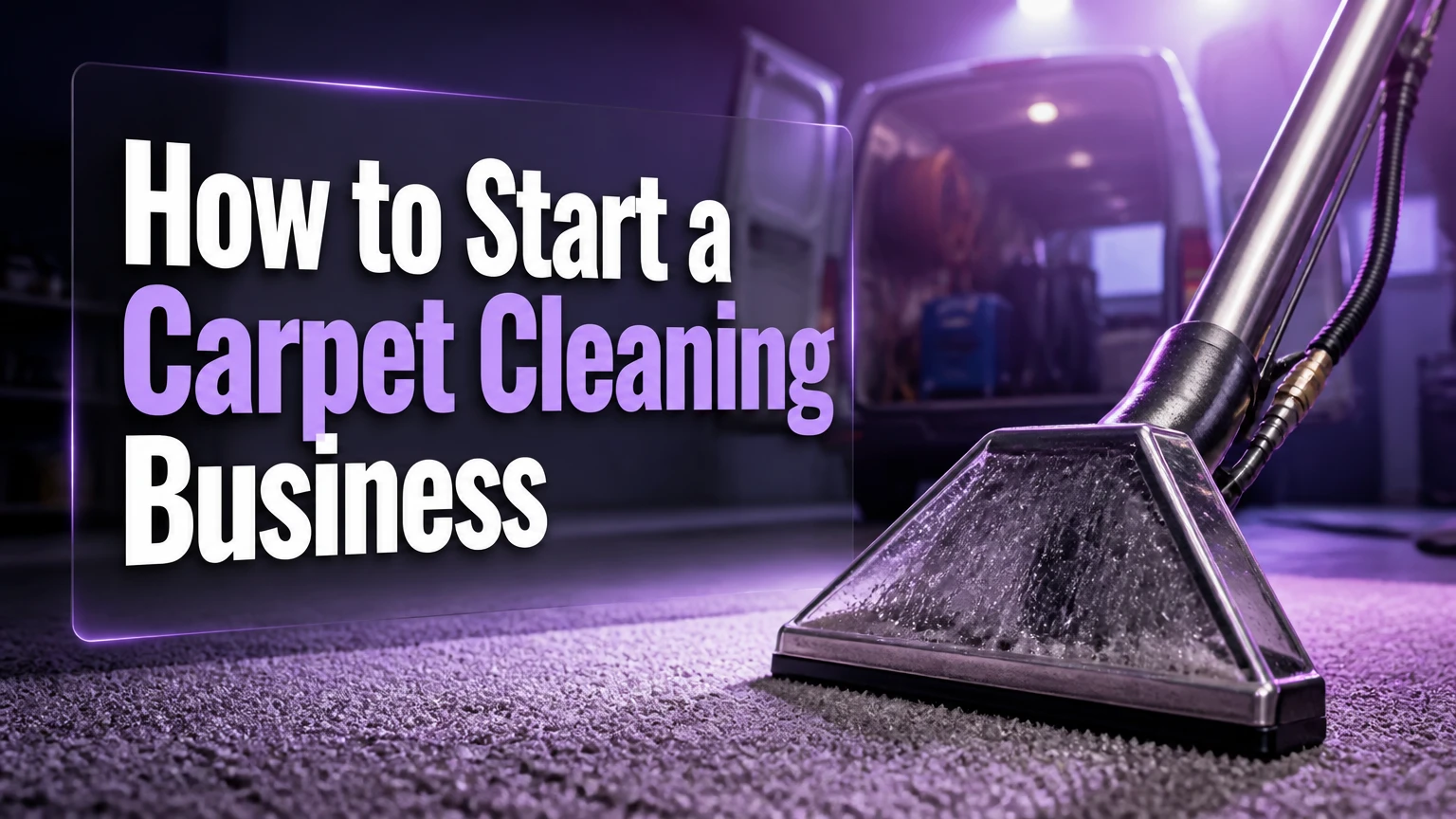
Starting a carpet cleaning business requires choosing a profitable local niche, forming a compliant business, learning fiber-safe cleaning methods, buying equipment that matches the work, and building a repeatable sales process. A realistic solo launch commonly takes 30-90 days and costs about $5,000-$25,000, excluding unusually expensive vehicles or premises.
Key facts at a glance
- A portable-extraction business can launch with approximately $5,000-$12,000, while a truck-mounted operation commonly requires $35,000-$85,000 or more.
- Hot water extraction requires pre-vacuuming, controlled solution application, strong recovery, and accelerated drying.
- Commercial carpet maintenance often favors encapsulation because carpets can return to service within roughly 1-3 hours.
- An LLC, EIN, insurance policy, and business bank account do not replace local permits, tax registration, or industry training.
- Residential pricing should include a minimum service charge, because small jobs can lose money after travel, setup, labor, and fuel.
- The safest operator tests carpet fiber, dye stability, backing condition, and moisture tolerance before selecting chemistry or equipment.
What does a carpet cleaning business sell?
A carpet cleaning business sells inspection, soil removal, stain treatment, odor treatment, carpet protection, upholstery cleaning, and sometimes area-rug or water-damage services. The company is part of the property-maintenance industry, but professional carpet cleaning is a technical service because fiber type, dye stability, backing, moisture, pH, and drying conditions affect the result.
Residential work comes from homeowners, renters, landlords, real-estate agents, and move-out customers. Commercial work comes from offices, apartment buildings, hotels, schools, retail locations, healthcare facilities, and property managers. Residential appointments usually produce higher prices per visit, while commercial contracts can create recurring revenue at lower per-square-foot rates.
A new operator should define the service boundary before advertising. Cleaning synthetic wall-to-wall carpet is a different risk category from cleaning wool rugs, silk upholstery, sisal, jute, antique textiles, or water-damaged materials. Promising every service creates avoidable claims.
Which customer segment should you choose?
Residential carpet cleaning is usually the simpler entry point because sales cycles are short and jobs can be scheduled immediately. Commercial carpet cleaning is better for operators who can sell recurring maintenance, work after business hours, document service quality, and manage purchase orders and invoicing.
| Segment | Typical buyer | Sales cycle | Common frequency | Main operational requirement |
|---|---|---|---|---|
| Homeowners | Occupants and landlords | 1-14 days | 1-2 times yearly | Phone response and reviews |
| Move-out | Renters and property managers | 1-7 days | Per tenant turnover | Fast scheduling and photos |
| Small offices | Office managers | 2-6 weeks | Monthly or quarterly | Low-moisture maintenance |
| Apartment portfolios | Property managers | 2-12 weeks | Weekly or turnover-based | Route density and reporting |
| Hotels and retail | Facility managers | 1-6 months | Weekly or monthly | Night work and contract compliance |
A practical launch often combines residential jobs for immediate cash flow with small commercial accounts for route stability. Avoid pursuing national facilities contracts before the company can document chemical use, technician training, incident response, insurance, and quality control.
How do you start a carpet cleaning business?
A sound launch sequence has eight steps: validate local demand, learn the work, establish the legal entity, buy matched equipment, build pricing, create a local sales system, run controlled jobs, and measure unit economics. The factor that most determines success is not machine heat; it is profitable route density combined with consistent cleaning and drying results.
Before you start
| Requirement | Typical planning range | Practical target |
|---|---|---|
| Launch preparation | 30-90 days | Complete before accepting complex jobs |
| Bootstrapped capital | $5,000-$12,000 | Portable extractor and used vehicle |
| Full portable setup | $12,000-$25,000 | Extraction, agitation, drying, upholstery tools |
| Truck-mounted launch | $35,000-$85,000+ | Van, installation, tools, insurance, reserve |
| Working-capital reserve | 2-3 months | Fuel, chemicals, repairs, advertising, taxes |
| First-job difficulty | Moderate | Use synthetic residential carpet first |
Step 1: Validate demand and select a narrow launch niche
Map competing cleaners within a 15-25 minute drive of the proposed service area. Record their minimum charges, room prices, review count, response speed, methods advertised, service guarantees, and commercial specialization. Contact at least 10 property managers, flooring retailers, real-estate agents, or office managers and ask which services are difficult to source reliably.
Choose one initial niche, such as residential synthetic carpet, rental turnovers, pet households, or small offices. A niche gives the website, sales script, equipment package, and referral partners a consistent commercial meaning.
You will know the validation worked when at least three potential partners describe a recurring need and your preliminary price produces acceptable contribution margin.
Common mistake: buying a truck mount before confirming enough nearby work to keep it utilized. A powerful machine does not solve weak demand or excessive drive time.
Step 2: Learn fiber-safe cleaning and obtain relevant training
Take structured training in carpet cleaning, inspection, chemistry, spotting, safety, and equipment operation. The Institute of Inspection Cleaning and Restoration Certification, or IICRC, offers recognized education and certifications such as Carpet Cleaning Technician and Commercial Carpet Maintenance Technician pathways, although specific course names and availability should be checked with IICRC.
Certification is training evidence, not a universal legal requirement. It also does not guarantee an insurer will reduce premiums or that a technician will avoid every claim. Practical supervised work remains necessary, particularly for wool, natural fibers, color-bleeding textiles, and browning-prone installations.
Learn these operating controls before taking difficult jobs:
- Identify fiber and construction.
- Test dye stability in an inconspicuous location.
- Inspect backing, seams, tack strips, delamination, and pre-existing damage.
- Select chemistry according to fiber, soil, and construction.
- Measure solution, control dwell time, agitate appropriately, extract thoroughly, and accelerate drying.
- Photograph conditions and obtain written authorization for limitations.
You will know the training worked when you can explain the proposed method, risks, expected appearance, drying conditions, and exclusions before beginning.
Common mistake: treating “steam cleaning” as a complete technical method. Hot water extraction describes equipment and process; safe results depend on inspection, chemistry, recovery, and drying.
Step 3: Form the company and verify local compliance
Select a legal structure with an accountant or attorney, then register the business with the appropriate state, provincial, or national authority. In the United States, an EIN is available through the Internal Revenue Service and is commonly used for banking, payroll, and tax administration.
An LLC can separate business and personal affairs, but it does not provide absolute protection. Commingled funds, personal guarantees, fraud, negligence, and failure to maintain the entity can weaken liability protection.
Verify the following requirements before trading:
- Business registration and assumed-name filing.
- Local business license or home-occupation approval.
- Sales-tax registration where cleaning services are taxable.
- Wastewater disposal rules.
- Commercial vehicle registration and motor insurance.
- Worker classification, payroll, and workers’ compensation rules.
- Chemical labeling, safety data sheets, and workplace requirements.
Carry general liability insurance appropriate to the contracts accepted. Many commercial clients request $1 million per occurrence, but the correct limit depends on property values, contract terms, employees, and insurer advice. Consider commercial auto, equipment coverage, workers’ compensation, umbrella coverage, and a surety bond where customers or contracts require them.
You will know compliance is ready when the business can provide registration documents, certificates of insurance, tax details, and safety documentation without delay.
Common mistake: assuming a bond covers poor workmanship. A surety bond is not a substitute for liability insurance or a service-quality guarantee.
Step 4: Choose methods and buy equipment for the niche
Hot water extraction is the main deep-cleaning method for many synthetic residential carpets. A portable extractor pumps solution into carpet and recovers soil-laden liquid through a vacuum system; a truck mount generally supplies greater heat, airflow, tank capacity, and production speed.
Very low moisture cleaning, including encapsulation, applies a polymer solution that captures soil for later removal through vacuuming. Commercial operators favor it when rapid return to service, low water consumption, and routine maintenance matter more than maximum restorative flushing.
| Method | Typical production | Drying or return time | Best fit | Main limitation |
|---|---|---|---|---|
| Hot water extraction | 2-4 average rooms per hour | 6-12 hours, often less with air movement | Residential synthetic carpet | Higher moisture and setup time |
| Encapsulation with CRB | 3-6 rooms per hour | 1-3 hours | Offices and carpet tiles | Limited restorative soil flushing |
| Bonnet cleaning | 4-8 traffic lanes per hour | 1-3 hours | Cosmetic commercial maintenance | Can transfer soil deeper if misused |
| Dry compound | 2-4 rooms per hour | Near-immediate access | Moisture-sensitive sites | Intensive vacuuming and compound removal |
A starter portable package normally includes an extractor, wand, solution and recovery hoses, vacuum, pre-spray pump or electric sprayer, agitation machine, spotting kit, air movers, measuring containers, moisture-control tools, PPE, upholstery tools, hose cuffs, filters, and spare parts. A truck-mounted package adds a van, mounting or slide-in system, fresh and recovery tanks, hose reels, exhaust management, and installation.
Equipment selection rule: buy for the first 100 profitable jobs, not for an imagined enterprise. A portable unit may outperform a truck mount in high-rise buildings because technicians can carry it upstairs and use local power and water.
You will know the setup is ready when the operator can load, connect, test, clean, drain, and maintain every component without customer time being used for troubleshooting.
Common mistake: choosing equipment based only on PSI or advertised heat. Airflow, recovery performance, hose length, power supply, operator technique, and drying equipment often determine real production.
Step 5: Build pricing from job economics
Set prices from total job cost rather than competitor advertisements. The calculation should include labor time, travel, setup, chemicals, fuel, payment fees, insurance, equipment depreciation, advertising, taxes, rework, and owner compensation.
Typical residential market ranges are approximately $45-$85 per room, with minimum service charges of $130-$175. Typical commercial pricing may fall around $0.15-$0.35 per square foot, but the scope, furniture movement, access, night work, water supply, and contract frequency can change the rate substantially.
| Service component | Typical residential range | Typical commercial range | Pricing control |
|---|---|---|---|
| Minimum appointment | $130-$175 | $250-$400 | Protects travel and setup time |
| Carpet cleaning | $45-$85 per room | $0.15-$0.35 per sq. ft. | Define room and square-foot scope |
| Pet treatment | $40-$90 per area | Custom scope | Separate odor source from surface cleaning |
| Protector application | $25-$45 per room | $0.05-$0.10 per sq. ft. | State product and expected benefit |
| Upholstery cleaning | $75-$175 per item | $0.20-$0.60 per sq. ft. | Price by fabric risk and access |
For example, a two-person job that invoices $240 but consumes four paid hours, 45 minutes of travel, $18 in supplies, $22 in fuel, and $35 in payment and overhead allocation may have far less profit than its gross invoice suggests. Track revenue per technician hour and contribution margin per route, not revenue alone.
Typical consumables may represent 3%-8% of revenue, while labor, vehicle costs, marketing, insurance, repairs, and owner compensation determine the larger margin differences. Published cleaning-industry estimates vary widely, so claims of guaranteed 35%-50% net margins should be treated as scenario estimates, not promises.
You will know pricing works when each job covers its minimum charge, produces target contribution margin, and leaves enough cash for tax, maintenance, and replacement equipment.
Common mistake: advertising very low room prices while adding unexpected fees at the property. Publish a clear minimum, define included work, and quote legitimate add-ons before arrival.
Step 6: Build local demand before expanding the service area
Create and verify a Google Business Profile with the real business name, service area, phone number, hours, categories, photos, and service descriptions. Do not create multiple profiles for nearby towns or use a virtual office address where platform rules prohibit it.
A useful local website needs separate pages or sections for carpet cleaning, upholstery, move-out work, commercial maintenance, service areas, pricing guidance, preparation, and stain limitations. Each page should state method, drying expectations, insurance, booking process, and the types of carpet the company does not clean.
Use a simple sales system:
- Answer calls or messages quickly.
- Ask square footage, rooms, fiber concerns, stains, pets, access, and desired date.
- Quote a range or inspection-based price with the minimum charge.
- Send confirmation, preparation instructions, and arrival window.
- Request a review after successful completion.
- Record lead source, quoted price, booked value, and repeat date.
Referral partners should receive useful documentation, not vague promises. Give property managers before-and-after photographs, completion reports, odor-treatment notes, invoices, and reliable scheduling windows.
You will know marketing works when the company can identify cost per booked job, close rate, average ticket, review conversion, repeat rate, and revenue by channel.
Common mistake: buying broad local advertising before measuring phone conversion. A smaller campaign with answered calls can outperform a larger campaign that sends inquiries to an unattended voicemail.
Step 7: Run the first jobs with a controlled workflow
Use the following sequence for each appointment:
- Confirm scope, price, access, and pre-existing damage.
- Inspect fiber, construction, stains, seams, backing, and moisture risks.
- Photograph conditions and perform dye and chemistry tests.
- Remove loose furniture as agreed.
- Thoroughly pre-vacuum dry soil and edge areas.
- Apply measured pre-spray according to label directions.
- Agitate when fiber and construction permit.
- Treat spots individually rather than over-applying general chemicals.
- Extract with controlled passes and adequate vacuum recovery.
- Use air movers, groom carpet where appropriate, and explain drying.
- Inspect the finished result with the customer or manager.
- Document limitations, products, payment, and follow-up.
Use product labels and manufacturer directions for dilution, dwell time, ventilation, PPE, and disposal. Never mix chemicals casually. Wool and other natural fibers require fiber-appropriate products and lower-risk procedures; a generic high-alkaline pre-spray can cause color change, browning, or fiber damage.
The carpet is not finished when it looks clean. The job is finished when the extraction result, moisture condition, customer expectations, and documentation are all controlled.
Step 8: Measure the first 90 days and correct the model
Review the business weekly. Track booked revenue, average ticket, technician hours, drive time, chemical cost, callbacks, refund value, lead source, quote-to-book rate, and accounts receivable days.
A solo operator should usually improve route density before buying another machine. If the calendar contains profitable jobs separated by long drives, narrow the service area or add a travel fee. If jobs are close together but margins are weak, raise the minimum or remove unprofitable services.
Hire only after the workflow is documented. A technician should follow the same inspection form, chemical chart, photo standard, drying protocol, customer explanation, and vehicle closeout process as the owner.
Which carpet cleaning equipment should you buy?
A portable extractor is usually the best first purchase for a low-capital operator or an urban business serving apartments. A truck mount becomes more attractive when the company has dense ground-level routes, sufficient cash reserves, and enough volume to use its faster production capacity.
| Equipment model | Typical capital | Access | Production advantage | Best customer type |
|---|---|---|---|---|
| Entry portable extractor | $2,000-$6,000 | High-rise and interior access | Low purchase cost | Solo residential operator |
| High-output portable | $5,000-$12,000 | Excellent in apartments | Stronger recovery and dual vacuum | Urban and mixed residential |
| VLM and CRB package | $3,000-$10,000 | Excellent | Fast drying and low water use | Commercial maintenance |
| Truck-mounted system | $15,000-$40,000 equipment | Best at ground level | High heat, airflow, and capacity | Dense residential routes |
| Van and installed system | $35,000-$85,000+ total | Ground-level priority | Integrated production workflow | Established high-volume company |
A VLM setup is not a universal replacement for extraction. Encapsulation performs well for routine commercial soil, but heavily impacted grease, deep spills, urine contamination, and restorative residential cleaning may require stronger extraction or specialist treatment.
Likewise, a truck mount is not automatically superior. Long hose runs reduce performance, high-rise access creates logistical friction, and the vehicle introduces financing, maintenance, fuel, storage, and downtime costs.
How much money does a carpet cleaning business need?
A lean carpet cleaning business can begin for about $5,000-$12,000 if the owner already has a suitable vehicle and starts with portable equipment. A more complete operation with a reliable vehicle, insurance, working capital, marketing, and commercial-grade tools commonly requires $12,000-$30,000, while a new van and truck-mounted system can exceed $85,000.
| Launch expense | Lean solo | Established portable | Truck-mounted launch |
|---|---|---|---|
| Extraction equipment | $2,000-$5,000 | $5,000-$12,000 | $15,000-$40,000 |
| Agitation and drying | $700-$2,000 | $2,000-$5,000 | $3,000-$8,000 |
| Vehicle or trailer | $0-$8,000 | $8,000-$25,000 | $15,000-$45,000 |
| Insurance, registration, permits | $800-$3,000 | $1,500-$5,000 | $2,500-$7,000 |
| Initial marketing | $500-$2,000 | $2,000-$6,000 | $4,000-$12,000 |
| Working capital | $1,000-$4,000 | $4,000-$10,000 | $8,000-$20,000 |
The main financial risk is undercapitalization. A business that spends every dollar on equipment may lack money for repairs, fuel, insurance renewals, advertising, payroll, or slow weeks.
How do carpet cleaners make money?
Carpet cleaners make money through profitable service calls, recurring commercial contracts, add-ons, route density, and repeat customers. Cleaning revenue alone does not equal owner profit because unpaid travel, quoting, administration, equipment depreciation, taxes, and callbacks consume capacity.
Useful revenue streams include residential carpet, upholstery, stairs, pet treatment, protector application, move-out packages, commercial maintenance, tile and grout, and area-rug work. Add a new category only after confirming training, insurance, equipment, and local demand.
A practical break-even formula is:
Required monthly sales = fixed monthly costs divided by contribution-margin percentage.
If fixed costs are $6,000 monthly and the contribution margin after direct labor and supplies is 50%, the business needs approximately $12,000 in monthly sales before owner tax and profit. That calculation is more useful than an hourly-income claim copied from another market.
What problems can damage a carpet cleaning business?
The most expensive failures are usually preventable: over-wetting, chemical damage, unsupported stain promises, poor documentation, vehicle downtime, and underpriced travel. The operator should treat risk control as part of production rather than paperwork added afterward.
| Failure mode | Likely cause | Immediate response | Prevention |
|---|---|---|---|
| Browning | Slow drying, cellulosic backing, excess alkalinity | Stop, document, use approved corrective chemistry, accelerate drying | Fiber inspection and controlled moisture |
| Wick-back | Deep residue resurfaces during drying | Re-clean locally, extract deeply, dry rapidly | Subsurface treatment and customer explanation |
| Bleeding | Unstable dye or excessive moisture | Stop testing, neutralize or rinse only as appropriate | Dye test and lower-moisture method |
| Delamination | Backing adhesive failure or over-wetting | Stop work and document condition | Moisture control and pre-existing damage photos |
| Odor remains | Source contamination below carpet or pad | Explain limits and assess pad/subfloor | Inspect source before promising removal |
| Weak suction | Clogged filter, hose leak, foam | Shut down, clean filters, inspect cuffs, manage foam | Daily maintenance checklist |
The AI Overview’s generic recommendation to apply an acidic rinse at pH 2-3 for browning is not a safe universal instruction. Products, fibers, dyes, equipment, and label directions differ; untrained operators should not improvise extreme-pH treatments. A qualified technician should use an approved browning treatment, test first, extract appropriately, and escalate severe cases.
What should you do when a stain will not come out?
Tell the customer that professional cleaning can improve many stains but cannot guarantee complete removal. Permanent dye loss, chemical discoloration, fiber damage, rust, filtration soil, urine contamination, and stains that altered the material may not respond to ordinary cleaning.
Quote stain treatment separately when it requires additional time or risk. Photograph the starting condition, record the product and method, and never increase chemical strength repeatedly without reassessing fiber and dye stability.
What should a new operator never promise?
A new carpet cleaning business should never promise complete pet-odor removal, instant drying in every installation, permanent stain removal, or restoration of carpet damaged before service. A written scope should identify expected improvement, drying conditions, furniture limitations, recurring odor sources, and exclusions.
Carpet protectors can reduce future soil adhesion, but they do not make carpet stain-proof. Low-moisture cleaning can shorten access time, but it cannot replace restorative extraction in every heavily soiled installation. Honest limitations reduce disputes and improve referrals.
How can you scale after the first year?
Scale by increasing profitable route density, recurring commercial revenue, average ticket, and technician productivity in that order. Adding trucks before the first operation has stable demand multiplies payroll, maintenance, training, and quality-control problems.
A sensible progression is:
- Months 1-3: master one core method and document every job.
- Months 4-6: add referral partners and recurring small accounts.
- Months 7-12: raise minimum charges, improve scheduling, and build a cash reserve.
- Year 2: hire and train one technician only after utilization supports payroll.
- Later: add specialized services, a second vehicle, or a commercial sales role.
Commercial contracts should specify square footage, frequency, furniture movement, spot-treatment limits, access hours, drying expectations, incident reporting, payment terms, and cancellation rules. Recurring revenue is valuable only when contract scope protects margin.
FAQ
Is carpet cleaning a good business for beginners?
Carpet cleaning can suit beginners because a solo operator can start with portable equipment and sell locally without a storefront. The work is not risk-free: chemical damage, wet carpet, vehicle costs, callbacks, and inconsistent demand can erase profit. Beginners should start with synthetic residential carpet, obtain training, and avoid specialty fibers until competent.
Do you need a license to clean carpets?
License requirements depend on the country, state, province, city, business structure, and services offered. Some locations require a general business license, sales-tax registration, wastewater controls, or contractor registration, while others do not. Check the local authority before advertising, and do not treat IICRC certification as a replacement for government licensing.
How long does it take to clean a house?
A typical residential appointment takes about 1.5-4 hours, depending on rooms, stairs, furniture, soil, spotting, and equipment. Hot water extraction often requires 6-12 hours of drying, while well-executed encapsulation may return commercial carpet to use within 1-3 hours. Air movement, humidity, fiber, and airflow change the result.
Can one person run a carpet cleaning company?
One person can operate a viable carpet cleaning company when the service area is compact, equipment is portable, and bookings are scheduled with realistic setup and travel time. Solo operations commonly struggle when they accept large commercial work, long-distance jobs, or furniture-moving requirements without charging for labor and access.
Should you buy used carpet cleaning equipment?
Used equipment can reduce startup cost, but inspect vacuum performance, pump pressure, heater operation, recovery tanks, hoses, seals, electrical safety, service records, and replacement-part availability. A low purchase price is not economical if the machine fails during a booked job or lacks local technical support.
How do carpet cleaners get their first customers?
The first customers usually come from personal referrals, local search, property managers, real-estate agents, flooring retailers, landlords, community groups, and introductory offers with clearly stated minimum charges. Ask every satisfied customer for a review, photograph completed work with permission, and track which source produced each booked appointment.
The Bottom Line
To start a carpet cleaning business successfully, validate a local niche, learn fiber-safe procedures, register and insure the company, buy equipment matched to the work, price from total job economics, and build a measurable local referral and search system. Start small enough to protect cash, but operate professionally enough to document every inspection, chemical choice, result, limitation, and customer promise. A carpet cleaning business becomes scalable when consistent results and profitable route density work together.